Fortune Garuda 500
Fortune Garuda 500 Review: The Fourth Reel Carries the Whole Temple
Fortune Garuda 500 does not hide its plan behind a long free-spin sequence. Nine positions sit in the middle of the screen, five fixed lines cross them, and a narrow reel on the right decides how much a completed line is worth. The first three reels find the win. The fourth reel grades it.
That distinction is the whole game. A plain three-of-a-kind result may look small on the main grid, yet the multiplier framed on the side can turn it into a respectable return. An Ex NUDGE result goes further by pulling a run of multiplier values through the frame, adding them together, and applying the total to the same paid spin. Fortune Garuda 500 is therefore less about waiting for a separate bonus round and more about watching one normal spin acquire a second life.
JILI wraps the system in a gold temple setting built around Garuda, the mythic bird figure found across Hindu and Buddhist traditions. The screen is lavish without becoming difficult to read. Letter symbols occupy most ordinary spins, gemstone tiles sit above them in the pay order, and the gold Garuda Wild is clear even on a small phone. The right edge remains visually separate from the 3x3 grid, which matters because the player must read two results at once.
The title carries a published maximum win of 25,000 times the stake. JILI lists the volatility as low to medium on its product page, while some independent catalogues label it low. Those labels describe a broad math profile, not a promise that a short session will feel gentle. High multipliers, long nudge sequences, and the 8x Extra Bet can create abrupt swings even when the standard mode is classified near the lower end of the scale.
A Small Grid With a Fourth-Reel Problem
The base layout uses three reels and three rows. Five fixed win lines run through that 3x3 block, and combinations are read from the first reel toward the third. A standard paid result needs matching symbols on consecutive reels along one of those lines. Only the best result on a line is counted, so overlapping interpretations of the same symbols do not create multiple line prizes.
At first sight, this resembles an old three-reel cabinet translated to a phone. The resemblance ends when the fourth reel starts moving. That special strip is not an ordinary symbol column and does not form part of the five-line pattern. It carries multiplier discs and the Ex NUDGE emblem. Its centre frame is the active position after a spin settles.
If the main grid has no win, the side result has nothing to multiply. A 100x or 500x disc can be visible on the strip and still mean zero because the first condition was not met. This is one of the most important details to understand before judging the game. The fourth reel is an amplifier, not an independent prize wheel.
When the main grid does contain a paid line, the value in the centre frame becomes relevant. A regular multiplier changes the line award according to the game calculation. Published rule summaries describe the standard formula as line payout multiplied by the special-reel value and divided across the five fixed lines. The in-game paytable should be treated as the final reference for the exact credit display in a particular currency or operator build.
That last qualification matters because JILI titles are distributed through many casino platforms, and a lobby may show pesos, credits, or a local token balance. The visual bet number alone does not always reveal the underlying coin value. A player who wants to check the math should use a clean winning spin, note the stake, note the base symbol combination, note the multiplier in the centre frame, and compare the final win against the local help screen.
The compact grid changes how wins look. Stacked letters can cover two or three positions, and a full reel of the same symbol can intersect more than one line. The reels therefore appear busy even though only nine base positions exist. This visual density is useful on mobile, but it can also make a modest multi-line return look larger than it is until the numeric counter finishes.
What the Symbols Are Really Doing
The regular ladder is short. J, Q, K, and A form the lower group. Red, blue, and green gemstones form the stronger group. The ordinary Garuda Wild substitutes for regular paying symbols and sits at the top of the base pay order. An Ex NUDGE Wild also substitutes, but its real purpose is tied to the side reel.
Published paytable summaries place three Wilds at 25 times the stake before the relevant side-reel treatment. The gemstone trio values are commonly listed at 10x, 7.5x, and 6x, followed by card-symbol returns ranging from 5x down to 1x. These figures explain an otherwise odd visual pattern: the base grid is not designed to carry the largest moments by itself. Its strongest ordinary line still needs the fourth reel to approach the numbers advertised on the loading page.
Stacks help the five-line structure. If a letter fills most of reel two, the chance that it meets the same letter on reels one and three across several paths becomes easier to see. A Wild stack can bridge several lines in the same way. Yet a multi-line screen is not automatically a profit. Each line value is modest, and the stake paid for the round still has to be recovered.
The Ex NUDGE Wild deserves separate attention. It may appear on any of the three main reels, works as a substitute, and can trigger its collection action when the spin has a win. Published rule descriptions state that it does not need to sit on the winning line; its presence on the grid plus a paid result is the relevant pairing. That makes it more powerful than a Wild whose only job is completing a combination.
The number shown on an Ex NUDGE Wild is not a cash multiplier applied once. It represents how many downward steps the special reel will make. Each framed multiplier encountered during those steps is collected. The collected values are added, not multiplied together. If a short sequence captures 2x, 3x, and 5x, the combined figure is 10x rather than 30x.
This addition rule prevents the mechanic from becoming mathematically absurd, but long counts can still build a large total. The visual rhythm is deliberately repetitive: step, frame, collect, step again. On a high count, the suspense comes from the accumulating sum and from the possibility of stronger discs entering the centre, not from new symbols appearing on the main grid.
The Special Reel Is the Actual Main Character
The right-hand strip carries values from 1x through 500x. Public rules list 1x, 2x, 3x, 5x, 10x, 15x, 20x, 25x, 50x, 100x, and 500x among the possible multiplier results. The exact set visible in ordinary play and each Extra Bet tier changes because low values are removed in the paid settings.
A standard multiplier is easy to read. The centre frame lands on a disc, the main-grid return is adjusted, and the win counter resolves. Ex NUDGE changes the procedure. The special-reel emblem initiates repeated downward movements, collecting each multiplier that passes through the active frame. Ex NUDGE Wild starts from the main grid but produces a comparable collection on the side.
Both actions depend on a winning base spin. That dependency keeps many rounds short. The player may see an Ex NUDGE icon, a tempting multiplier above the frame, or Garuda moving at the side, but no payment is due unless the grid satisfies the line condition. Fortune Garuda 500 is good at showing potential before it confirms value, so reading the final counter is more reliable than reading the animation.
The maximum nudge count can reach 500 under the stronger configurations. This does not mean 500 free spins. It means up to 500 movements of the special reel inside the resolution of one paid round. The distinction is critical. The stake is tied to the initiating round, the multiplier discs are accumulated during that round, and the process ends when the collection is complete or the payout cap is reached.
Long sequences may be accelerated by the interface, and a casino build can compress part of the count. That is why a displayed Ex NUDGE number should not be interpreted as a promise of the same number of separately controllable spins. It is a collection count. The game can process several steps quickly, especially under Turbo settings, while the final sum records the captured values.
The special reel also gives ordinary wins more texture. A three-symbol line followed by 1x feels almost flat. The same line followed by 20x becomes the moment the player remembers. Since both outcomes begin with a similar grid, the emotional difference is concentrated in a narrow column on the right. JILI has effectively moved most of the variance away from symbol matching and into post-match grading.
Gift of Garuda Rewrites a Settled Spin
Gift of Garuda can arrive at random during normal play. It is not a scatter round and does not take the screen to a new location. Garuda intervenes in the existing result through one or more modifiers connected to the grid or special reel.
One version selects several multiplier values or Ex NUDGE and raises their chance of appearing on the special strip. The selection is displayed before the final side result, letting the player see which outcomes have been favoured. This is still a probability change rather than a guaranteed capture of the largest marked value.
Another version chooses a stronger multiplier or Ex NUDGE and may replace the result that originally settled in the centre frame. A related version upgrades the framed multiplier directly. The practical difference between these animations is small from the player side: a weak side result is given a route toward a stronger one.
A further modifier respins a base reel while guaranteeing a higher winning combination. This is the clearest reminder that the two parts of the screen are linked. Improving the main grid raises the amount waiting to be multiplied; improving only the side reel raises the factor applied to the same base amount. A strong outcome needs both halves to cooperate.
Gift of Garuda may also select a multiplier visible above or below the centre frame and move a higher one into the active position. Because the candidate is already on screen, this version is easier to follow than a hidden random upgrade. The player can see the rejected centre result and the better disc that takes its place.
The mechanic solves a pacing issue found in many compact slots. A 3x3 grid with five lines can become repetitive very quickly. Garuda gives occasional interruptions without forcing a separate bonus loading sequence. The round remains readable, and the change has an immediate relationship to the result already on screen.
It also creates a common misunderstanding. A dramatic Garuda animation does not guarantee a net gain. The modifier may improve a 1x result to 3x, yet the base line can still be too small to cover the total stake. Improvement is measured against the original outcome, not automatically against the cost of the spin.
Extra Bet Changes the Multiplier Pool, Not the Past
Two Extra Bet settings sit behind the EX control. The first costs 1.5 times the standard stake. The second costs 8 times the standard stake. They do more than increase the denomination; they alter which low multipliers remain available and expand the possible Ex NUDGE counts.
At 1.5x, the 1x and 2x discs are removed from the special reel and Gift of Garuda pool according to published rules. The remaining set starts higher, and Ex NUDGE or Ex NUDGE Wild may reach counts up to 500. The player pays an additional 50 percent for that revised distribution.
At 8x, the pool becomes much more severe. Values from 1x through 10x are removed, leaving 15x, 20x, 25x, 50x, 100x, and 500x in the published description. Ex NUDGE and Ex NUDGE Wild counts are raised by a factor of five and may also reach 500. The word may is doing substantial work here. The higher charge buys a different set of probabilities; it does not buy a hit.
An example makes the cost easier to grasp. Suppose the base stake shown by the game is 10 credits. Standard play costs 10. Extra Bet 1 costs 15. Extra Bet 2 costs 80. Ten spins therefore cost 100, 150, or 800 credits before any returns are counted. The third option is not a slightly stronger version of the first. It is a different budget pace.
The 8x mode can make the screen look kinder because weak side multipliers have been stripped out. That visual impression ignores all losing base grids. A removed 1x disc has no value on a round where the three main reels fail to form a line, and the eightfold charge is still paid. The revised special reel matters only after the first gate has opened.
This is also why switching Extra Bet on after a run of losses has no mathematical basis. Previous results do not improve the next grid, and the game does not owe a Garuda modifier. The toggle changes future wager cost and future outcome distribution. It cannot repair past spins.
The 1.5x tier is easier to study in a demo because the cost difference remains visible without racing through the balance. The 8x tier is the headline mode, but it can distort a first impression. Large framed values appear more often by design while the cost per attempt has risen far more sharply than the jump from standard play to 1.5x.
The 97.10 Percent Figure Needs Context
Independent game catalogues commonly publish an RTP of 97.10 percent for Fortune Garuda 500. JILI's short product page does not place that figure beside the other headline specifications, so it should be checked against the help file loaded by the actual casino before money is used. Some studios distribute more than one math configuration, and operator implementations may vary.
An RTP figure is a long-run theoretical ratio across an enormous sample of wagers. It does not mean a 100-credit session should end near 97.10 credits. It also does not mean every 1,000 spins will behave alike. A single Ex NUDGE chain can dominate the return of one session, while another session may contain many plain 1x and 2x resolutions.
If 97.10 percent is the active configuration, the mathematical house margin is 2.90 percent before considering outside promotions or wagering conditions. Multiplying the stake by the number of rounds gives turnover; multiplying turnover by 2.90 percent gives the theoretical long-run loss attached to that turnover. This is an expectation across a very large sample, not a forecast for tonight.
Extra Bet complicates casual comparisons. A person may count 100 spins in standard mode and 100 spins at 8x as equal samples. They are not equal in turnover. The second block risks eight times as many credits if the displayed base amount stays unchanged. RTP is applied to wager volume, so spin count alone hides the true exposure.
Volatility labels are also inconsistent across public pages. JILI marks low to medium. Several catalogues mark low, while some casino articles call it high because the side-reel mechanic can generate sharp peaks. JILI's own label is the best headline reference, yet the 8x Extra Bet can still feel severe at session scale. A classification describes the underlying distribution, while personal experience is shaped by stake size, session length, and which mode was selected.
The maximum of 25,000x is a cap, not a target frequency. Published rule summaries state that play ends and the accumulated return is paid when the cap is reached. The 500x disc and 500 nudge count are inputs to the mechanic; neither guarantees 25,000x. A base grid still has to win, and the calculation remains subject to the cap.
Reading One Spin Without Being Fooled by the Animation
A clean way to audit a round is to separate it into four questions.
First, did the 3x3 grid form one or more of the five fixed line patterns? If not, the side reel cannot rescue the round through an ordinary multiplier.
Second, which regular symbols or Wild substitutions created the paid line? This determines the base line value before the special-reel treatment.
Third, what settled in the active centre frame? A multiplier resolves directly. Ex NUDGE begins a collection. An Ex NUDGE Wild on the main grid can also begin a collection when the round contains a win.
Fourth, which wager mode was active? Standard, 1.5x, and 8x use different costs and different side-reel pools. Comparing the final cash amount without checking the stake can make an 8x result appear far stronger than it was relative to cost.
These four questions strip away most of the visual noise. Coins, flashes, Garuda gestures, and enlarged win labels are presentation layers. The useful record is the main-grid line, active special result, total wager, and final paid amount.
Turbo changes the speed but not the published rules. In ordinary speed, each nudge step is easier to inspect. In faster modes, long collections pass rapidly and the final counter becomes more important. Anyone learning the system should leave the animation at normal speed until the relationship between the centre frame and total win is familiar.
Autoplay deserves similar care. The compact grid can process rounds quickly, and the absence of a long free-spin mode means fewer natural pauses. If Extra Bet is active, each automatic round inherits the higher charge. A setting that looked affordable for manual taps may consume the displayed balance at a very different pace when automated.
Why There Is No Conventional Free-Spin Chapter
Fortune Garuda 500 does not build its identity around three scatters, ten free spins, or a bonus-buy button. Its extended sequence is the nudge collection attached to one winning base round. That design cuts away the usual wait for a separate mode and concentrates the top values on the fourth reel.
The absence of free spins is neither automatically good nor bad. It shortens the rules path. A player does not need to remember a second paytable, sticky-symbol state, or growing multiplier across ten rounds. The trade-off is that sessions have less structural variety. Most of the time, the screen returns to the same nine positions after the result counter closes.
Gift of Garuda partly fills that gap by changing a settled round. Ex NUDGE fills it more strongly by extending one result into many reel steps. The difference is psychological as much as mechanical. A conventional bonus gives several new bets at no new charge after a trigger. A nudge sequence feels like a bonus because it lasts, but all of its value belongs to the initiating spin.
This distinction also helps explain user complaints about a large displayed nudge number. The count is not a batch of manually viewed free rounds. It refers to multiplier grabs processed by the special reel. Casino speed settings, animation compression, and the game's counter display can make the number of visible steps look different from a player's expectation. The proper check is the history record and final accumulated multiplier, not an assumption that each unit equals a separate spin.
Presentation: Gold With a Functional Purpose
The art direction uses sandstone frames, jewel inlays, deep violet sky, and large areas of polished gold. Garuda stands to the right of the cabinet, visually connecting the character to the special reel rather than blocking the central symbols. The main grid uses a duller stone background, allowing the multiplier discs to remain the brightest moving objects.
This hierarchy is smart. The main symbols need to be identified quickly, but the side result is where the round changes scale. Red illumination outlines the special reel during active sequences, while the centre frame stays fixed as values move through it. Even without reading the help page, the player can infer that the framed item is the one being counted.
The letter symbols use metallic edges and small gemstones. They are not imaginative, but they are legible. The higher gemstone tiles are more decorative and easy to separate by hue. Wild and Ex NUDGE Wild use Garuda faces with different labels, so the special function is not left to a tiny corner icon.
The soundtrack leans on temple percussion and orchestral swells. Ordinary spins remain restrained, while Garuda interventions and large multiplier captures add heavier hits. Long nudge runs repeat their collection cue, which communicates progress but can become tiring. The mute control is easy to reach if the sequence outlasts its novelty.
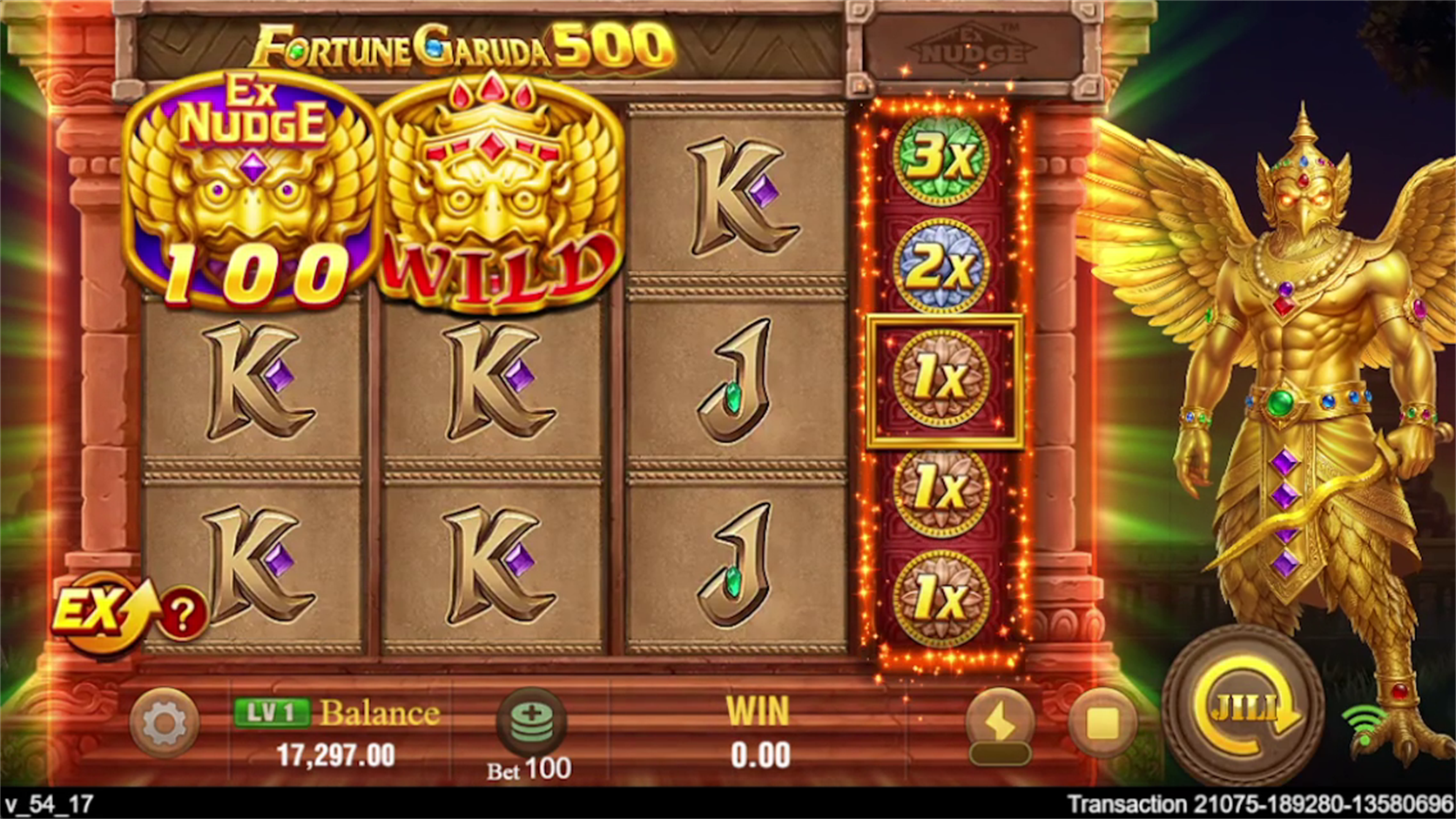
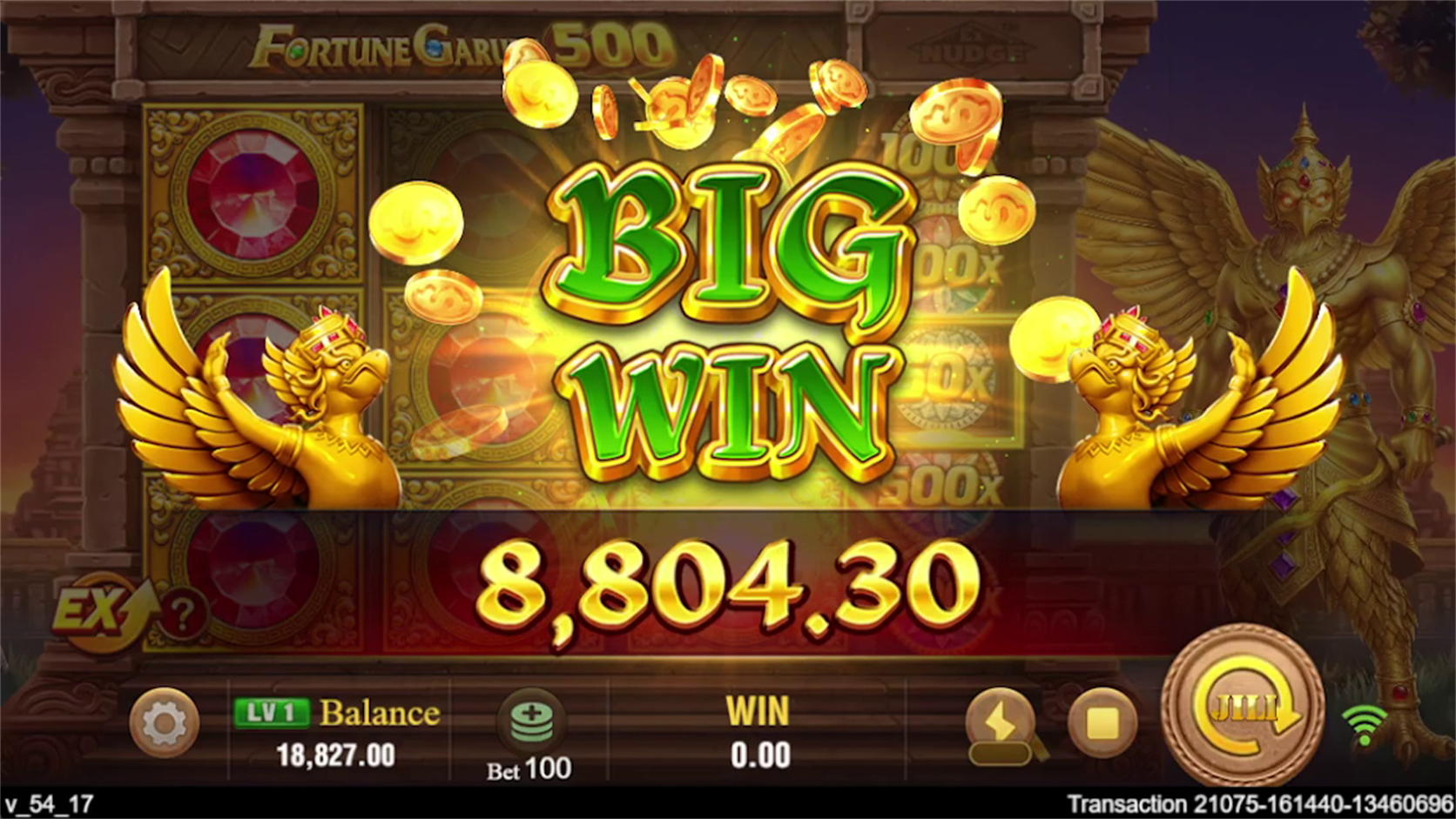
Big Win overlays occupy most of the screen and briefly obscure the exact symbols that created the payment. This is common in mobile slots, yet it makes the history button more useful. A large label is not a substitute for checking the wager multiple. In the official promotional screen, a Big Win of 8,804.30 is shown against a bet of 100, which is about 88.04 times the stake, substantial but far below the 25,000x ceiling.
How It Holds Up on a Horizontal Phone
The landscape layout is built for a phone held sideways. The 3x3 grid takes the centre-left area, the special reel forms a narrow column beside it, and Garuda occupies the far right. Bet, balance, win, spin, stop, settings, and Extra Bet controls sit along the lower edge.
This arrangement keeps the five-line cabinet large enough to read without hiding the special strip. A portrait crop would damage the concept because the fourth reel and Garuda character need horizontal space. On a smaller handset, the values inside the side discs can still be read, although transaction text and tiny version numbers at the bottom are naturally much smaller.
The spin button uses a large circular target, with stop and speed controls beside it. The EX switch sits on the opposite side to reduce accidental activation. That separation is important because the 8x choice changes cost drastically. A confirmation layer should still be read each time; colour alone is not a reliable check that the intended tier is active.
Connection quality matters during long nudge resolutions. The game result is determined by the server, not by how smoothly every frame is drawn on the device. If the screen freezes after a paid spin, reopening the title and checking transaction history is safer than repeatedly pressing controls. A missing animation does not necessarily mean a missing result.
JILI states broad language support, and the linked product material is designed for many currencies. Filipino users may see peso values, but the available stake range depends on the casino. Public directories show ranges such as 0.20 to 1,000 in generic currency units, while some local lobbies use different minimums. The number displayed inside the active game is the relevant one.
A Philippine-Focused Reading of the Bet Controls
Fortune Garuda 500 fits the short-session pattern common on Philippine mobile casino lobbies: quick horizontal loading, a familiar plus-and-minus wager control, and no lengthy bonus tutorial. That accessibility makes the Extra Bet cost easy to underestimate.
If the base display reads ₱10, the three modes cost ₱10, ₱15, and ₱80 per round. At twenty rounds, turnover becomes ₱200, ₱300, or ₱1,600. The same visible base number therefore leads to very different cash exposure. Checking the final total beside the spin control is more useful than remembering only the base denomination.
GCash, Maya, bank transfer, or another payment rail does not change slot mathematics. Deposit speed and game RTP are separate matters. A casino promotion can also attach wagering requirements that make credited bonus funds behave differently from withdrawable cash. Those terms belong to the operator, not to Fortune Garuda 500 itself.
Local access rules should be checked before play because operator status and permitted markets can change. The game studio controls the software; the casino controls account verification, deposits, withdrawals, transaction records, and complaint handling. A dispute about an interrupted nudge sequence should be sent to the casino with the round ID shown at the bottom of the game screen.
That transaction number is worth preserving. A screenshot of the Ex NUDGE count alone does not show the final settlement. A useful record includes the round ID, time, stake mode, starting and ending balance, displayed collected multiplier, and result in the operator history. Those details give support staff something that can be audited.
The Strong Parts and the Friction Points
Fortune Garuda 500's best decision is the separation of selection and amplification. The main reels answer a simple yes-or-no question about paylines. The side reel then determines scale. A new player can understand the first layer immediately and learn the nudge system after seeing it once.
The five-line 3x3 format also works well on a small display. Symbols stay large, Wild stacks are obvious, and the special reel never gets buried beneath a crowded six-reel board. Gift of Garuda adds variation without opening a detached bonus room.
The published 97.10 percent RTP is attractive if it matches the active help screen, and the 25,000x cap gives the compact cabinet a high ceiling. Those two numbers should not be blended into a promise of frequent large payments. Return percentage and maximum win describe different parts of the math.
The largest friction point is repetition. There is no conventional free-spin mode, no persistent collection meter between spins, and no second visual setting. People who want a long bonus with changing rules may find the loop thin after the nudge mechanic is understood.
The Extra Bet labels also demand more care than their small control suggests. The 1.5x tier is a measured increase; the 8x tier is an eightfold leap. Removing low multiplier discs makes the reel look stronger, but it does not remove losing base grids. The interface could state the final cash stake even more prominently during every spin.
Public data quality is another nuisance. JILI's product page correctly describes a 3x3 grid with five win lines, yet a separate metadata field on the same page shows Paylines 1. The gameplay screen and detailed rule summaries support five fixed lines, so the solitary 1 appears to be a page-entry error. Release dates also vary between catalogue listings and the official rollout material. The studio page places the game in April 2026, while associated official news gives March 31, 2026 for global release.
Final Assessment: A Multiplier Game Wearing a Three-Reel Mask
Fortune Garuda 500 looks like a tiny line slot, but its real subject is multiplier accumulation. The main grid performs the minimum work needed to qualify a result. The special reel, Ex NUDGE, Ex NUDGE Wild, and Gift of Garuda decide how far that result travels.
The system is strongest when a modest line meets a long collection. Each captured disc adds a visible piece to the total, so the player can follow the growth rather than receiving an unexplained final number. Gift of Garuda is less dramatic but useful, especially when it replaces a weak centre multiplier or improves the base combination before calculation.
Standard mode keeps the game's scale understandable. Extra Bet 1 raises the floor of the side-reel pool at a moderate additional cost. Extra Bet 2 turns the same interface into a far more expensive test, and the stronger multiplier set should never distract from the eightfold wager.
The lack of free spins is the clearest dividing line. Anyone expecting scatters and a ten-round bonus will not find them here. Anyone interested in a compact fourth-reel mechanism gets a focused interpretation with unusually large nudge counts and a clearly stated 25,000x ceiling.
The fairest verdict is that Fortune Garuda 500 is mechanically sharper than its gold-heavy surface suggests. It understands which part of the screen matters, keeps that part visible, and resolves its biggest moments within one paid round. Its weaknesses are equally plain: repeated base spins, inconsistent public metadata, and an 8x control that changes session cost much faster than the compact cabinet implies.
Before real-money play, the local help file should be checked for RTP, stake range, five-line layout, Extra Bet prices, and payout cap. The official product material establishes the core design, but the operator build is the final authority for the version attached to an account. Fortune Garuda 500 is easiest to judge once the fourth reel is treated as the game and the three reels beside it are treated as the admission ticket.
By Fairy Editorial - 01 Aug 2026
Dream Catcher
Dream Catcher Evolution Review: The Wheel That Made Live Casino a Game Show
Dream Catcher asks one question and refuses to hide it behind a maze of side games. Which numbered segment will stop under the pointer?
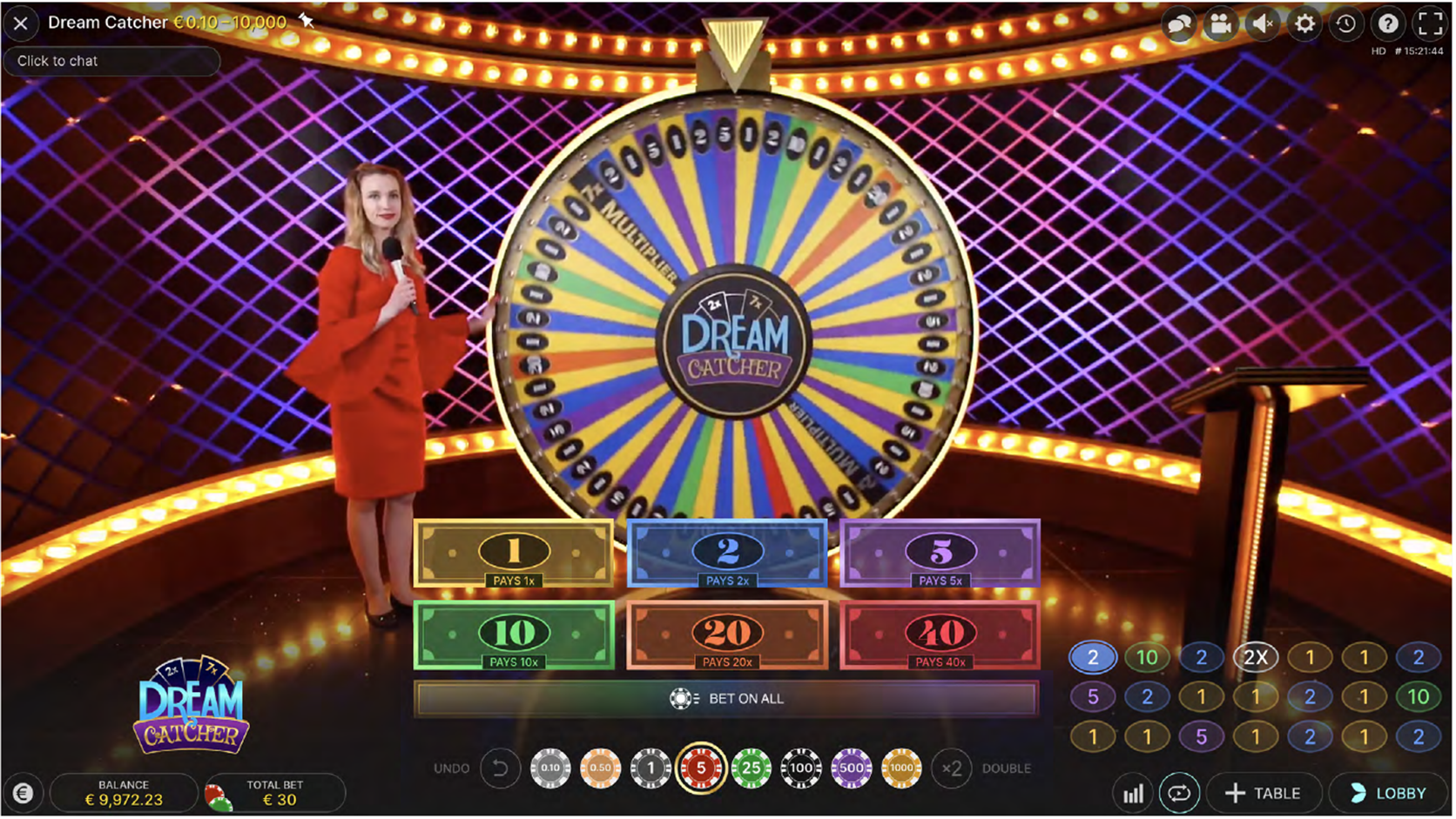
There are no cards to total, no reels to read, and no dealer decision that changes the result. A presenter spins a giant vertical wheel divided into 54 equal sections. Six numbered outcomes carry prizes of 1, 2, 5, 10, 20, or 40 to 1. Two multiplier sections can hold every wager in place and send the wheel around again.
That spare design is historically important. Evolution launched Dream Catcher in February 2017 as the first title in its Live Lucky Wheel category. Later releases such as Monopoly Live and Crazy Time added bonus games, augmented-reality stages, and more elaborate payout routes. Dream Catcher is the foundation beneath them: a live host, a physical wheel, a short betting window, and a result anyone can understand before the first round ends.
Its simplicity does not make the mathematics uniform. The six numbers occupy different amounts of wheel space, so every betting position has its own hit rate and theoretical return. Evolution lists an RTP range from 89.88 percent to 95.65 percent, not one percentage that applies equally to the whole betting layout. That single fact separates a useful review from a promotional summary.
A Wheel Whose Geometry Is the Paytable
The wheel contains 54 sections separated by metal pins. Twenty-three sections show 1. Fifteen show 2. Seven show 5. Four show 10. Two show 20. One shows 40. The remaining sections are the silver 2x multiplier and gold 7x multiplier, one of each.
Those counts explain the entire base game. Number 1 appears often because it pays only 1 to 1. Number 40 has a much larger prize but occupies a single section. The game does not need hidden reel strips or a virtual symbol map; most of the probability structure is visible on the studio wheel.
On an individual physical spin, 1 occupies 23 of 54 sections, or about 42.59 percent. Number 2 occupies 15 of 54, around 27.78 percent. The shares then fall sharply: 5 covers about 12.96 percent, 10 about 7.41 percent, 20 about 3.70 percent, and 40 about 1.85 percent.
Each multiplier also occupies 1 of 54 sections. The chance of landing either multiplier on a physical spin is therefore 2 out of 54, or about 3.70 percent. A multiplier is not a numbered result. It pauses settlement, keeps existing wagers on the layout, and requires another spin.
Because multiplier spins repeat until a numbered section appears, the final numbered outcome has a slightly different distribution from a single physical spin. Once the two multiplier sections are removed from the denominator, the terminating number is drawn from 52 numbered sections. Number 1 then represents 23 of 52 final numbered outcomes, number 2 represents 15 of 52, and number 40 represents 1 of 52.
That distinction matters when reviewing a session log. A round may contain two or three physical spins but only one final numbered result. The multiplier spins belong to the same unresolved round rather than creating separate wins or losses.
What Happens From Bet Open to Settlement
A countdown marks the betting phase. The six positions appear on the interface as coloured panels labelled 1, 2, 5, 10, 20, and 40. Chips may be placed on one position or spread across several, subject to the table's minimum, maximum, and aggregate limits.
Once the timer closes, no more wagers can be added. The host spins the wheel, the camera follows its movement, and a fixed flapper at the top clicks over the pins as the wheel loses speed. The section held beneath that flapper becomes the result.
If a numbered section wins, bets on that number receive the printed odds and the original stake returns. A PHP 100 wager on 5 produces PHP 500 profit plus the PHP 100 stake when 5 lands. Bets on the other five numbers lose.
The distinction between profit and total amount credited should remain clear. A 5-to-1 result does not mean the account receives only five times the stake including the original wager. It means five times the stake as profit, with the successful stake returned alongside it. The total credit is six times the bet before any multiplier is considered.
A bet on 1 therefore produces PHP 100 profit from a PHP 100 wager and returns the original PHP 100, for a PHP 200 credit. A successful PHP 100 bet on 40 produces PHP 4,000 profit plus the returned stake, for PHP 4,100 credited.
The visual size of a number on the betting panel has no connection to its frequency. The six panels use comparable screen space because the interface needs six clear targets. Their actual probabilities come from the number of matching sections around the wheel.
The 2x and 7x Sections Do Not Pay by Themselves
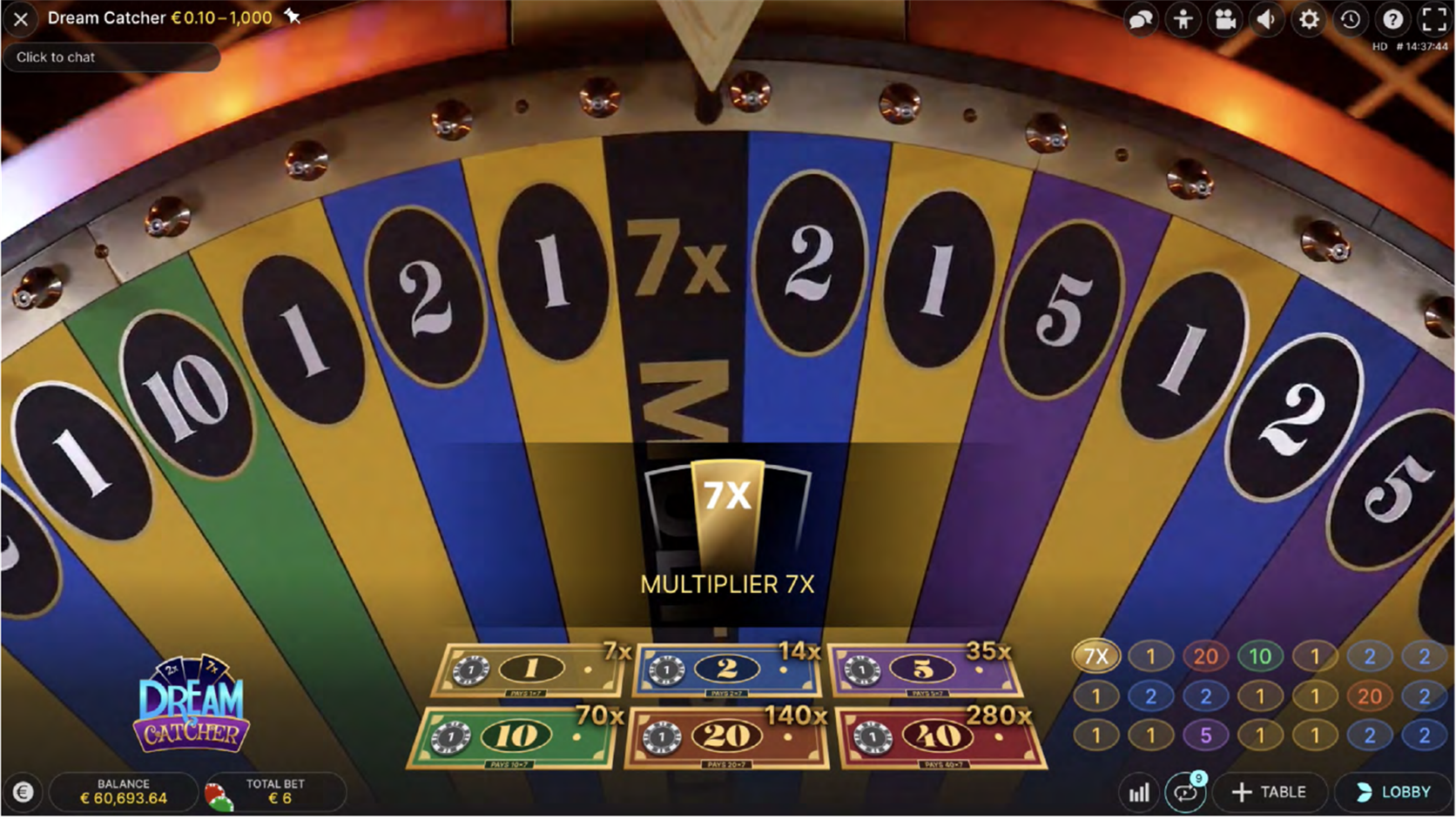
Landing on silver 2x or gold 7x does not settle a bet placed on one of the six numbers. No separate wager is placed directly on the multiplier sections. They modify the prize attached to the eventual numbered outcome.
When a multiplier lands, every active number bet remains on the table. The betting window stays closed, so no one can add money after seeing the boost. The presenter spins again. If the next result is a number, the payout odds on the winning position are multiplied by the carried value.
Suppose PHP 100 is placed on 5. The first spin lands on 2x, and the next lands on 5. The normal 5-to-1 prize becomes 10 to 1. The profit is PHP 1,000, and the original PHP 100 wager also returns.
Now suppose the sequence is 2x, then 7x, then 5. Consecutive multipliers are multiplied together, producing 14x. The 5-to-1 odds become 70 to 1. A PHP 100 wager earns PHP 7,000 profit plus the returned stake.
They are not added into 9x. This is one of the most common errors in Dream Catcher explanations. A chain of 7x followed by another 7x becomes 49x. Three consecutive 7x sections become 343x before the final number is applied.
The chain can contain either multiplier in any order. A sequence of 7x, 2x, 2x, and then 10 creates a combined multiplier of 28x. The normal 10-to-1 prize becomes 280 to 1.
Every multiplier spin keeps the round unresolved. Recent-results panels may display each physical stop, but the account history should group the chain under one game round. Evaluating each spin as an independent stake would overcount both the amount wagered and the number of settled outcomes.
The Gold Section Changes Every Panel at Once
A multiplier applies to the payout odds of the eventual winning number. It does not affect only one selected panel. If wagers are spread across several numbers, the multiplier boosts the numbered wager that succeeds at settlement.
After a 7x result, the interface can show the adjusted prizes directly on the six positions. Number 1 becomes 7 to 1, number 2 becomes 14 to 1, number 5 becomes 35 to 1, number 10 becomes 70 to 1, number 20 becomes 140 to 1, and number 40 becomes 280 to 1.
Those values are conditional. Only one numbered section finally stops beneath the pointer, so only that matching position receives a prize. Seeing 280x printed over the 40 panel does not mean every participant has gained access to a 280x payment. A stake must already have been placed on 40 before betting closed, and 40 must then land.
The most dramatic displayed figure may still be attached to the least frequent numbered section. After 7x, the 280-to-1 prize on 40 occupies a bright panel at the bottom of the screen, but the wheel still contains only one 40 section. The boost changes the payment, not the physical amount of 40s around the wheel.
Multiplier chains create the game's longest pauses between wager and resolution. A standard round may end after one spin. A 2x or 7x extends it, and another multiplier extends it again. The host keeps spinning until a numbered section finally settles the round or the configured cap applies.
RTP Belongs to the Bet Position
Evolution's official material lists an optimal theoretical return of 95.65 percent and a full range from 89.88 percent to 95.65 percent. The range exists because the six numbers do not share the same relationship between segment count and payout.
Number 10 is commonly identified as the position associated with the 95.65 percent optimal figure under the published configuration. Number 40 sits at the low end of the official range. The other number bets fall between those limits.
It is therefore inaccurate to describe Dream Catcher as a 95.65 percent game without qualification. That figure is the best theoretical return available among the individual betting positions, not a universal rate attached to every chip placed on the screen.
A theoretical return describes a vast number of rounds under the stated limits and rules. It does not mean PHP 95.65 comes back from each PHP 100 wagered. A short session may contain several 1 results, a rare 40, a multiplier chain, or a long stretch in which a selected number never appears.
The corresponding house edge also changes by position. A 95.65 percent RTP implies a 4.35 percent theoretical edge. An 89.88 percent RTP implies a 10.12 percent edge. That is a substantial pricing difference inside one betting layout.
Spreading a wager over several numbers blends the returns according to the money allocated to each position. It does not automatically inherit the highest RTP. If half the stake uses a higher-return panel and half uses a lower-return panel, the combined theoretical rate lies between them, adjusted for the exact allocations and any table rules.
The official range already accounts for multiplier mechanics and the configured maximums. Calculations that treat the multiplier chain as unlimited can produce a higher theoretical number, especially because rare repeated 7x events have a large influence on an uncapped mathematical expectation. Dream Catcher limits the accumulated multiplier to 20,000x and also applies a default maximum win of €500,000 or the equivalent amount in another currency.
Covering More Numbers Changes the Shape, Not the Price
The interface permits simultaneous bets on several positions. This reduces the chance that every chip loses on the final numbered result, but the total amount at risk rises with every added wager. Coverage should therefore be measured against total stake rather than judged only by the frequency of seeing one panel win.
Consider PHP 10 placed on each of the six numbers. The total stake is PHP 60. If 1 lands without a multiplier, the successful position returns PHP 20: PHP 10 profit and the PHP 10 stake. The other five bets lose PHP 50. The round finishes PHP 40 down despite producing a winning animation.
If 2 lands, the successful PHP 10 stake earns PHP 20 profit and returns PHP 10. The PHP 30 credit still sits below the PHP 60 total stake, creating a PHP 30 net loss.
A result of 5 produces PHP 50 profit plus the returned PHP 10 stake. The total credit equals the PHP 60 originally placed, so the round breaks even before a multiplier. Number 10 produces PHP 110 credited from the successful panel and loses the other PHP 50, leaving a PHP 50 net gain. The higher numbers create larger gains, but they occupy far fewer sections.
This explains why the Bet on All control is a convenience button rather than a mathematical advantage. It places the selected chip on all six panels at once. It saves taps and makes a numbered win almost certain after any multiplier chain resolves, but low-number results can still return less than the combined stake.
The multiplier changes those calculations. With PHP 10 on all six numbers, a 7x followed by 1 turns the 1-to-1 profit into 7 to 1. The winning panel returns PHP 80, while the other five bets lose PHP 50, creating a PHP 20 net gain. A single boost can therefore convert a low number from a net loss under full coverage into a positive round.
That does not make full coverage superior to a single-position bet. It creates a different result distribution by exchanging larger total cost for more numbered coverage. The theoretical return remains the weighted result of the six chosen positions.
The same principle applies to unequal allocations. A large chip on 1 and smaller chips on 10, 20, and 40 may produce frequent partial recovery alongside rare large gains. The screen may look balanced, but the exposure is determined by cash assigned to each panel, not the number of panels containing a chip.
Recent Results Are a Record, Not a Forecast
A result road on the right side of the interface displays recent wheel stops. The colours and numbers help users reconstruct the last several rounds and see multiplier chains. This record is useful for auditing; it has no power over the next spin.
If 1 has appeared six times in a row, its wheel share does not shrink on the seventh spin. The physical wheel returns to the same set of 54 sections. A long absence of 40 does not make the single 40 section larger or cause it to become due.
Humans are quick to read short sequences as patterns. Alternating colours may look deliberate. Several low numbers may create an expectation that a high number must follow. Three recent 2 results may tempt someone to avoid 2 because it has already appeared too often. None of those impressions changes the section counts.
The history panel becomes genuinely useful after a multiplier. It can confirm that the sequence was 2x, 7x, and then 5, allowing the combined 14x factor to be checked against the credited result. It also helps distinguish physical spins from settled rounds when reviewing a session.
A proper log should contain two columns of thought even if no table is used. Record each wheel stop in sequence, then group multiplier stops with the numbered result that closes the round. Counting every stop as a fresh paid wager produces a false turnover figure.
The Host Controls Pace, Not the Outcome
Dream Catcher is presented from a dedicated studio rather than generated as a slot animation. A host opens betting, speaks to the camera, spins the wheel, and announces the section beneath the flapper. Several camera angles show the wheel at full size and move closer as it slows.
The large physical prop gives the game much of its character. The clicking pins create a rising sense of proximity as the wheel loses momentum. A high-value section may approach the pointer, pass underneath it, or stop one pin away. That sequence is easier to follow than a digital number appearing instantly.
The presenter does not select the winning section. The spin, wheel momentum, pins, and flapper produce the physical result under the game's certified setup. A softer or harder visible spin may change how long the wheel turns, but it does not create a usable prediction method from a remote video feed.
Camera delay is another reason manual timing cannot affect a placed wager. Betting closes before the spin resolves. Clicking after the countdown ends cannot move a chip onto the section approaching the pointer. The accepted wager state is locked at the server before the result.
The host's strongest practical influence is rhythm. Conversation can make the betting interval feel shorter, especially on mobile. Prepared chip values and the Repeat control reduce the number of actions needed before the timer reaches zero.
Studio production remains restrained compared with Evolution's later game shows. The wheel dominates the set. Gold bulbs, purple latticework, coloured wedges, and a presenter fill the scene without a separate bonus room or animated character stage. The design dates from an earlier phase of the category, yet the visual hierarchy is still clear.
A Multiplier Chain Is Rarer Than a Multiplier
Either multiplier occupies 2 of the 54 sections combined, so a physical spin has about a 3.70 percent chance of extending the round. Two multiplier results in succession require the wheel to hit that two-section group twice before a number appears. Under the equal-section model, that raw sequence probability is roughly 0.137 percent from the start of a round.
The exact identities within the chain matter. A 2x followed by 2x creates 4x. A 2x followed by 7x creates 14x. Two 7x results create 49x. Each specific multiplier section occupies only 1 of 54 positions on each spin.
Three or more consecutive multiplier results become much rarer, but their products grow rapidly. This heavy right tail is why unlimited theoretical calculations can be misleading. Very unlikely chains carry enormous mathematical weight once repeated 7x values are multiplied together.
Evolution stops that escalation at a 20,000x accumulated multiplier. The default maximum cash win adds a second boundary. If the calculated award exceeds the permitted cap, the credited amount is limited according to the game and operator rules.
The two limits are not identical. A low stake may reach a 20,000x multiplier without reaching the cash maximum. A large stake may encounter the cash ceiling before the multiplier ceiling becomes relevant. Table limits and currency conversion decide which boundary matters first.
Dream Catcher promotional material sometimes describes prizes multiplied up to 20,000 times. That figure refers to the multiplier chain cap. It should not be confused with the ordinary 40-to-1 number prize or treated as a routine maximum return from one common event.
Mobile Play Compresses the Same Studio
The game runs on desktop, tablet, and phone. Mobile does not replace the live wheel with an RNG result. The same studio video and round outcome are streamed into a smaller interface.
Portrait mode places the video above the betting controls, which makes the six number panels easier to tap but reduces the apparent size of the wheel. Landscape mode gives the studio more room and resembles the desktop composition. The better choice depends on the immediate task: portrait for clean chip placement, landscape for watching the wheel and reading the pointer.
On a narrow screen, verify the total stake after placing chips across several panels. Small chips can overlap visually, and Repeat may restore the entire previous layout rather than one selected position. The amount displayed under Total Bet is the reliable final check before betting closes.
The video-quality control affects stream resolution, not wheel probability. Lower quality can reduce data use or stabilise a weak connection, but compressed motion makes the final few pins harder to see. The server result remains the same even when the picture briefly drops frames.
If the stream freezes near settlement, the account history should be used instead of guessing. A completed round is settled by the server, and reconnecting does not generate a replacement result simply because the viewer missed the pointer.
Chat adds the social layer expected from a live studio. It can make waiting between rounds less sterile, though it also adds scrolling movement around an already busy mobile layout. Collapsing chat leaves more room for the wheel, betting panels, and result road.
Live Dream Catcher and First Person Dream Catcher
Evolution also distributes First Person Dream Catcher, an RNG-based 3D edition. It uses the same six number positions, 2x and 7x multiplier logic, and familiar wheel design. The main difference is who controls the pace and how the result is produced.
In the live version, the presenter runs a shared schedule for everyone at the table. Betting windows, spins, and settlements happen at the studio's pace. A user joining midway waits for the next open period.
In First Person, the user presses Spin and may choose from speed settings such as Fast, Normal, and Relaxed. The wheel is rendered in 3D and the result comes from the game system rather than a physical studio wheel. A Go Live control can move the session into the live table.
Neither format changes the basic wager into a slot. The six number panels remain direct predictions of the wheel result. The choice is mainly between shared live presentation and private on-demand pacing.
The live version has stronger social presence and visible mechanical motion. First Person removes presenter downtime and allows faster repeated rounds. Fast control also increases turnover speed, so equal time periods can contain very different total stakes even when the bet per round is unchanged.
For a review, results from the two formats should not be mixed casually. A log from First Person describes an RNG product, while a log from live Dream Catcher describes the studio wheel. Rules and payouts may match, but the execution environment and round timing do not.
What Dream Catcher Lacks Next to Newer Game Shows
Dream Catcher has no separate bonus game. The 2x and 7x sections extend and multiply the current number round, but they do not open a pachinko board, animated city, card-picking stage, or second wheel.
Crazy Time surrounds its main wheel with several bonus routes and a Top Slot multiplier. Monopoly Live adds a board-game sequence. Other Evolution titles combine live wheels with digital layers, character sequences, and several kinds of boosted outcomes.
Dream Catcher stays with the original money-wheel idea. That makes it easier to audit. Every normal result is visible on the wheel, the segment counts are published, and the multiplier calculation can be reconstructed with basic arithmetic.
The price of that clarity is repetition. After several rounds, the structure does not reveal a new mode. The visual peak is a multiplier chain followed by a high number. Anyone expecting a long bonus sequence may find the game thin beside its successors.
Its slower studio pace also becomes more noticeable because there is only one main event. Later shows fill more of the broadcast with reveals and bonus stages. Dream Catcher alternates between betting, spinning, and settlement with little deviation.
This restraint is also why it remains approachable. A new user does not need to understand four bonus symbols, random Top Slot values, or several risk levels. The wheel shows the available outcomes, and the betting panels mirror them.
How to Audit a Demo or Low-Stake Session
A short observation cannot verify RTP, but it can test rule understanding and interface behaviour. Begin by recording the table limits, official RTP range, chip denominations, and any operator-level maximum win.
Track settled rounds separately from physical spins. Write each multiplier into the same sequence as the number that follows it. A line such as 7x, 2x, 10 represents one paid round, a 14x combined multiplier, and a 140-to-1 prize on a successful 10 bet.
Record total stake across all number panels before each betting window closes. If PHP 20 is placed on 1 and PHP 10 on 10, the round stake is PHP 30. A win on 1 credits PHP 40 from that position, but the PHP 10 wager on 10 is lost, leaving PHP 10 net profit. The gross win message alone does not show that net result.
Separate credited amount from profit. A PHP 10 bet on 5 returns PHP 60 when successful without a multiplier: PHP 50 profit plus the PHP 10 stake. Recording only the PHP 50 odds award makes the account credit look wrong; recording PHP 60 as pure profit makes performance look too strong.
The result road can be copied for fifty or one hundred physical stops to confirm the visible segment mix, but small samples will move widely around theoretical frequencies. One 40 in 20 spins does not prove that 40 appears 5 percent of the time. No 40 in 100 spins does not prove the section is inactive.
Multiplier frequency should also be measured by physical spins, not settled rounds. If 100 rounds contain 104 wheel spins because four rounds included a multiplier, the observed multiplier rate is four out of 104 spins rather than four out of 100.
For connection testing, note any freeze, resolution change, rejected late wager, or delayed balance update. These observations describe stream and interface quality. They should not be mixed with claims about wheel mathematics.
The Parts That Still Work
The published wheel layout makes probability unusually visible. A user can see that 1 appears many times and 40 only once without opening a complex paytable. The betting interface copies that simple structure.
Multiplier arithmetic is also clean. Values multiply across consecutive bonus stops and then multiply the printed odds of the terminating number. The adjusted panels show the calculation before settlement.
The live wheel has physical presence that an RNG animation cannot fully imitate. Pins, flapper noise, changing momentum, and the host's reaction turn one result into a short broadcast event.
The official RTP range gives informed users enough information to distinguish one number position from another. The crucial requirement is to read the range correctly rather than repeat the optimal 95.65 percent figure as if it covered every wager.
The Parts That Age Poorly
There is almost no mechanical variation beyond multiplier chains. A long session repeats the same betting and spinning cycle. The game predates the elaborate bonus architecture now associated with live casino shows.
The 89.88 percent lower end is expensive compared with many modern casino games. Selecting the largest printed prize also selects one of the least favourable theoretical positions under the official range.
Multi-number betting can create misleading win messages. A highlighted successful panel may still leave the round negative after the other positions are counted. The interface shows gross payouts more prominently than net change.
The 20,000x headline depends on extreme multiplier chaining and remains subject to a cash cap. It should be read as a boundary, not a representative target.
Recent-result displays invite pattern hunting even though past stops do not alter the wheel geometry. Their best role is verification, not prediction.
Final Spin
Dream Catcher is not a simplified version of Crazy Time. It is the earlier blueprint from which Evolution's live game-show category grew. A 54-section wheel, six numbered bets, two multipliers, and a live presenter carry the entire product.
Its rules can be learned in a minute, but accurate evaluation requires more care. Number counts differ, RTP changes by betting position, multiple bets increase total exposure, and multiplier chains belong to one unresolved round. The 2x and 7x sections multiply together, while the accumulated value stops at 20,000x and remains subject to the default €500,000 maximum win.
The game is at its best when transparency matters more than spectacle. Wheel geometry is visible, payouts match the printed numbers, and a multiplier calculation can be checked directly on screen. It is weakest when repeated studio pacing and the absence of bonus stages begin to feel dated.
Dream Catcher still earns its place in Evolution's catalogue because the central object does all the work. The wheel is the theme, the random mechanism, the paytable, and the show. Later titles built larger worlds around the same circle. This one lets the circle speak for itself.
By Fairy Editorial - 31 Jul 2026
Lucky Chilli
Lucky Chilli Review: The Bonus That Turns One Spin Into Four Screens
Lucky Chilli spends its paid game pretending to be smaller than it is. Five reels, three rows, and 25 fixed lines make the opening screen look like a conventional JILI slot from the early mobile era. A red pepper sits beside guitars, maracas, cacti, horses, tacos, and card ranks. Three Scatter symbols lead to free games. None of that sounds unusual.
The identity of the game appears after the bonus begins. Instead of merely repeating the same reel set without a charge, Lucky Chilli starts the round with two active boards. Collected chilli symbols then work toward further expansion. Reach the first collection mark and a third board joins the calculation. Reach the next mark and a fourth board opens. One free spin may then resolve four independent 5 by 3 grids.
That expansion is more important than the Mexican decoration. It changes the amount of reel space attached to every remaining free spin and makes the timing of each collected pepper matter. Opening the fourth board near the start is not equivalent to opening it on the final turn. The visual state may end in the same place, but the earlier unlock has had more chances to generate line results.
Public game directories list a 97 percent RTP, low volatility, a stake range from 0.1 to 100, and a maximum return of 2,000 times the stake. Those numbers make Lucky Chilli look mild. The base game often supports that description. The expanding bonus is where the math becomes less ordinary.
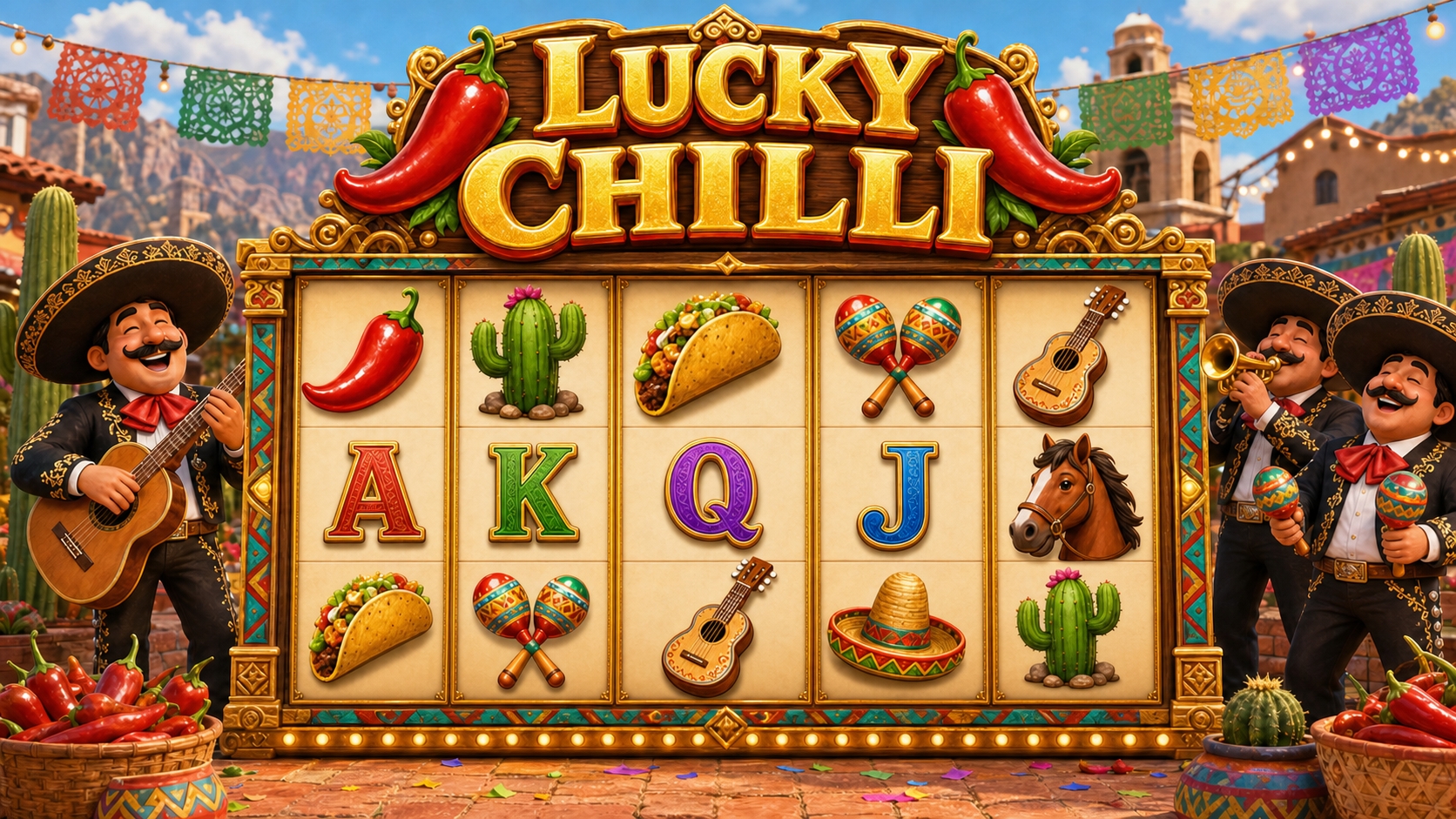
The image above is an editorial reconstruction based on the published theme and 5 by 3 layout. It is not an official gameplay capture.
The Calm Part Is Deliberate
There is little clutter in the paid game. The five reels stop, active lines are checked, and the next round is ready. No tumble removes symbols. No expanding grid remains active between stakes. No meter built during ordinary spins creates a future cash entitlement. The chilli-collection idea belongs to the free-game sequence.
That division gives the slot two distinct speeds. The paid game is compact and familiar. The bonus turns the same symbol family into a multi-board exercise. JILI does not need to explain a new pay system in the opening rounds because the basic method is the traditional fixed-line model.
Twenty-five lines cross the 5 by 3 matrix. A regular combination begins on the leftmost reel and follows one of the predefined paths through consecutive reels. Matching symbols scattered across unrelated positions do not combine simply because several are visible. The line path, starting position, symbol type, and number of consecutive reels all count.
This is not a 25-ways game despite some directories using the word betways in their data fields. The practical screen rule is fixed paylines. A horse on reel one, another on reel three, and a third on reel five cannot form a standard line win when reel two breaks the sequence. A valid path usually needs the matching run to start at reel one and move through adjacent reels according to the paytable.
The difference matters during the four-board bonus. Forty or fifty similar symbols may appear across the combined display, but the game does not pool them into one giant count. Each board checks its own 25 lines. The returns from the active boards are then added into the free-spin result.
Lucky Chilli therefore remains a line slot even at maximum expansion. It multiplies the number of places where lines are evaluated; it does not replace those lines with cluster counting or Pay Anywhere rules.
A Payline Example Without Guesswork
Imagine that the first active line runs straight across the centre row. A matching guitar on reels one, two, and three may qualify for the guitar's three-symbol value. If reels four and five also show guitars on that same path, the longer award replaces the shorter one according to the paytable.
Now imagine five guitars landing across the screen but spread between the top, middle, and bottom rows. They pay only if one of the 25 displayed line patterns links them in the required order. Visual quantity alone is not enough.
The Wild symbol can complete many regular combinations by standing in for the missing symbol, subject to the local paytable. A Wild on reel two between matching horses on reels one and three may turn a broken run into a three-reel line. The same Wild can take part in more than one active payline when several paths cross its position.
That does not mean one Wild automatically multiplies the win. Substitution and multiplication are different mechanics. Public summaries consistently identify a Wild, but the exact payout behaviour should be read from the active help file. Some third-party descriptions attach multiplier language to the title without reproducing a complete official rules sheet. The safe reading is to treat the symbol as a substitute unless the live client explicitly prints an additional multiplier.
Scatter symbols are evaluated outside the ordinary left-to-right line requirement. Three Scatters activate the free-game round. Their positions on the five reels matter less than their count, which is why a Scatter on the first, third, and fifth reel may still open the bonus.
The paytable remains the final authority for symbol values and Scatter awards. Public sources agree on the structure but do not reproduce a consistent full payout list. Inventing a set of values would make the review look precise while reducing its accuracy. The useful analysis lies in how the symbols are processed rather than in unsupported numbers.
What the Base Screen Is Really Testing
The paid game tests line recognition and patience more than mechanical reaction. Most rounds finish after one reel stop. A user can quickly see the central horizontal line, but the diagonal and zigzag paths are harder to audit by eye. The win-line overlay becomes valuable when a return seems to come from disconnected positions.
Winning animations normally highlight the contributing path and dim irrelevant symbols. Watching that trace is the quickest way to learn the 25-line geometry. After several rounds, recurring shapes become familiar: straight rows, shallow V patterns, inverted V patterns, and short diagonals that move between the three row positions.
The interface should also show balance, total stake, last win, settings, and spin controls. A 25-line label means all lines are active under the total stake. It does not necessarily mean the amount shown is charged 25 times again. In many digital slots, the displayed total bet already covers the entire line set.
For example, a displayed total stake of PHP 10 means the round costs PHP 10 unless the local interface states a separate coin-per-line calculation. Dividing that value by 25 gives a useful conceptual line stake of PHP 0.40, but the game may express symbol awards through a bet multiplier rather than a visible per-line coin amount.
The help page removes that ambiguity. Check the basis used for payout values: total bet, line bet, coin value, or a selected bet level. Two interfaces can display the same number at the bottom while calculating the paytable differently.
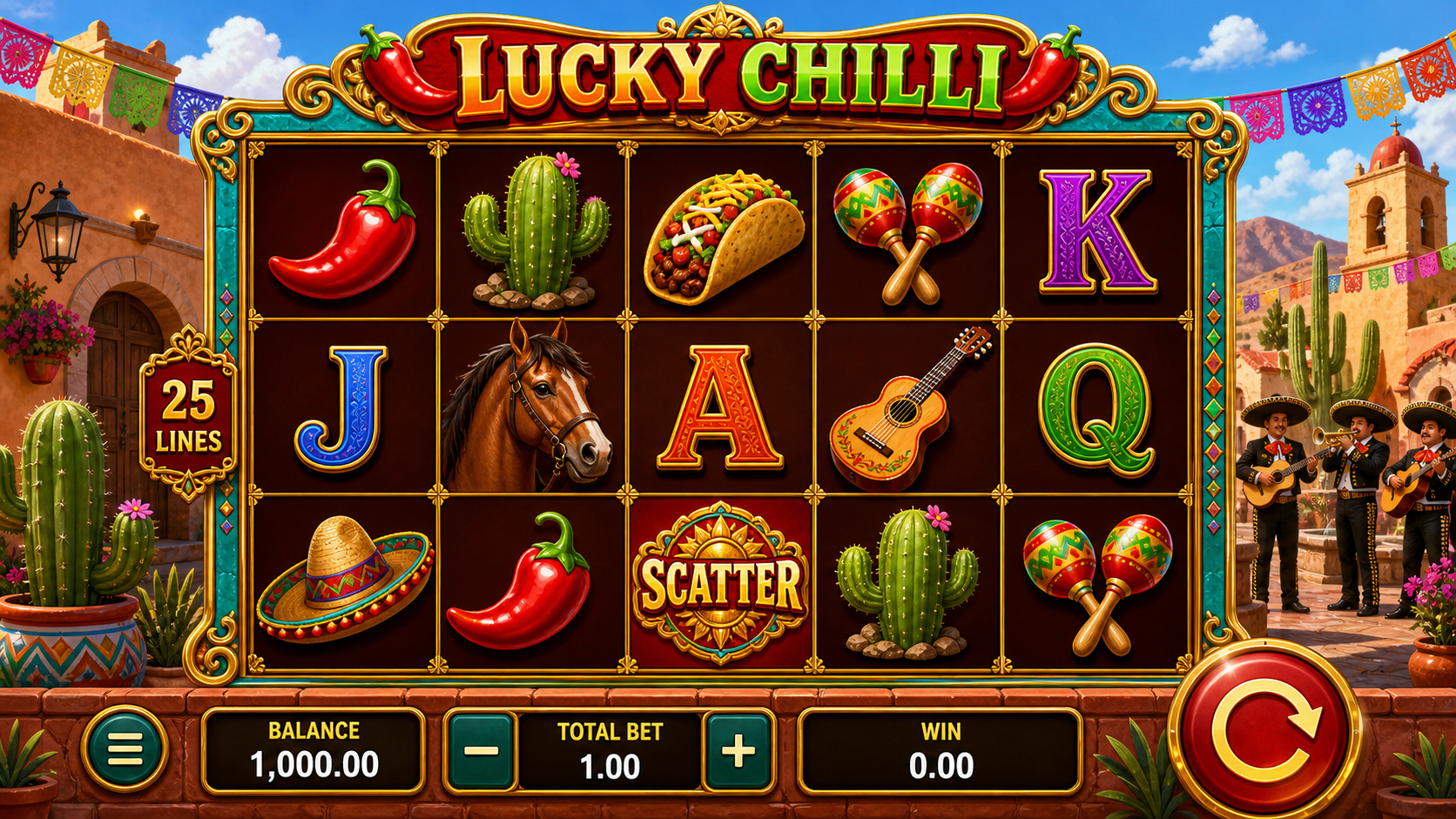
This editorial reconstruction illustrates the single 5 by 3 paid-game board, Mexican symbol family, 25-line label, and common mobile controls.
The base screen also reveals why Lucky Chilli is easy to misjudge from a short clip. A video that shows only paid spins makes it resemble dozens of fiesta-themed line slots. The collector has no reason to dominate the ordinary interface because it becomes meaningful after the Scatter trigger. A proper review must follow the title through the transition into the bonus.
Three Scatters Change the Scale
The free-game round begins with two separate reel boards. Each board follows the same five-reel, three-row structure and checks its own active lines. A single free spin therefore starts with twice the visible reel area of the paid game.
This opening state already changes the probability landscape. It does not guarantee twice the money on every turn, because either board can miss and symbol strips may differ inside the bonus. It does mean two independent result fields are being resolved under one free-spin counter.
Special chilli symbols appear during the round and feed a collection meter. Published descriptions state that collecting nine chillies opens the third board and collecting fourteen opens the fourth. The live rules page should be checked for the exact labels in the hosted version, but these are the commonly reported progression points.
The collection does not act like a cash prize by itself. Its value comes from changing later spins. A pepper collected while the meter is still below the next threshold moves the round closer to another board. Once the threshold is crossed, every remaining free spin has another 5 by 3 field capable of making line wins.
The fourth board represents the complete form of the bonus. Four sets of five reels mean 20 reels are being resolved on one free-spin turn. With 25 fixed lines on each board, up to 100 line paths are checked across the full display. They remain separated into four groups; the game does not draw a line from one board into another.
The marketing phrase one bet, four rewards describes that final state more clearly than calling the game a 100-line slot. The paid wager originally opened a feature that can reach four concurrent boards, but the base game itself still has 25 lines.
Unlock Timing Is the Hidden Variable
Suppose a feature has ten free spins for illustration. This example is about timing, not a claim that every hosted version awards that exact count. If the third board opens after spin two, it participates in eight remaining turns. If it opens after spin eight, it participates in only two.
The same reasoning applies to the fourth board. An early 14th chilli increases the quantity of active reel space for much of the feature. A late 14th chilli may create only one or two four-board turns. Failing to reach 14 leaves the round at two or three boards.
This creates three layers of bonus luck. First, the Scatter trigger must arrive. Second, collection symbols must appear quickly enough to cross the thresholds. Third, the expanded boards must turn their extra reel space into paid combinations. Reaching four boards is progress, but it is not a direct cash award.
A feature can therefore look successful while returning little. The chilli meter may fill rapidly, all four boards may appear, and the final grids may still miss their strongest lines. Another feature might remain on two or three boards yet land a high-symbol five-of-a-kind and finish with more money.
The board count measures opportunity volume, not guaranteed return. Its real contribution can be estimated by counting how many board-spins were actually resolved.
If the first five free turns use two boards, the next three use three boards, and the last two use four boards, the feature contains 10 plus 9 plus 8, or 27 board-spins. A feature that unlocks the third board on turn two and the fourth on turn four might contain far more than 27 board-spins over the same nominal number of free turns.
That board-spin count is a better diagnostic than simply writing down that four boards were reached. It captures both the final expansion level and the time spent at each stage.
Four Boards Do Not Create Four Stakes
No additional paid wager is taken for each new board inside the free-game round. The expansion belongs to the already-triggered bonus. The total bet used to enter the qualifying paid spin remains the reference stake for the resulting line awards.
This is where the phrase one bet, four rewards can be misunderstood. It does not mean a standard paid spin immediately settles four boards. It means the free-game collector may unlock as many as four boards from the originating stake.
Each board contributes independently. Board one could contain two line wins, board two none, board three one, and board four three. The game adds those line values to the current free-spin result and then adds that result to the accumulated bonus total.
Overlapping lines on a single board can also pay at the same time. A central Wild may support a horse combination on one path and a guitar combination on another. The paytable and win-line display show which combinations were counted. The visual total across four boards can become busy enough that manual inspection is unreliable without the history panel.
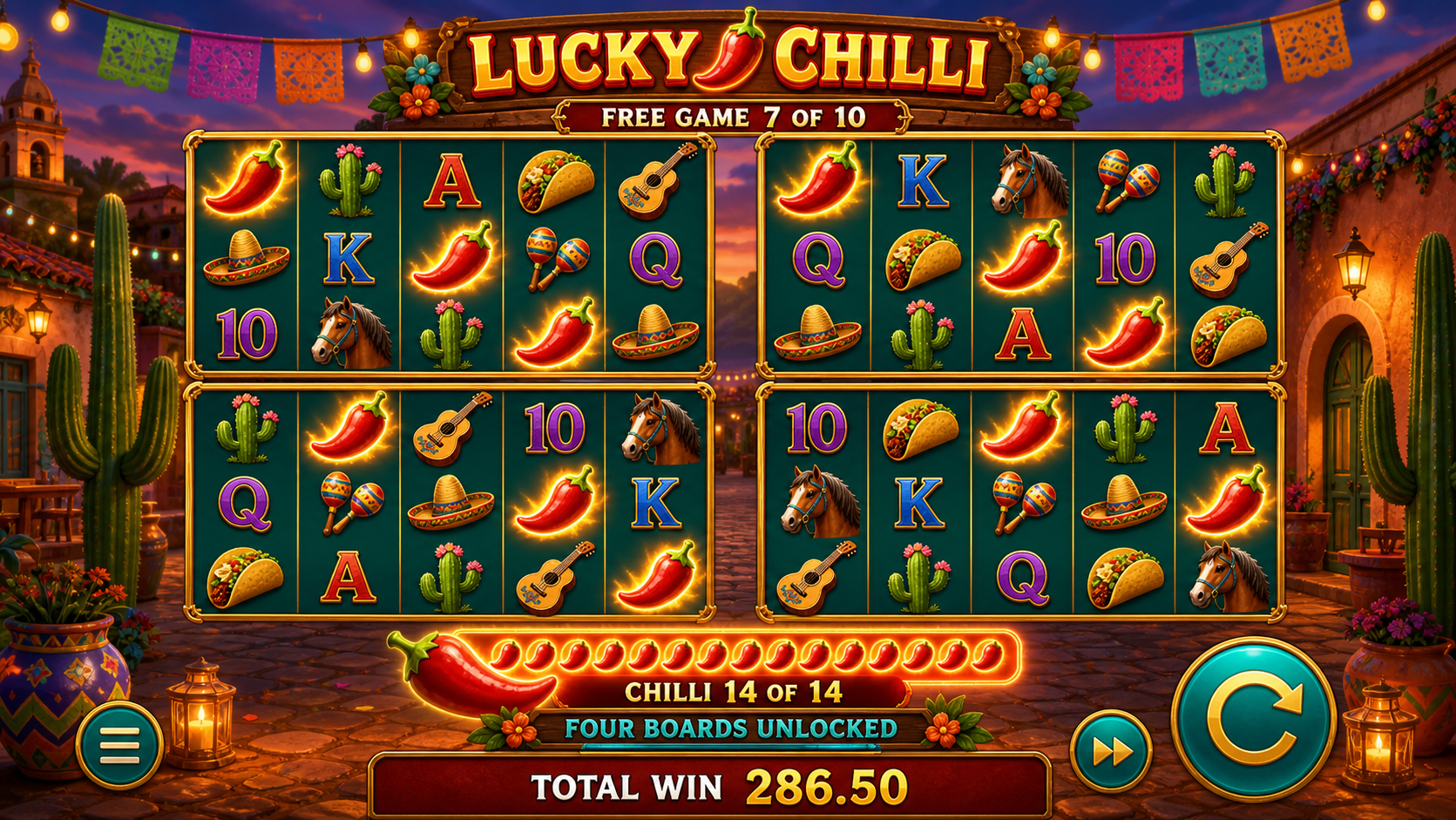
The image above reconstructs the fully expanded four-board state and chilli meter for editorial explanation. It is not an official result screen.
The four-board view is the visual payoff of the design. It also creates the clearest usability test. Every grid must remain legible on a phone, the collector must be visible, and the user must still see the remaining spins and accumulated win. A poor mobile scaling job would turn the signature mechanism into a wall of tiny symbols.
JILI's use of compact 5 by 3 boards helps avoid that problem. Four boards arranged in a 2 by 2 pattern fit landscape screens more naturally than four tall six-reel grids. The symbol art uses bold silhouettes, so a chilli, cactus, guitar, and horse remain distinguishable after being reduced.
The Meaning of a Listed 97 Percent RTP
Lucky Chilli is commonly indexed at 97 percent RTP. That figure is higher than the mid-96-percent range often seen in online slots, but it still needs careful interpretation. RTP is a long-run theoretical ratio calculated across an enormous set of resolved wagers. It is not a session rebate and does not predict the next bonus.
At a theoretical 97 percent return, the corresponding house edge is 3 percent. Across PHP 100,000 of cumulative turnover, the mathematical expectation is PHP 97,000 returned and PHP 3,000 retained by the game. A real account may finish far above or below those values because the sample is tiny compared with the model used to calculate RTP.
Turnover is larger than the original deposit whenever returned funds are wagered again. A PHP 1,000 balance used through many PHP 10 rounds can create several thousand pesos of total stake even though only PHP 1,000 entered the account. RTP relates to that cumulative stake, not merely to the first deposit.
The 97 percent listing should also be verified inside the hosted game. Operators sometimes receive multiple mathematical configurations, and third-party databases may combine old and new records. Lucky Chilli has been catalogued with both a 2020 publication reference and a December 2021 directory release date. That history is another reason to trust the active help page over a copied lobby description.
If the local client displays 97 percent, the specification is competitive on paper. It does not make the chilli collector predictable. A high listed return can coexist with long stretches without a bonus, weak line combinations, or a four-board round that fails to recover the triggering stake. Return level and distribution shape are separate questions.
Low Volatility With a Distinct Bonus Spike
Directories label Lucky Chilli as low volatility. The paid game supports that classification through a traditional 25-line structure in which several lines can register smaller results. More line paths create more places for partial stake returns than a one-line classic machine would have.
Low volatility does not mean that every round wins, and it does not mean the balance moves only upward. It describes the intended spread of results relative to higher-variance games. Smaller outcomes tend to carry more of the model, while the far end of the payout range receives less weight.
The free-game expansion introduces a temporary change in feel without turning the entire product into a high-volatility slot. Two boards double the immediate display. Three and four boards increase it further. The combined result can jump because several grids are paying under one free-spin counter.
Yet many of those results may still be small line values. Four boards can generate a list of minor wins rather than one enormous award. The animation becomes busier, but the payout scale depends on the symbols, line lengths, Wild participation, and the value assigned to each combination.
This is a useful distinction for Philippine users accustomed to JILI titles that advertise constant multipliers or rapid cascade chains. Lucky Chilli builds its bonus around screen quantity. It raises the number of evaluated grids rather than placing an enormous multiplier over a single grid.
That design can make the bonus feel more active without relying on one rare 500x orb. The tradeoff is that a four-board sequence may look far more substantial than its final total. Screen density is not a substitute for reading the win amount as a stake multiple.
The 2000x Limit Sets the Real Boundary
The published maximum win is 2,000 times the total stake. A PHP 5 stake corresponds to a theoretical maximum of PHP 10,000. At PHP 20, the same limit becomes PHP 40,000. At PHP 100, it becomes PHP 200,000, subject to the casino's own single-round and account limits.
This cap applies to the full round rather than separately creating a 2,000x maximum for each of four boards. The boards feed the same accumulated result. Four simultaneous grids increase the number of contributing lines, but they do not multiply the headline limit to 8,000x.
The distinction matters when the interface presents each board as its own miniature machine. Visually, four machines seem capable of four separate jackpots. Mathematically, they belong to one bonus attached to one original stake and one published ceiling.
Reaching 2,000x is still rare under a low-volatility distribution. A maximum is not a typical bonus size, a target that becomes more likely after losses, or a figure the collector meter gradually guarantees. It is the upper boundary of a resolved result.
The commonly listed bet interval runs from 0.1 to 100 in the selected currency. Regional currency settings may round or replace those values. Philippine deployments may show pesos directly or use credits that the operator maps to cash. The total-bet field and transaction history settle the actual amount charged.
Increasing the stake changes the cash value of every paytable result but does not improve the random chance of a Scatter or chilli collection unless the local rules explicitly describe a bet-dependent mechanic. A PHP 50 round is not closer to the bonus than a PHP 5 round merely because more money is at risk.
What the Chilli Meter Does Not Do
The collector is easy to read as a progress bar, and progress bars usually imply that the user is approaching something inevitable. Lucky Chilli uses the visual language of progress inside a finite free-game round. That changes the meaning.
The meter does not normally remain filled after the bonus closes. A new bonus begins its own collection sequence. Reaching eight chillies and missing the nine-chilli threshold does not store eight peppers for the next trigger.
The meter also does not change the past. Opening board three cannot apply that board retroactively to earlier spins. Its value begins with the turns remaining after activation.
Nor does the 14th chilli guarantee that board four will win. It unlocks the grid and allows it to be evaluated. Empty line patterns remain possible.
These limitations make the collection race readable but not deterministic. A strong start may collect several chillies rapidly, then stall below the next mark. Another round may cross both marks early and spend most of its time at four boards. The meter explains the route taken; it does not allow the next collection symbol to be forecast.
Public directories also tag the game with additional free spins. The exact award condition and count should be taken from the local rules screen because accessible summaries do not agree on all details. Extra turns are especially valuable after board expansion. Five added spins at four boards equal 20 more board-spins, while five added turns at two boards equal ten.
This multiplication of board-spins is why a late extension can matter more than its small displayed number suggests. The nominal count says five turns. The expanded state determines how much reel space those turns actually contain.
Landscape Is the Proper Mobile View
Lucky Chilli runs through HTML5 and is commonly listed for desktop and mobile platforms. The paid game fits either orientation, but the bonus strongly favours landscape. Two boards need horizontal room, and four boards need enough width to preserve five columns inside every panel.
In portrait view, an operator wrapper may rotate the game automatically or place it inside a letterboxed frame. If rotation is locked, the symbols and line traces may become too small for reliable inspection. A landscape phone position gives the four-board layout the space it was designed around.
The most important bonus elements are the chilli count, current board count, remaining free turns, current result, and accumulated total. All five should remain visible after the screen expands. If a celebration temporarily covers the meter, wait for the sequence to settle before assuming another threshold has been reached.
Quick-spin modes shorten reel movement but do not change the line math. On four boards, accelerated play can make separate grid results flash by too quickly to audit. The history button is more useful here than in the single-board paid game because it consolidates the final amount after many highlighted paths.
Sound also signals the progression. The paid game uses a light mariachi-style rhythm, while Scatter entry and board unlocks receive stronger musical cues. The shift helps mark the moment a third or fourth grid joins the round. Muted play remains workable because the board itself appears visually, but the audio cue makes the transition harder to miss.
The Mexican setting relies on familiar commercial symbols rather than a detailed story. Musicians, sombreros, cacti, horses, guitars, maracas, and food icons fill the frame. This keeps the theme immediately readable on a small screen, though it also makes the art less distinctive than the multi-board mechanism.
A Demo Audit Built Around Board-Spins
A useful demo test begins with configuration notes. Record the RTP shown in the help file, the number of fixed lines, total stake, free-game trigger condition, starting number of boards, chilli thresholds, extension rules, and maximum win. This creates a factual baseline before any sample is observed.
For paid rounds, record each return as a multiple of stake. Separate blank results, returns below 1x, returns from 1x to 5x, and larger outcomes. Low-volatility labels become more meaningful when the distribution is visible instead of inferred from animation frequency.
Also note the source of each paid result. Was it a natural three-symbol line, a four- or five-reel run, several simultaneous paths, or a Wild-assisted result? This shows how much of the base-game activity comes from repeated small line combinations.
When three Scatters arrive, write down the entry spin and reset the chilli counter. For every free turn, record the number of active boards at the start, chillies collected, unlocks reached, total line return, and remaining turns.
A compact observation might read two boards, two chillies, 0.6x. The next line might read two boards, three chillies, third board unlocked, 2.4x. A later line could read three boards, four chillies, fourth board unlocked, 8.1x. That record captures the mechanism without relying on memory.
At the end, calculate total board-spins. If four free turns used two boards, three turns used three, and three turns used four, the calculation is eight plus nine plus twelve, giving 29 board-spins. Divide the total bonus return by 29 to estimate return per board-spin for that one feature.
That number is not an RTP test. It is a descriptive measure that helps compare two bonuses with different unlock timing. A 40x bonus over 20 board-spins has a different internal pattern from a 40x bonus over 35 board-spins, even though the credited money is equal.
Run the same record across several demo bonuses and the design becomes easier to read. Some rounds gain most of their value from early board expansion. Others depend on one five-symbol line. Some reach four boards but generate low average board returns. The sample remains too small to judge the published mathematics, yet it exposes the route through which short-session results are assembled.
Virtual credits create their own bias. They make rapid spinning and high nominal stakes feel inconsequential. A demo can reveal controls and result structure, but it cannot reproduce the emotional effect of a cash balance moving through the same sequence.
Where Lucky Chilli Gets the Design Right
The strongest idea is easy to see and easy to measure. Collect peppers, open more boards, and give the remaining free turns more reel space. No lengthy story scene or complicated choice menu interrupts the round.
The progression also changes the screen in a meaningful way. Many slot meters merely add a multiplier number or award a fixed prize. Lucky Chilli makes the machine physically larger. The user sees the result of crossing each threshold before the next spin starts.
Fixed lines keep the expanded layout manageable. Each board uses rules already learned in the paid game. The bonus increases quantity without asking the user to learn a second payout system.
The listed 97 percent RTP is another strong specification when confirmed by the active help file. Combined with low volatility, it positions the title away from JILI releases built around rare all-or-nothing events.
The 2,000x cap is modest beside modern slots advertising five-digit maximums, but it matches the broader distribution. Lucky Chilli is not pretending that every mechanic exists solely to chase an enormous ceiling. Much of its appeal lies in seeing the bonus grow from two boards to four.
Where the Heat Fades
The paid game has very little mechanical depth on its own. Until three Scatters arrive, the experience is a familiar five-reel line slot with theme-based symbols and a Wild. Anyone expecting the collector to operate on every round may find the opening game repetitive.
The bonus progression can also create a sharp form of disappointment. Finishing one pepper short of a new board feels worse than an ordinary blank spin because the screen shows an unrealised threshold. The uncollected board has no partial cash value.
Late unlocks reduce the practical benefit of reaching the goal. A fourth board appearing on the final turn is visually satisfying but has almost no time to influence the feature. The meter celebrates the same threshold regardless of how many spins remain.
Four-board animation may exaggerate the apparent strength of a result. Many flashing lines can still sum to a small multiple when they involve lower symbols or short runs. The accumulated win field is more informative than the quantity of movement.
Public information is another weakness around this older title. Directory pages agree on the central mechanism, 25 lines, 2,000x cap, and reported 97 percent RTP, yet they do not reproduce every paytable value or extension rule consistently. The hosted help file must fill those gaps.
Final Reading
Lucky Chilli is best understood as a compact line slot hiding a screen-expansion bonus. Its ordinary rounds are intentionally simple. The meaningful transformation begins with three Scatters, two free-game boards, and a chilli collection race toward the third and fourth grids.
The 9- and 14-chilli thresholds make timing central. Reaching a board early creates more board-spins. Reaching it late creates fewer. The collector therefore changes the remaining capacity of the bonus rather than awarding a fixed sum.
At full expansion, one free turn resolves four separate 5 by 3 boards and checks as many as 100 fixed-line paths across them. Those paths never merge into a single giant grid, and the maximum remains 2,000x for the full round rather than 2,000x per board.
The reported 97 percent RTP and low-volatility label give Lucky Chilli a gentler mathematical profile than many current multi-board games. Short sessions can still depart sharply from that profile, especially when Scatter triggers or chilli collections arrive slowly.
Its greatest strength is clarity. The screen grows because the collector has reached a visible mark. Its greatest weakness is the waiting period before that transformation. The base game supplies the ticket; the free-game expansion is the reason the title is still worth discussing.
By Fairy Editorial - 31 Jul 2026
Gates of Party Casino
Gates of Party Casino Review: Same Thunder, Lower Return?
Gates of Party Casino looks familiar before the first spin has even started. A white-bearded god watches from the side, jewel symbols fill a six-column grid, and glowing multiplier orbs wait to turn an ordinary tumble into a headline result. That recognition is deliberate. Pragmatic Play built this PartyCasino edition on the framework of Gates of Olympus, then changed the presentation and adjusted the published return figure.
Purple lighting and party branding fit the theme, but a harder question remains: does this edition give a player any practical reason to choose it over the original? The answer is mixed. The slot retains the clean Pay Anywhere counting system, chained tumbles, multiplier values reaching 500x, and a 15-spin bonus in which multiplier values remain active across the entire round. Yet the listed RTP is 95.5 percent, one percentage point below the 96.5 percent figure commonly attached to the standard Gates of Olympus release.
That gap matters more than the new background. A one-point difference is easy to ignore during ten spins, fifty spins, or even a single long evening. It becomes meaningful across a large body of stakes. The PartyCasino version therefore deserves to be judged as its own product, not treated as a harmless visual reskin.
The image above is an editorial reconstruction based on the published game layout and theme. It is not an official gameplay capture.
A Familiar Machine Wearing Party Clothes
The structure is a 6 by 5 symbol field with no conventional paylines. Wins are counted by quantity. Eight or more copies of the same paying symbol may land anywhere on the grid and still qualify, even when those symbols do not touch. Pragmatic Play calls this Pay Anywhere.
That distinction is worth spelling out because the screen can resemble a cluster slot at a glance. Cluster games usually require matching symbols to connect through adjacent positions. Gates of Party Casino does not. A crown in the top-left corner and another crown in the bottom-right corner contribute to the same count. Position affects what may happen after a tumble, but it does not decide the initial group's payment status.
Every winning symbol disappears. New symbols fall into the empty spaces, creating another full grid without charging for another wager. If the replacement grid contains a qualifying count, the process repeats. The paid round ends only when a new layout fails to make another win. A long tumble chain can therefore contain several separate payouts while still belonging to one stake.
This is the heart of the game. The reels themselves are not complicated, and there is no side board, collection meter, or branching bonus map. Nearly all tension comes from three questions. Will the first grid reach eight matching symbols? Will the tumble create another count? Will a multiplier orb arrive on a grid that already contains a win?
PartyCasino branding changes the surrounding mood. Purple club lighting, gold trim, spotlights, and celebratory details sit around the Greek setting. Zeus remains the central character in all but name and purpose. He raises his hand, charges an orb, and throws it toward the reels when a multiplier enters play. The presentation is livelier than the pale-blue clouds of the older release, although the underlying rhythm is almost identical.
The result feels less like a separate sequel and more like a casino-exclusive edition. Anyone who knows Gates of Olympus can operate it immediately. Anyone meeting the system for the first time should ignore the mascot for a moment and learn the accounting of each tumble. That accounting explains nearly every large result shown on screen.
Reading the Grid Without Paylines
Low symbols are coloured gems. Higher symbols are a chalice, ring, hourglass, and crown. Their values rise with the number collected on one settled grid. Eight or nine matching symbols form the lowest paying band, ten or eleven form the middle band, and twelve or more reach the top band.
The crown is the strongest regular symbol. Its standard schedule is 10x for eight or nine, 25x for ten or eleven, and 50x for twelve or more. The hourglass follows at 2.5x, 10x, and 25x. The ring pays 2x, 5x, and 15x. The chalice pays 1.5x, 2x, and 12x.
The gems carry smaller values. Red pays 1x, 1.5x, and 10x across the three count bands. Purple pays 0.8x, 1.2x, and 8x. Green pays 0.5x, 0.9x, and 5x. Blue pays 0.4x, 0.8x, and 4x. Yellow sits at the bottom with 0.3x, 0.5x, and 2x.
All of those figures are multiples of the current stake. At a PHP 50 stake, eight yellow gems return PHP 15 before any multiplier is considered. Twelve crowns return PHP 2,500. The broad spread between those examples shows why a busy grid may still produce a modest balance change. Symbol count and symbol class both matter.
The game totals all qualifying groups on the same grid before applying active multipliers. Suppose a PHP 20 round lands twelve purple gems for 8x and ten rings for 5x. The unmultiplied grid value is 13x, or PHP 260. If a 10x orb is also present, the grid becomes 130x, or PHP 2,600. If 10x and 25x orbs are both active, their values are added to 35x rather than multiplied by one another. The 13x grid then becomes 455x, or PHP 9,100.
That additive rule is central. Two large multiplier orbs do not create exponential multiplication. A 100x orb plus a 50x orb produces a 150x multiplier total. It does not produce 5,000x by multiplying the two together. The visual fireworks can make a multi-orb moment seem limitless, but the calculation remains straightforward.
No regular win means no multiplier payout. An orb may land, flash its printed value, and disappear without adding anything if the symbol field has failed to form an eight-symbol count. This is one of the slot's sharpest moments. A 100x or 500x orb is not a prize by itself. It is conditional power attached to a qualifying symbol result on that exact part of the sequence.
What a Paid Spin Actually Contains
The first grid is only the opening state. Once it pays, every qualifying symbol is removed at the same time. Non-winning symbols remain in place, and replacements fall around them. That detail shapes the next chance. A nearly complete group may survive one tumble and receive the extra symbols it needs on the next drop.
Imagine that a grid pays with eight blue gems and leaves seven red gems untouched. The blue group vanishes. New symbols arrive, including one more red. The eight reds now qualify, so another payout follows. If a multiplier orb accompanies that second layout, it applies to the red win and any other groups present on that grid.
Each tumble is scored separately. The machine does not wait until the chain ends and apply a late multiplier to everything that happened before it. A multiplier belongs to the winning grid on which it appears. Earlier wins remain at their earlier values.
This is why replaying a result mentally can be misleading. A session history may show a total return of 80x, but that total might have come from four small grids, one multiplied grid, and a scatter award. The final number says little about how the round was assembled. Watching the order of events gives a clearer picture of the model.
The image above reconstructs the six-by-five base screen, symbol families, control area, and PartyCasino presentation for editorial illustration.
In the paid game, multiplier values do not become a permanent meter. They are collected only when a win is present, added together for that calculation, and then the whole paid round eventually closes. The next stake begins without the earlier total. A long tumble chain can make a single paid round feel like a mini-feature, but it does not create a carry-over advantage for the following spin.
The common multiplier values range from 2x to 500x. Small values appear far more often than the rare top end. A 2x or 3x orb can rescue a low-gem count from insignificance. A 100x or 500x value can turn a plain qualifying grid into a major balance swing. The hard part is not merely seeing a large orb. It is pairing it with a win at the correct moment.
That dependency produces the game's characteristic frustration. The screen may show a superb multiplier on a dead grid, then land a decent crown count one spin later with no orb. Neither event alone is enough. The mathematical value comes from intersection, not from the isolated frequency of either component.
Fifteen Spins and a Multiplier Memory
Four or more scatter symbols trigger the free-spins round. Four scatters commonly pay 3x, five pay 5x, and six pay 100x in addition to starting the feature. The entry award can therefore range from a minor addition to a substantial result before the first free grid appears.
The feature starts with 15 free spins. The reel rules remain recognisable: eight matching symbols pay, wins tumble, and multiplier orbs affect a winning grid. The decisive change is memory. Multiplier values collected on winning free-spin grids are added to a running total, and that total remains in force for later qualifying wins during the same feature.
Suppose the first spin collects a 5x orb on a win. The total multiplier becomes 5x. A later win with no new orb may still be scored at 5x under the standard Gates framework. If a 10x orb is then collected, the total rises to 15x. A subsequent 25x orb moves it to 40x. The meter does not fall back to zero between free spins.
This turns early orbs into more valuable events than late ones. A 50x value on spin two has many remaining chances to multiply future symbol counts. The same value on the final spin can affect only the immediate end of the round unless extra spins are awarded. Printed multiplier size matters, but timing matters almost as much.
Standard Gates rules permit extra free spins when enough scatters return during the round, commonly adding five spins from three or more scatters. Casino builds may display local rule text differently, so the in-game help screen remains the final reference for a particular deployment. The practical point is unchanged: a retrigger is more than extra reel drops because it gives an accumulated multiplier more time to work.
This editorial reconstruction shows the free-spins state with a persistent multiplier total and several orb values. It illustrates the mechanism rather than reproducing an official result.
The bonus can still end at a low multiple. Fifteen free spins sound substantial, but several may fail to form an eight-symbol count. Multiplier orbs may miss paying grids, and strong multipliers may arrive only near the end. There is no guaranteed progression toward a large total. The meter records successful multiplier events; it does not promise them.
A modest bonus often follows one of three patterns. The first is a string of small gem counts with no multiplier. The second is several multiplier orbs landing on empty grids. The third is an accumulated multiplier that rises slowly but rarely meets a strong crown, hourglass, or multi-group grid. A powerful bonus reverses those conditions: useful orbs arrive early, qualifying groups remain frequent, and tumbles lengthen the life of each spin.
The strongest sequence is not necessarily a 500x orb. An early series of 10x, 25x, and 50x collections can build a durable total that multiplies several later wins. A single 500x near the finish may create one spectacular calculation, but a lower total used repeatedly can generate more money. The game directs attention toward the largest printed number, while repeated application often matters more.
Double Chance Is a Different Price, Not Free Help
An Ante or Double Chance control may appear beside the main stake panel. Activating it usually raises the cost per spin by 25 percent and increases the chance of triggering free spins. A displayed PHP 40 base stake would therefore cost PHP 50 with the switch active.
The crucial comparison is cost per resolved round, not the number shown in the ordinary bet field. A feature arriving sooner under the boosted mode does not automatically mean the setting has created extra value. Every unsuccessful round has also cost more. The control changes the distribution of a session by steering a larger share of stake toward scatter access.
For testing, the cleanest method is to record total money wagered under each mode rather than compare equal spin counts. One hundred standard spins and one hundred Double Chance spins are not an equal-cost experiment. At a nominal PHP 20 stake, the first sample costs PHP 2,000. The boosted sample costs PHP 2,500. Any feature-frequency comparison should account for that difference.
The RTP displayed in the local help file should also be checked after changing modes. Many Pragmatic Play titles retain the same theoretical return while altering hit distribution, but operators may host different configurations. An icon, label, or remembered value from another casino is not a substitute for the active game's information panel.
Some markets also permit a direct Bonus Buy, commonly priced at 100 times the chosen base stake for entry to the 15-spin round. Other jurisdictions, including tightly regulated markets, may remove the purchase entirely. Its absence is not a technical fault. It reflects the local build and regulatory setting.
A 100x purchase should be read literally. At PHP 10, the entry price is PHP 1,000. The resulting feature can finish below PHP 1,000, near it, or far above it. Buying access removes the wait for scatters; it does not place a floor under the return. The same volatile multiplier timing still governs the outcome.
The 95.5 Percent Question
The listed RTP for Gates of Party Casino is 95.5 percent. That number describes a theoretical return across a vast volume of play under the specified configuration. It does not predict the next session and does not mean that PHP 95.50 will come back from every PHP 100 wagered.
The branded edition deserves extra scrutiny because the original Gates of Olympus is widely listed at 96.5 percent. A one-percentage-point reduction changes the theoretical house edge from 3.5 percent to 4.5 percent. Relative to the original edge, that is not a tiny change. The 4.5 percent edge is about 28.6 percent larger than 3.5 percent.
Consider PHP 100,000 in cumulative stakes. At 96.5 percent, the theoretical loss is PHP 3,500. At 95.5 percent, it is PHP 4,500. The difference is PHP 1,000 across that turnover. Real results will wander widely around those expectations because the slot is highly volatile, yet the underlying gap remains part of the price.
This does not make every PartyCasino session worse than every session on the original. Short-term variance can overwhelm a one-point RTP difference. A single strong multiplier can place one player far ahead while another receives a dry run on the higher-RTP version. RTP becomes useful when comparing products and configurations, not when forecasting the next ten minutes.
The sensible habit is to open the game's own help menu. Pragmatic Play distributes multiple RTP settings for some titles, and casino pages do not always list the exact active configuration. In this branded version, the commonly indexed figure is 95.5 percent. If the local help file shows something else, the local figure takes priority.
The return gap is the main reason this edition cannot be reviewed as decoration alone. Purple lights may appeal to PartyCasino regulars, and the exclusive placement may make it easier to find inside that lobby. Neither point changes the price of repeated play. Anyone with access to both editions has a concrete mathematical reason to compare them before choosing.
High Activity Does Not Mean Frequent Profit
Gates of Party Casino is classified as high volatility. That label is sometimes reduced to a slogan about large but rare wins, yet the actual screen behaviour is more deceptive. The grid may pay fairly often at small values. Tumbles may keep the animation moving. Multiplier orbs may appear regularly enough to remain visible in memory. None of those observations proves that the balance is holding steady.
Many qualifying gem counts return less than the stake. Eight yellow gems pay 0.3x, eight blue gems pay 0.4x, and eight green gems pay 0.5x. Even a second tumble can leave the entire round below 1x. The interface records a win because the symbols qualified, but the wallet records a partial loss because the return did not cover the bet.
This difference between hit frequency and profitable-spin frequency is essential. A round that pays 0.4x is not economically equivalent to a blank, but it still reduces the balance by 0.6x. Several such hits can create the impression of steady action while the balance trends downward.
High symbols improve the equation, though their count requirements are the same. Eight crowns pay 10x, making a crown group meaningful even without a multiplier. Twelve crowns pay 50x before orbs. Those events are much less common than low-gem counts, which is one reason the game can spend long stretches returning small fractions and then shift sharply on one grid.
The multiplier system adds another layer of variance. A large orb on a non-paying grid is worth zero. A paying grid without an orb is scored at its ordinary value. The memorable outcomes require both conditions to align, sometimes after an early tumble has already rearranged most of the screen. This compound dependency creates much of the distance between routine rounds and the results used in promotional material.
The free-spins round concentrates that variance. Persistent multiplier memory gives the bonus a path toward very large returns, but early dry spins can consume much of the available time before the meter has grown. Two bonuses triggered at the same stake may bear almost no resemblance to each other. One may end below 10x; another may build a triple-digit total multiplier and repeatedly apply it to paying grids.
The 5000x Ceiling Changes the Final Calculation
The published maximum win is 5,000 times the stake. At PHP 20, that ceiling equals PHP 100,000. At PHP 100, it equals PHP 500,000, subject to casino limits, account rules, and the game's permitted stake range.
The cap matters because the visible components can theoretically suggest a number above it. A 500x accumulated multiplier applied to a 12x symbol result already produces 6,000x. Multiple groups on one grid could push the raw calculation higher still. Once the game reaches its maximum, the round is paid at the cap and the play sequence may close according to the local rules.
This is not a common-session concern for most users. Reaching 5,000x is rare. It is still part of an accurate review because the top orb value and persistent bonus meter can make the system appear uncapped. The headline maximum is not merely a marketing statistic; it is a boundary on what the multiplier engine may finally credit.
Stake size does not change the 5,000x multiple, but it changes the cash equivalent. It may also interact with operator-level maximum payouts. A slot can show a theoretical cash amount that exceeds the casino's permitted win for a single round or account. The game rules and the operator terms should therefore be read together when using larger stakes.
The commonly indexed stake range for this PartyCasino build runs from 0.20 to 125 in the selected currency, although directories and regional deployments sometimes report a different upper limit. Currency conversion, denomination menus, and local settings can alter what appears on screen. The active client is the reliable source for the exact minimum and maximum.
Mobile Play Makes the Accounting Easier to Miss
The 6 by 5 grid adapts naturally to a landscape phone screen. Symbols remain large, the spin control stays within thumb reach, and the side character can be reduced without interfering with the reels. Portrait mode usually compresses peripheral art more aggressively, so landscape is the clearer view for checking small multiplier values and the running total during free spins.
The most important information is not always the largest text. A player should be able to identify the actual total stake after Double Chance is activated, the current tumble win, the accumulated feature multiplier, and the number of free spins remaining. On a small display, celebratory effects may briefly cover one of those fields. Waiting for the animation to settle is safer than estimating from the flying coins.
Turbo or quick-spin settings shorten the pause between stages. They do not alter the published math, but they compress the time available to notice how a result was formed. A paid round with three tumbles and two multiplier collections can finish in seconds. The history panel becomes useful when the final credited amount seems inconsistent with the last visible grid.
Autoplay availability depends on jurisdiction and device. Where it exists, the stop conditions deserve attention because a scatter trigger, balance change, or single-win threshold can interrupt the sequence. In markets where autoplay is disabled, its absence belongs to regulation or operator policy rather than the underlying game design.
Audio carries practical cues as well as atmosphere. A qualifying count produces one response, an incoming multiplier another, and a collected orb a stronger cue. Muted play remains fully possible, but visual attention must then carry the entire accounting burden. The game does not need sound to resolve correctly; sound merely helps separate stages of a fast tumble.
A Better Demo Test Than Counting Good Spins
A short demo session cannot verify RTP. The theoretical percentage belongs to a huge mathematical sample, far beyond a casual test. A demo is still useful for understanding pace, interface behaviour, and the way returns are distributed within a limited observation window.
Start by recording the displayed RTP, stake, Double Chance state, and any speed settings. Those details establish the configuration. Next, count resolved paid rounds, not every falling grid. A five-tumble chain consumes one stake and should remain one paid-round entry in the record.
For each round, note total return as a multiple of stake. Mark results below 1x separately from results at or above 1x. This prevents small visual wins from being mistaken for profitable rounds. A simple sequence might read 0x, 0.4x, 0x, 1.8x, 0.3x, and 12x. That line tells more about balance pressure than a statement claiming that four of six rounds won.
Multiplier observations should be split into seen and collected. Seen means an orb landed. Collected means the same grid also contained a paying symbol count and the multiplier was applied. The gap between those categories reveals why the mechanic can look active without producing comparable money.
If free spins trigger, record the multiplier total after each spin, the number of tumbles, and the bonus return before the entry scatter payment. This creates a readable map of the bonus. It shows the source of value: one late spike, repeated use of an early multiplier, or a strong unmultiplied symbol count.
Testing standard and Double Chance mode requires equal total stake rather than equal round count. At a 25 percent surcharge, 400 boosted rounds cost the same as 500 ordinary rounds at the same nominal base value. Even that sample is far too small for a mathematical verdict, but the equal-cost approach gives a more honest comparison of session texture.
Bonus Buy testing should record the purchase price as the starting loss for every feature. A 70x bonus after a 100x purchase is a 30x net loss, not a 70x success. A 160x bonus is a 60x net gain. Separating gross bonus return from net result avoids the most common distortion in bought-feature videos.
Demo credits can also change behaviour. Losing virtual money carries no cash consequence, which encourages faster spins and larger nominal stakes. That does not invalidate the mechanical observations, but it limits any claim about how comfortable the same pace would feel with real funds.
Party Edition Against the Original Gates
Mechanically, the two editions are extremely close. Both use a 6 by 5 Pay Anywhere grid, eight-symbol thresholds, tumbles, multiplier orbs from 2x to 500x, 15 starting free spins, and a persistent bonus multiplier. Both publish a 5,000x maximum win. A user who understands one will understand the other.
The presentation is the obvious change. Gates of Olympus uses a cleaner heavenly setting, while Gates of Party Casino applies purple club lighting and PartyCasino identity. Preference here is personal. The party skin gives the old framework a more festive lobby presence, but it does not create a new route to winning.
The RTP is the material change. The commonly listed PartyCasino figure is 95.5 percent against the original game's widely published 96.5 percent. When every other major rule is nearly the same, the lower return becomes difficult to dismiss. The branded edition asks a higher theoretical price for substantially the same machine.
Availability can still decide the choice. Gates of Party Casino may be placed prominently for PartyCasino accounts, and a regional lobby may not host the original under the same conditions. Local promotions, currency choices, and regulatory controls may also differ. Those surrounding conditions can affect access, but they do not rewrite the reel mathematics shown in the help file.
The branded title therefore works best as an alternate presentation for an audience already using PartyCasino. It is less persuasive as a mathematical replacement for the original. Where both sit side by side with their commonly published settings, the 96.5 percent edition has the stronger long-run specification.
Where the Design Works
The Pay Anywhere rule is easy to audit once the count threshold is understood. There are no zigzag paylines to trace and no requirement to inspect adjacency. The three count bands give every symbol a clear progression, while the tumble makes one wager capable of producing several scored grids.
Multiplier arithmetic is also transparent. Active values are added, then the sum multiplies the qualifying symbol total. The free-spins meter shows how earlier collections affect later grids. A player may dislike the variance, but the core calculation can be reconstructed from the information on screen.
The 15-spin starting round gives the persistent meter enough space to matter. A shorter bonus would leave fewer chances for an early multiplier to repeat. Retriggers can extend that runway further. At its best, the design creates a coherent escalation: collect a multiplier, keep it alive, add another, and wait for a strong count.
The art direction suits the exclusive branding. Gold ornament, purple lighting, and party details distinguish the lobby tile and game frame from the original without obscuring the familiar symbols. The god character remains readable on mobile, and the reel area keeps priority over the background.
Where It Pushes Back
The lower RTP is the clearest weakness. A cosmetic edition that retains almost every recognised mechanism while reducing theoretical return gives informed users little mathematical compensation for the change.
Small gem counts can also make the game appear more generous than the balance movement indicates. Eight matching symbols trigger a celebration even when the return is only 0.3x or 0.4x. The slot correctly labels these as wins under its rules, but a session review must separate animation frequency from stake recovery.
Dead multipliers are another source of friction. A large orb landing without a qualifying count creates anticipation and then pays nothing. This is intentional, not a malfunction. Still, repeated misses can make the session feel harsher than a conventional multiplier attached directly to a symbol win.
The free-spins round has no guaranteed minimum beyond any scatter award. Fifteen spins may build almost no multiplier total, or may build a total that rarely meets a paying grid. The same open-ended structure that permits a 5,000x result also permits a feature that barely returns anything.
Finally, the game adds little mechanical novelty for anyone already familiar with Gates of Olympus. The party setting changes tone, not decision-making. Double Chance and Bonus Buy alter access and cost, but the central event remains the same alignment of counts, tumbles, and orbs.
Final Assessment
Gates of Party Casino is a polished branded variation of one of Pragmatic Play's best-known slot frameworks. Its appeal rests on a readable count system and a multiplier bonus whose value can grow across 15 free spins. The strongest rounds have a satisfying internal logic: a paying group starts the tumble, replacement symbols create another count, and collected orbs raise the value of the sequence.
The review turns on one number. At a commonly listed 95.5 percent RTP, this edition sits below the original Gates of Olympus figure of 96.5 percent. Short play will not expose that difference reliably, but repeated stakes make it part of the product's cost. The party skin is not enough to erase it.
For someone restricted to the PartyCasino lobby, the game remains a clear example of the Gates formula. Learn that eight symbols may pay from anywhere, remember that dead-grid orbs are worth nothing, and distinguish the reset base multiplier from the persistent free-spins total. Those three ideas explain nearly everything happening behind the effects.
For someone able to choose between this edition and the original at their usual listed settings, the older 96.5 percent version has the better theoretical specification. Gates of Party Casino brings a louder room and the same thunder, but the ticket price is marginally higher.
By Fairy Editorial - 31 Jul 2026
Gemstone
Gemstone Review: Nine Cells, Five Lines and One Ruthless Multiplier
Gemstone strips a slot machine down until almost nothing remains between the spin button and the result. The main cabinet has three reels, three rows and five fixed lines. Every main reel lands as a full stack of one symbol. A narrow fourth reel sits beside the grid and selects a multiplier after the gemstones stop.
There is no Scatter chase, no free-spin counter, no collection meter and no purchasable bonus. The right-hand reel is the entire mechanical hook. It carries 1×, 2×, 3×, 5×, 10× and 15× values, and the selected number multiplies every line award from that round.
That sparse structure makes Gemstone easy to read but harder to judge than it first appears. A screen full of matching pink gems may be multiplied by 1×. A lower gem may meet 15×. Three Wild reels with the top multiplier reach the mathematical ceiling of 375× the stake. Each round therefore has two parts: the symbol result creates the base amount, then the fourth reel decides how much of that amount survives into the final total.
Pragmatic Play placed the game in a neon city rather than another underground mine. Chrome frames, glass towers and pink-blue street light make the cabinet resemble a large arcade machine installed in a futuristic plaza. The setting is modern; the underlying math belongs to a much older school of slot design.
The Release Date Is Less Clear Than the Rules
Public game databases do not agree on one launch date. Several industry listings record 19 September 2023, while casino review pages cite early October or 10 October 2023. This type of discrepancy often comes from separating certification, first integration and broad public release.
The mechanics remain consistent across those records: a 3×3 layout, five fixed lines, a separate multiplier reel, 96.52 percent RTP and low-to-medium or medium volatility. The September date is the earliest stable listing, while October appears to mark wider catalogue exposure.
For backend publishing, September 2023 is safe at month level. A day-specific date should match the local catalogue being used. The game itself does not depend on a seasonal event, so the date conflict has no effect on its rules.
A 3×3 Grid That Behaves Like Three Symbols
At first glance, the main grid contains nine independent symbol positions. In practice, each reel lands as a complete three-symbol stack. Reel one shows one gem in all three rows, reel two shows another complete stack, and reel three does the same.
That means the screen usually contains only three symbol decisions rather than nine. If the first reel lands orange, all three cells on that reel are orange. If the second lands turquoise, all three positions are turquoise. The vertical arrangement is fixed by the stack.
Five paylines cross those stacks. Three run horizontally through the top, middle and bottom rows. The remaining two form diagonal routes. Under an ordinary 3×3 design, each line could carry a distinct combination. Gemstone removes most of that separation because every row on a reel contains the same symbol.
Suppose all three reels land pink. The top horizontal line wins, the middle line wins, the bottom line wins, and both diagonals win. All five lines read pink-pink-pink. If the third reel lands green instead, all five lines read pink-pink-green and all five fail together.
The five-line map therefore repeats one left-to-right symbol result five times. It is still mathematically counted as five paylines, but those lines do not create five independent chances. They multiply the payout of one successful three-reel match by five.
This is the central fact behind Gemstone. Anyone reading the cabinet as nine separately chosen cells may overestimate how many ways it contains. The game is closer to a three-symbol draw with a fivefold line count and a second-stage multiplier.
How a Win Is Formed
A line requires three matching symbols on adjacent reels, starting from the leftmost reel. Since the cabinet has only three main reels, a complete match must span all three.
The Wild substitutes for every regular gemstone. Orange-Wild-orange forms an orange line. Wild-purple-purple forms a purple line. Three Wild reels form the highest basic line award.
Because symbols are stacked, a valid combination usually appears on all five lines at once. The paytable shows a value for one line, and the five-line result is the sum of five identical line awards. The fourth reel multiplier applies after that sum has been calculated.
The order is:
- The three stacked symbol reels stop.
- Each of the five fixed lines is checked.
- All line awards are added.
- The fourth reel stops on one multiplier.
- The summed line amount is multiplied by that value.
Nothing carries into the following round. The multiplier is not sticky, and a 15× result does not remain active after a losing spin.
Seven Regular Gems and One Wild
Gemstone uses seven regular symbols. Their shapes matter as much as their colours because the neon lighting can make blue, turquoise and purple appear similar on a small screen.
The blue square sits at the bottom of the regular paytable and returns 0.4× the total stake for three on one line. The purple rhombus pays 1×. The orange diamond pays 1.6×. The yellow triangle pays 2×. The green pentagon pays 2.4×. The turquoise hexagon pays 3×. The pink octagon leads the regular set at 4×.
The red circular Wild pays 5× for a complete three-symbol line. It also replaces any regular symbol required to finish a match.
These values are per line before the fourth-reel multiplier. Since a full stacked match appears on five lines, the real base totals are five times larger:
Blue square full screen: 2× total stake
Purple rhombus full screen: 5×
Orange diamond full screen: 8×
Yellow triangle full screen: 10×
Green pentagon full screen: 12×
Turquoise hexagon full screen: 15×
Pink octagon full screen: 20×
Red Wild full screen: 25×
The word full screen is visually accurate here because each successful pure match fills all nine cells with the same icon. Mixed reels involving Wilds can also form five simultaneous lines, though the award follows the applicable substituted symbol rather than automatically becoming the full Wild value.
The Fourth Reel Is the Actual Game
The main reels answer a binary question: match or no match. The fourth reel decides the scale of a successful match.
Its possible values are 1×, 2×, 3×, 5×, 10× and 15×. Three multiplier medallions are visible at a time, but only the value aligned to the designated middle position is applied. The other two are preview symbols, not extra multipliers to be added together.
This distinction prevents a common reading error. A screenshot may show 10× above, 15× in the middle and 2× below. The result is 15×, not 27×. The gold selection frame and central pointer identify the active item.
The multiplier is selected on every spin, including rounds with no line win. A 15× on a losing gemstone pattern pays zero. This creates Gemstone's main source of frustration: the most valuable multiplier may appear when the base grid has nothing to multiply.
The reverse also happens. Nine pink gems may stop across the main cabinet, producing a 20× base result, only for the fourth reel to settle on 1×. The visual setup looks enormous but stays at 20×. At 15×, the same pink screen becomes 300×.
The game has no mechanism for saving a high multiplier until a later win. Every symbol result and multiplier must coincide in the same round.
Pay Calculations Without Guesswork
Gemstone becomes much easier to audit once all awards are expressed in multiples of the total stake.
Take a 1.00 stake and a complete turquoise match. Turquoise pays 3× per line. Five lines create 15.00 before the fourth reel. A 5× multiplier changes the final amount to 75.00.
Now use the pink octagon. It pays 4× per line, creating 20× across five lines. A 10× multiplier raises the final result to 200× the stake. At a 0.20 stake, that equals 40.00. At a 2.00 stake, it equals 400.00.
A full Wild screen pays 5× per line. Five lines make 25× before the multiplier. The top 15× item creates 375×:
5× line value × 5 lines × 15× multiplier = 375× total stake
This is the accepted maximum for the standard Gemstone build. Some databases leave the maximum field blank because the studio catalogue did not advertise a headline cap, but the game rules make the calculation visible.
The ceiling is much smaller than the 5,000× or 10,000× figures common in feature-heavy Pragmatic Play releases. Gemstone trades extreme peak potential for a short ruleset and a lower volatility profile.
The 375× Screen Explained
The maximum-result reconstruction above shows the conditions clearly. All three main reels are filled with the red circular Wild, so every fixed line contains three Wilds. Each line is worth 5×. Five lines produce 25×. The selected fourth-reel item is 15×.
Multiplying 25 by 15 gives 375. Nothing else is needed: no Scatter, no hidden jackpot and no post-win gamble round.
The simplicity is useful for verification. A maximum result in many modern slots depends on an extended chain of multipliers, expanding symbols and bonus-stage rules. In Gemstone, the entire formula fits on one line.
The reconstruction is an editorial image based on real game screenshots. It illustrates the pay logic rather than documenting a live cash session. The cabinet proportions, Wild design, payline count and fourth-reel values follow the inspected game rules.
Stacked Reels Change the Hit Pattern
Stacked symbols are sometimes described as an extra feature. In Gemstone they are not an occasional event. They define every main-reel result.
The structure increases visual clarity. One glance reveals the three selected symbols. It also creates all-or-nothing line behaviour. Since every payline crosses the same reel identities, there is little room for a partial result on one line while the others fail.
This differs from a standard five-line 3×3 slot, where the top row might show three matching symbols while the middle and diagonal routes show unrelated icons. Gemstone collapses those independent patterns into one repeated combination.
Wild reels can bridge a mismatch only when the two regular reels share a symbol. Pink-Wild-pink wins. Pink-Wild-green does not form a regular three-of-a-kind because the Wild cannot represent pink and green simultaneously on the same line.
Two Wild reels make the remaining regular symbol the logical match. Wild-Wild-turquoise produces turquoise combinations across all five lines. Three Wild reels use the Wild's own 5× pay value.
The stack design makes wins easy to spot before the fourth reel stops. The suspense comes from waiting for the active multiplier rather than searching the grid for several separate line routes.
Five Lines, One Repeated Outcome
The line counter at the side of the cabinet labels five fixed routes, but changing the number of active lines is not part of the standard game. The total stake covers all five.
Three horizontal lines are obvious. Two diagonal lines cross the upper and lower corners through the centre. With full symbol stacks, every route takes one copy of the same reel-one symbol, one copy of the same reel-two symbol and one copy of the same reel-three symbol.
The five lines act like a built-in scaling factor. A paytable value of 4× for pink becomes 20× when pink fills all three reels. A Wild value of 5× becomes 25× before the multiplier.
This also clarifies the 0.05 minimum stake. It is the total cost for all five lines, not 0.05 on each line unless a local interface states otherwise. The paytable and balance display should be checked in the selected currency because coin-view and money-view labels can differ.
RTP at 96.52 Percent
The standard Gemstone rules list theoretical RTP at 96.52 percent. That number belongs to the complete model: base symbol frequencies, Wild frequency and the six-value fourth reel.
RTP does not mean the fourth reel averages 96.52 percent of each spin. It is the long-run ratio of all prizes to all stakes across a very large mathematical sample. A short session may sit far above or below it.
The multiplier reel makes short samples particularly noisy. A run may contain several 10× or 15× items with no base match, followed by many wins attached to 1× or 2×. Another sample may pair a premium full screen with a high multiplier early.
No skill changes the symbol or multiplier selection. Stopping the fourth reel manually, pressing the spin button at a certain moment or switching speed modes does not alter the random result.
Some Pragmatic Play titles exist in several RTP profiles. The inspected Gemstone rules state 96.52 percent, and current directories consistently repeat that figure. A live casino information panel still has final authority because regional configurations may change over time.
Low-to-Medium or Medium Volatility
The game rule screen uses a multi-bolt volatility gauge, while public databases split between low-to-medium and medium labels. Both descriptions point to the same general shape: Gemstone sits below the high-volatility end of the studio's catalogue.
Its 375× cap supports that reading. There is no rare bonus carrying a 10,000× prize and no accumulating multiplier that can grow without a strict ceiling. Returns come entirely from base rounds.
That does not imply smooth, predictable balance movement. A match still needs three compatible reel symbols, and high multiplier items can miss those matches. Dry sequences remain possible.
The distribution is shaped by two random layers. First comes the probability of a valid stacked symbol combination. Second comes the value on the multiplier reel. Common low multipliers keep ordinary wins contained, while 10× and 15× create the larger jumps.
The term low-to-medium should therefore be read relative to modern bonus slots, not as a promise of constant wins. Gemstone has fewer violent swings than a high-volatility bonus purchase game, but its short-term results still depend entirely on random pairing.
Why 15× Often Feels Wasted
Human attention naturally locks onto the largest visible number. When 15× stops beside a losing grid, it feels as though something valuable has been taken away. Mathematically, it was simply one complete losing result.
The cabinet reinforces this reaction by displaying the multiplier even when it multiplies zero. A conventional slot may hide unused bonus values. Gemstone shows the missed scale plainly.
This creates a different kind of tension from free-spin anticipation. There is no long wait for three Scatters. Instead, every round can display one half of a strong outcome while withholding the other half.
A full premium screen with 1× creates the opposite disappointment. The rare-looking symbol pattern lands, but the fourth reel supplies the smallest value. Neither part is enough alone. Gemstone is built around coincidence.
This pairing structure deserves more attention than generic comments about simple play. The rules are simple; the emotional response is not. The game repeatedly shows how close one random layer came to aligning with another.
A Neon City Instead of a Mine
Gem titles often default to caves, carts and pickaxes. Gemstone puts its cabinet beside glass towers under a dark city sky. Cyan windows, pink road reflections and chrome borders make the reels resemble part of the skyline.
The main stones use geometric silhouettes rather than natural cuts. Square, rhombus, triangle, pentagon, hexagon and octagon shapes make the hierarchy readable without relying only on hue. The red Wild uses a circular gem surrounded by gold.
The art direction fits the stripped rules. There is no character animation or narrative panel competing with the reels. The city stays behind the cabinet, and the cabinet occupies most of the screen.
Electronic music and short arcade cues follow the same approach. Reel stops are crisp. A win introduces brighter tones, and a higher multiplier adds extra emphasis. The sound loop is easy to understand but may become repetitive during long auto sessions because there is no bonus mode to change the score.
Desktop and Mobile Readability
The 3×3 grid scales well on phones because only nine large cells need to remain visible. The narrow multiplier reel is the smallest important element, and its selected central value should still be readable in landscape orientation.
Portrait mode may reduce the city backdrop or move controls beneath the cabinet. The rules do not change. Three stacked symbol reels remain on the left and the multiplier reel remains a separate calculation stage.
The simple controls suit touch screens. Stake adjustment, spin, speed and auto mode where permitted account for almost the entire interaction. There is no bonus purchase panel and no complicated feature menu.
Normal speed is useful for the first few rounds because it shows the order of calculation. The main reels stop, the lines are evaluated, and the fourth reel fixes the final scale. Turbo mode shortens the presentation but does not change the result.
Bet Range and Interface Variations
The commonly listed total stake range is 0.05 to 100.00. The actual currency symbols, denominations and upper limit may differ by operator or regulation.
Gemstone supports money and coin displays in builds that include the standard Pragmatic Play menu. A paytable screenshot captured at a 2.00 stake may show cash amounts such as 10.00 for a 5× Wild line. Switching stake size changes those cash figures while the underlying multipliers stay fixed.
The fourth reel does not cost an extra wager. Every paid spin includes its multiplier selection. The five paylines are also fixed inside the total stake.
Autoplay limits depend on the market. Some versions permit long automatic sequences, while regulated regions may remove autoplay entirely. These interface differences do not alter the symbol paytable.
What Gemstone Does Well
The payout process is transparent. Every component of the result is visible on one screen: three reel symbols, five fixed routes, the paytable value and the selected multiplier.
The shape coding is strong. Blue and turquoise remain separable because one is square and the other hexagonal. Pink sits in an octagonal frame, while the Wild is circular and red.
The fourth reel gives a small classic cabinet a second stage without adding a lengthy bonus. A strong match remains unresolved until the multiplier stops, so the game creates suspense with very little machinery.
The 96.52 percent RTP is competitive for this compact format. The 0.05 minimum also makes the complete five-line system accessible at a small nominal stake where supported.
Most importantly, Gemstone is honest about its size. It does not disguise three reels behind hundreds of ways or fill the menu with features that rarely appear. The game is a stacked-symbol draw multiplied by a separate number reel.
Where the Minimalism Becomes Repetition
The same clarity also limits long-term variety. Every round uses the same stacked-reel structure. There are no expanding Wilds, respins, pick rounds or alternate screens.
Five paylines sound broader than they behave. Because all symbols are fully stacked, the lines repeat the same three reel identities. Discovering this removes much of the visual mystery from the cabinet.
The 375× cap is modest beside current Pragmatic Play releases. A full Wild screen with 15× is the final destination; there is no hidden route beyond it.
The multiplier reel can feel detached from the main result. High values frequently land on losing combinations, and low values can accompany premium screens. That mismatch creates tension, but it can also become tiresome when repeated.
The electronic soundtrack has no second mode, so longer sessions keep the same visual and audio rhythm. Anyone drawn to multi-stage features will find the cabinet thin.
Gemstone Versus Aztec Gems
Gemstone shares the basic 3×3, five-line and separate-multiplier concept associated with Aztec Gems. Both titles use stacked symbols, 96.52 percent RTP and a 375× ceiling linked to a 15× multiplier.
The largest difference is presentation. Aztec Gems uses a jungle and carved-stone setting. Gemstone moves the same compact rhythm into a neon city with geometric jewels and chrome frames.
This makes Gemstone closer to a visual restaging than a new mathematical direction. The multiplier values, top calculation and volatility class remain familiar.
The comparison is useful because some reviews incorrectly stop the Gemstone multiplier list at 10×. Real game screenshots show 15× on the fourth reel, and the 375× ceiling only makes sense with that value. Importing incomplete data from another summary can therefore distort the core specification.
How to Audit the Demo Properly
The first demo task is to confirm that each main reel lands as one complete stack. Watch several rounds at normal speed and compare the top, middle and bottom cells of each reel. They should share the same symbol.
Next, follow the five line markers. A pure three-reel match should light all five lines because every route reads the same symbol sequence.
Then note the fourth reel. Only the centrally aligned medallion applies. Values above and below are not added. Record a few losing rounds with high multipliers and winning rounds with low multipliers to see how the two random layers remain independent.
Open the paytable and compare money view with the selected stake. A red Wild line at a 2.00 total stake should display the equivalent of 5× for one line before the five-line sum and multiplier.
Finally, verify the local RTP and stake range in the information menu. Demo results are useful for learning calculation order, not for forecasting a real-money session.
What the 375× Ceiling Means in Real Numbers
A maximum expressed as a multiplier becomes easier to understand after converting it at several stakes. At the 0.05 minimum, 375× equals 18.75. At 0.20 it equals 75.00. At 1.00 it equals 375.00. At 5.00 it equals 1,875.00. These are gross awards before the original stake is considered in any net-session calculation.
The conversion does not change the probability. Raising the stake increases the money attached to every possible result by the same proportion. It does not make Wild reels or 15× medallions more likely.
The ceiling also sets a firm expectation for editorial language. Gemstone is not a jackpot chase and should not be described with claims about unlimited upside. Even its perfect visible configuration stops at 375×.
This smaller endpoint has an upside for analysis. There is no uncertainty about an obscure maximum path. The top screen is made from elements that appear in ordinary play: Wild stacks and a multiplier item. The rarity comes from aligning the best versions of both, not from entering a separate mode with undisclosed stages.
Casino pages sometimes rank games only by their largest published multiplier. That method underrates pacing and overstates theoretical peaks. Gemstone needs a more direct reading. Its appeal rests on quick resolution, visible arithmetic and a moderate volatility class, not on a giant top number.
Why the Game Still Needs a Deep Review
Minimal games are often given minimal reviews. A short summary may mention three reels, five lines and a multiplier, then stop. That misses the parts most likely to confuse a reader.
The first hidden detail is reel stacking. Nine visible cells suggest nine symbol selections, but only three stacked identities drive the result. The second is line duplication. Five line paths look independent, yet all five read the same three reel symbols. The third is multiplier timing. Three values are visible on the fourth reel, but only the centrally selected item counts.
The fourth detail is the ceiling formula. A 5× Wild award appears modest when read as one line. Five simultaneous lines turn it into 25×, and the 15× reel turns that into 375×. Without walking through those stages, the maximum may appear unsupported.
The fifth detail is version metadata. Release dates vary across databases, volatility descriptions range from low-to-medium to medium, and a few summaries omit 15× from the multiplier list. Real rules screenshots resolve the important mechanical questions even when catalogue fields differ.
A deep review is therefore useful precisely because the cabinet is small. It separates what the screen seems to show from what the math actually counts.
The Multiplier Does Not Change the Paytable
The fourth reel scales a completed line total; it does not upgrade one gem into another. A turquoise match remains a turquoise match under 15×. The calculation uses the 3× per-line turquoise value, sums the five lines and then applies the multiplier.
This matters when Wilds appear. A substituting Wild helps complete the selected regular symbol combination, but the line should be checked according to the game's highest applicable award rules shown in the paytable. A partial Wild combination should not be described as a 5× Wild line merely because one Wild is present.
Only a complete three-Wild line receives the Wild's own top base value without relying on substitution. Since all reels are stacked, three Wild reels create that result on every fixed line.
The distinction keeps screenshots honest. A board containing several Wild cells may look close to the maximum, but the actual formula depends on all three reel identities, all five completed routes and the selected right-hand value.
Final Verdict
Gemstone is a compact probability machine dressed as a neon arcade cabinet. Its nine cells reduce to three stacked symbol decisions. Its five paylines repeat those decisions across five routes. Its fourth reel then expands the summed base amount by 1×, 2×, 3×, 5×, 10× or 15×.
The best possible screen is easy to calculate: three full Wild reels create 25× across five lines, and 15× raises that result to 375×. The same transparency applies to every smaller outcome.
There is no deep feature tree to discover. The depth comes from understanding how visual scale, stacked reels and the multiplier stage interact. A 15× symbol has no value without a match. A premium match may remain modest under 1×. Strong results need both halves to align.
The 96.52 percent RTP and low-to-medium mathematical profile place Gemstone outside the high-volatility bonus-chasing group. Its ceiling is restrained, its pace is quick, and every prize happens in the base game.
That makes it a clear choice for readers who want an uncluttered reel structure and a visible calculation. It is a weak match for anyone expecting free spins, persistent multipliers or four-figure win caps.
Gemstone never pretends to be larger than it is. Three symbols decide the match. One extra reel decides the punch.
By Fairy Editorial - 31 Jul 2026
Gemine
Gemine Review: How Far Can One Tumble Dig?
Gemine is built around a simple tension. A normal cluster win is easy to understand, yet the important target sits far beyond that first match. Every removed gem feeds a counter, every marked square may open a board modifier, and every new drop asks the same question: can this chain survive long enough to reach 114 collected symbols?
That target changes the way the game feels. Most cluster slots make the current payout the centre of attention. Gemine keeps drawing the eye toward the next removal. A small win may be worth little on its own, but it can expose a coloured mark, trigger a board change, create another cluster, and push the meter closer to the five-level Gems Feature. The result is a game of momentum rather than isolated spins.
Pragmatic Play released Gemine on 25 October 2023. It runs on an 8×8 grid, uses Cluster Pays, carries high volatility, and lists a standard RTP of 96.55 percent in the commonly distributed version. The regular stake range is 0.20 to 100 in supported currencies, though local casino settings and regulations may narrow that range. A 100× purchase may also be present outside restricted markets.
Those specifications only describe the frame. The real review starts with how the five coloured marks interact, how hard the collection targets are to reach, and why the game sometimes looks busy while paying very little.
A Mine With Familiar Machinery
The name is a compact wordplay on gem and mine. The screen follows that idea without much narrative decoration. Timber beams surround a square board, blue-green light leaks through the cavern, and faceted stones fill all 64 positions. A bearded miner appears on Wild tiles during two modifiers, but he is not a permanent host who comments on every spin.
This restraint is useful because the board already carries a large amount of information. Seven regular symbols, coloured marks beneath some cells, a collection meter, modifier progress and the tumble sequence all need space. The cave art sits at the edges instead of fighting with the grid.
Mechanically, Gemine is closely related to Gems Bonanza and Santa's Wonderland. The family resemblance is not subtle. The 8×8 board, collected winning symbols, five coloured modifiers and rising level multipliers come from the same design line. Gemine changes the setting, uses a miner for its special Wild, and adds direct access through a feature purchase. Anyone expecting a wholly new system will spot the recycled structure quickly.
That does not make the game pointless. It makes the evaluation more specific. The studio did not invent a new grid format here. The real question is how cleanly this version packages the format and how much pressure its central collection race creates.
The 8×8 Board Is More Than a Large Reel Set
Gemine has no fixed paylines. A payout forms when at least five matching regular symbols touch along horizontal or vertical edges. Diagonal contact does not join two groups. If one purple gem sits only at the corner of another purple gem, they belong to separate areas unless a third stone connects them through an edge.
That rule sounds basic, but it determines almost every meaningful outcome. A wide strip across two rows is usually more useful than a narrow diagonal because fresh symbols fall vertically into the cleared cells. An L-shaped removal can open several columns at different depths. A compact block may expose multiple marked squares at once. Board shape matters because the first win is also the blueprint for the next drop.
Winning symbols disappear, the gaps fill from above, and the grid is checked again. A new cluster causes another tumble. The sequence ends only after no fresh cluster remains and any earned spin modifiers have been resolved. One paid spin may therefore contain a single dead board, a short two-step chain, or a long series that moves through several modifiers.
The game counts each removed winning symbol rather than the number of winning groups. Clearing a cluster of 12 adds 12 points to the current collection. Two separate clusters of six add the same total. This distinction matters because the natural Gems Feature requires 114 removals during one base-game sequence. The meter does not preserve partial progress after the chain dies. A spin that stops at 109 feels close, but the next paid round starts the chase again from zero.
Reading the Seven Gem Values
The regular symbol set has seven stones. Four rounded gems form the lower group: yellow, purple, pink and light blue. Three framed jewels form the upper group: dark blue, green and red. The metallic border makes the premium stones easy to identify even when several colours overlap during a busy tumble.
Cluster size sets the bracket. Five symbols produce the lowest award for that gem, and progressively larger groups move through higher steps until the 25-or-more bracket. Red sits at the top of the hierarchy, followed by green and dark blue. Light blue leads the rounded set, then pink, purple and yellow.
The exact cash amount shown in the pay screen scales with the selected stake. It is therefore better to read the table as a curve than to memorise one currency figure. Small clusters of low stones are primarily chain starters. A 25-plus block of a framed jewel is a serious result. Most rounds fall between those extremes, and many visually large removals are made from low stones whose direct award is modest.
This is one of Gemine's sharper psychological tricks. Sixteen yellow gems exploding across the board look substantial, yet their main value may be the space they open and the collection points they add. A compact group of red jewels can be worth far more despite making less visual noise. The animation communicates size better than value, so the symbol hierarchy deserves attention during the first practice session.
Tumbles Create Access, Not Automatic Profit
It is tempting to treat every extra tumble as a benefit. In Gemine, a tumble is better understood as another board check. New symbols may connect, but the grid may also settle without a match. Even a long chain can consist mostly of low-value groups.
The important part is access. Each removal reveals the marked cell beneath it, changes the column heights and moves the collection meter. A chain becomes valuable when those three effects reinforce one another. For example, a purple cluster may clear a red-marked cell, the resulting Super Gems modifier may install a large block, and that block may remove enough symbols to reach the feature threshold. The direct payment from the first purple group may be the least important element in the sequence.
This is why Gemine feels colder than its busy screen suggests. There are many explosions, falling stones and flashes, but high volatility concentrates much of the mathematical weight in rare extended sequences. Motion is frequent; strong returns are not. The contrast is deliberate and should be understood before judging the game from a short sample.
Five Marks Hidden Under the Stones
Up to five specially coloured positions may sit behind symbols in the base game. A winning cluster must remove the symbol covering a mark before that mark becomes active. Simply seeing a coloured border does nothing. After the ordinary tumbles finish, all earned modifiers play in a fixed sequence.
Blue Mark: Mining
Mining clears the entire grid and calls for a new set of 64 symbols. It does not guarantee a payout. Its strength lies in restarting the board without charging for another spin and without discarding the current chain's collection total.
A full clear also removes an awkward layout that has become fragmented after several tumbles. Because every cell is replaced, Mining has the broadest reset effect of the five modifiers. It may immediately end with no cluster, yet it may also begin a second phase of the same paid round.
Purple Mark: Wild Miner
Wild Miner chooses one regular symbol type and changes every instance of that symbol on the board into Miner Wilds. These Wilds substitute for regular gems and may take part in more than one cluster at the same time.
The shared use is important. A Wild touching a red group on one side and a green group on another can support both wins if each group reaches the required size. A normal gem belongs only to its own symbol family. The Miner can bridge several families during the same evaluation.
Wild Miner depends heavily on distribution. Transforming a symbol scattered across isolated cells may produce little. Transforming a dense, well-connected symbol can turn one moderate group into several simultaneous removals. Since all wins then tumble, the conversion may also expose other coloured marks.
Yellow Mark: Squares
Squares places blocks of identical symbols in 2×2 formations at random positions. These are not four separate unrelated drops; the arrangement itself starts with edge-to-edge contact. A block still needs at least one matching neighbour to reach the minimum cluster size of five, unless several blocks overlap or sit adjacent.
The modifier therefore works as a board builder rather than an instant win in every case. A 2×2 block beside one matching stone becomes a paying cluster. A block placed alone may wait for another effect or finish without payment. Its best use comes when it lands near existing premium stones or helps connect two larger areas.
Red Mark: Super Gems
Super Gems installs a much larger block made from one symbol type. The block can measure 3×3, 4×4 or 5×5. Even the smallest version contains nine matching cells, so it begins above the cluster minimum. The larger versions create 16 or 25 matching positions before neighbouring symbols are counted.
This modifier has the clearest immediate impact because size is built into the result. Symbol selection still matters. A 5×5 red block sits in another value class from the same block made of yellow stones. Position matters too, especially if the removal uncovers another mark or leaves useful gaps for the next drop.
Super Gems is also one of the fastest ways to push the collection meter. A large installed block may remove a quarter or more of the board in one event. Reaching 114 naturally usually requires several substantial clearances, and this modifier can supply a major part of that total.
Green Mark: Lucky Miner
Lucky Miner adds between 5 and 15 Miner Wilds to random board positions. Unlike Wild Miner, it does not convert every copy of one chosen gem. It scatters new substituting tiles across the grid.
Five isolated Wilds may fail to join anything. Fifteen well-placed Wilds may connect several gem families, create multiple clusters and keep the collection race alive. Its range is wide in both quantity and placement, which makes it the least predictable modifier.
Lucky Miner resolves last. By that point, Mining may have reset the board, Wild Miner may have changed one family, Squares may have installed compact groups, and Super Gems may have removed a large block. The remaining layout can be very different from the one that first exposed the green mark.
The Fixed Modifier Order Changes the Outcome
When several marks activate in one sequence, Gemine resolves them as Mining, Wild Miner, Squares, Super Gems and Lucky Miner. This is not a cosmetic order. Each stage changes the board inherited by the next.
Mining goes first because it wipes the existing symbols. If Squares or Super Gems acted before that clear, their installed blocks would disappear. Wild Miner then converts a symbol family on the fresh board. Squares and Super Gems add prepared groups, and Lucky Miner finishes by placing extra substituting tiles among the remaining stones.
The order gives multi-mark triggers much more weight than five independent effects. A blue mark alone is merely a reset. Blue followed by purple gives the new board a full-family Wild conversion. Yellow and red then add connected mass. Green gets the final chance to stitch surviving areas together. This staged construction explains why the largest chains tend to come from rounds that expose several colours, not from one isolated modifier.
It also explains why the interface shows all five colours so prominently. The right-side display is not just a checklist. It is a map of the sequence that will rebuild the grid.
The 114-Symbol Gate
Every winning symbol removed during a single base round raises the Gems meter. At 114, the main feature starts after all pending tumbles and modifiers have finished. A raw 8×8 board contains 64 cells, so one full clear is not enough. The chain must remove the equivalent of almost 1.8 complete boards without ending.
That comparison puts the threshold in perspective. A first cluster of eight followed by another group of six is normal activity, but it reaches only 14. Even a Super Gems block of 25 leaves a long distance. Natural entry usually requires a layered sequence: repeated tumbles, one or more exposed marks, and enough follow-up wins for the meter to keep climbing.
The counter reset is the harsh part. There is no persistent collection across paid spins. Gemine does not let a session slowly accumulate 114 symbols over time. The whole job must be done inside one chain. This design keeps the feature rare and aligns with the high-volatility model.
Near misses have no stored value. The meter's purpose is to show the current chain's health, not long-term progress. That may frustrate anyone who reads a nearly full gauge as an investment. It is better viewed as a live diagnostic: the sequence is either still alive or it has ended.
Inside the Five-Level Gems Feature
The Gems Feature replaces the one-off random hunt with a structured five-level climb. At each level, all five spin modifiers are played once in their fixed order. Wins carry a level multiplier, and enough removed symbols advance the round to the next stage.
Level 1 starts with a 2× multiplier. Collecting 116 winning symbols at that stage opens Level 2, where the multiplier becomes 4×. Level 2 asks for 120 to reach Level 3 and its 6× multiplier. Level 3 asks for 124 to reach Level 4 at 8×. Level 4 asks for 132 to reach Level 5 at 10×. Level 5 runs the modifier sequence at the top multiplier, then the feature closes after its programmed resolution.
The targets rise as the multipliers rise. This prevents the level ladder from behaving like five guaranteed high-value rounds. Entry guarantees access to Level 1 and its full modifier cycle, not a trip to 10×. Advancement still depends on how many symbols the constructed boards remove.
The feature has a different rhythm from free spins. There is no ordinary counter of ten or twelve independent spins. Instead, each level is a controlled chain of board operations. The useful question is not how many spins remain. It is how many symbols the present level has collected before the sequence stops.
That distinction is important for accurate backend copy. Calling the mode free spins is common shorthand on casino pages, but it hides the actual structure. Gems Feature or multi-level bonus is the clearer description.
Why the Multiplier Ladder Is Harder Than It Looks
A progression from 2× to 10× sounds direct, yet the highest values sit behind increasingly strict collection gates. The 10× stage is not selected randomly and is not granted on entry. It must be earned through four successful level transitions.
The multiplier applies to wins at the active stage, so board quality and symbol value still matter. A 10× multiplier attached to small yellow clusters is not automatically a headline result. A 4× level with a large premium cluster may outperform it. The ladder magnifies what the board produces; it does not replace the pay hierarchy.
This is also why visual reconstructions of the feature should show both the multiplier and the grid state. A large 6× badge without the 8×8 board tells only half the story. The level number sets the scale, but cluster size, gem type, Wild placement and remaining modifier steps determine the actual result.
The strongest feature rounds create a feedback loop. A modifier builds a large cluster, the cluster removes many cells, the falling replacements make further wins, and those removals advance the level. The next stage repeats the five modifiers at a larger multiplier. Failure at any transition breaks that loop.
Natural Trigger Versus the 100× Purchase
In markets where the Buy Gems Feature control is enabled, the price is 100 times the chosen stake. Paying it starts the feature from Level 1 after the current board has resolved. The purchased round follows the same level targets and modifier sequence as a natural trigger.
The purchase changes access, not the bonus rules. It avoids waiting for a 114-symbol base chain, but it does not guarantee Level 2, Level 5 or a profit. At a 2.00 stake, the entry price is 200. The first feature level would need to return more than that amount merely to finish above its direct cost.
The listed theoretical return is commonly 96.51 percent for the purchase route, compared with 96.55 percent in standard play. The difference is small in percentage terms, yet the shape of play is very different. Base mode spreads the cost across many rounds and includes the chance of a natural trigger. Buying compresses the stake into one high-priced event.
Availability also varies. The control is absent in jurisdictions that prohibit feature purchases, including regulated markets with specific restrictions. A screenshot from one casino is therefore not proof that the same button will appear everywhere.
RTP Needs a Version Check, Not a Sales Line
The widely cited RTP for Gemine is 96.55 percent in normal mode. Some regulated deployments carry lower selectable profiles, with 95.58 percent and 94.60 percent also reported in current game directories. Casino operators choose the approved configuration available to their market.
The only reliable figure for a live session is the value shown in that game's information panel. The studio name and title do not guarantee that every casino runs the same profile. This matters more than decorative claims about an above-average percentage.
RTP is a long-run mathematical setting, not a forecast for one visit. A 96.55 percent model may still produce a complete loss over a short sample, especially in a high-volatility grid where much of the value sits in rare extended chains. The number is useful for comparing versions; it cannot tell anyone when a large cluster will land.
The purchase-route figure deserves the same treatment. If the Buy control appears, the help screen should state the applicable return. Do not assume that a figure copied from a review site matches the local build.
The 7,500× and 10,000× Disagreement
Gemine has an unusually persistent specification conflict. Reviews published close to the October 2023 release, including pages that inspected the original game rules, list a maximum award of 7,500× the stake. Several later casino directories list 10,000× instead.
The safer reading for the original release is 7,500×. That figure appears repeatedly in contemporary rule-based reviews and is specifically described as lower than the 10,000× cap attached to the related Gems Bonanza framework. The 10,000× number may reflect a later regional build, a database inheritance from the earlier game, or simple catalogue copying.
For a live casino listing, the local help file takes priority. If it states 10,000×, that build should be described that way. If it states 7,500×, marketing copy should not replace it with the larger directory number. This review uses 7,500× as the original cap while acknowledging the later 10,000× listings.
That distinction is more honest than choosing the larger number for a headline. It also shows why slot specifications need version checks even when the mechanics appear unchanged.
High Volatility in Practical Terms
Gemine's high-volatility label is visible in the distance between activity and value. Small clusters occur, modifiers appear, and stones tumble, yet many paid rounds finish without a meaningful return. The collection meter may rise rapidly and then reset one step before the feature gate.
The game places a notable share of its potential in several nested conditions. A paying cluster must form. It should remove a marked cell. The modifier should create another useful board. The chain must gather 114 symbols for feature entry. Later levels then require 116, 120, 124 and 132 removals. Each condition narrows the path.
This does not mean the base game is empty. The five marks give ordinary rounds a chance to grow, and Super Gems can create a sizeable result before the main feature appears. It means the distribution is uneven. A long quiet section and one intense sequence are both normal expressions of the same model.
Short test sessions are particularly misleading. Ten minutes may show only basic clusters, or it may happen to catch a multi-mark chain. Neither sample defines the true frequency. Demo play is best used to learn the sequence and interface, not to estimate personal odds from a small number of rounds.
The Interface Handles a Complicated Ruleset Well
The central grid remains readable despite the number of systems attached to it. Rounded low stones and metal-framed premium stones separate the pay groups at a glance. Coloured marks sit behind the symbols, so they remain visible without replacing the gem itself. The right-side sequence display keeps the five modifier colours in view.
The timber frame does useful work as visual structure. It separates the square board from the turquoise cave and makes the grid feel like a mining apparatus rather than a floating puzzle. Purple crystals add contrast around the edges, while the central cells stay dark enough for symbol colours to remain distinct.
Audio follows the same layered approach. Ordinary drops use short stone clicks and low impacts. Cluster removals add sharper cracks. Modifier steps bring heavier mechanical cues, and the feature raises the musical pressure as the level multiplier climbs. The sound mix is functional rather than cinematic, which suits a board that may process many events in quick succession.
Turbo mode makes base rounds faster, but it can hide why a mark activated or how one cluster connected. Normal speed is better for the first demo session. Once the five-colour order becomes familiar, faster settings are easier to follow.
Mobile Play Compresses the Edges, Not the Rules
The HTML5 build scales to modern phones and tablets. In landscape orientation, the square grid occupies most of the screen and the side panels narrow. In portrait orientation, the interface may stack or shrink controls, making the coloured marks harder to inspect during a fast tumble.
The 8×8 board contains 64 active cells, so a very small display is not ideal. Premium borders and mark colours remain distinguishable on a mid-size phone, but text in the information pages may require zooming or a deliberate pause. Landscape mode gives the cleanest reading of the grid.
Touch controls are straightforward because there is no manual symbol selection. The main interaction is stake selection, spin, auto mode where permitted, speed settings and the purchase control where legal. All outcomes remain random; touching a particular gem or stopping the animation does not change the result.
The generated images used in this article are wide editorial reconstructions based on real game screenshots. They preserve the board proportions and key interface landmarks while expanding the low-resolution public references to a 1672×941 format suitable for a content backend. They should not be mistaken for evidence of a specific cash outcome.
Where Gemine Improves the Earlier Formula
The mining skin is easier to read than the busier map styling of Gems Bonanza. Framed premium stones stand apart cleanly, the miner gives Wild tiles an immediate identity, and the cave border keeps attention on the grid. The direct feature purchase also makes the complete level sequence accessible in demo environments that support it.
The name is concise and the art matches it. There is no unrelated mythology or long character story. The game says mine, shows gems and turns clearing stones into a deeper collection race. That thematic economy works.
The five-colour order remains the strongest part of the inherited design. Triggering several marks does not produce a random pile of effects. The board is rebuilt in a rational order from full clear to conversion, blocks, large blocks and scattered Wilds. Once learned, the sequence is easy to anticipate even when the outcome remains random.
Where the Design Shows Its Age
The close mechanical reuse is the largest weakness. Anyone familiar with Gems Bonanza or Santa's Wonderland will find little structural discovery here. The miner and purchase button change the presentation and access route, but the collection logic is largely the same.
The 114-symbol natural gate can also feel remote. Because progress resets after every finished chain, most meter movement has no lasting effect. A persistent collection would create a different volatility model, but it would also make each small win feel connected to a future target. Gemine chooses the harsher single-sequence test.
Visual scale can mislead. Large low-gem clearances look more important than compact premium clusters. The game eventually teaches the hierarchy, yet early sessions may overvalue spectacle. The pay screen is essential reading.
Finally, the maximum-award disagreement across casino catalogues creates unnecessary confusion. A game with several RTP profiles already requires a version check; conflicting 7,500× and 10,000× listings add another specification that publishers must verify before posting.
A Better Way to Test the Demo
A useful Gemine demo test is not a hunt for a lucky screenshot. It is a rules audit. Start at normal speed and watch one complete paid round from the first drop until the meter resets. Confirm that diagonal gems do not connect. Then note which coloured marks are removed and compare their resolution with the fixed order.
Next, inspect how Wild Miner and Lucky Miner differ. The purple effect converts every copy of one selected gem family. The green effect places 5 to 15 new Wilds. They may look similar after resolution, but their board logic is different.
When Squares appears, check for a matching neighbour beside the 2×2 block. Four cells alone do not meet the five-symbol minimum. When Super Gems appears, note the block size and gem type. Those two observations explain why one large animation may pay much more than another.
If the purchase control is present in demo mode, one bought feature is enough to study the level structure. Watch the target reset at each stage, the multiplier rise from 2× through 4×, 6×, 8× and 10×, and the full five-modifier sequence repeat. The goal is understanding, not using virtual results as a prediction.
Finally, open the local help panel. Record the RTP profile, purchase RTP if shown, stake limits and maximum award. Those figures settle the regional version more reliably than any third-party summary.
Final Assessment
Gemine is at its best when several systems lock together. A cluster exposes more than one mark, Mining refreshes the board, Wild Miner creates bridges, Squares and Super Gems install connected mass, Lucky Miner stitches the remains, and the counter crosses 114. The following level climb then gives every removal a multiplier and a new target.
That sequence is rare enough to support the high-volatility label. Between those moments, the game can spend long stretches clearing small low-value groups and resetting an incomplete meter. The busy animation should not be confused with steady returns.
As a new mechanical idea, Gemine is limited. It is a mining-themed revision of an established Pragmatic Play framework. As an accessible version of that framework, it is clear, well organised and easy to read. The 8×8 geometry is legible, the five modifiers have a logical order, and the multi-level bonus has a stronger sense of progress than a plain free-spin counter.
The original 96.55 percent setting is competitive for this class, though lower regional profiles exist. The 100× purchase slightly reduces the listed return in the common build and changes the pace more than it changes the rules. The original maximum is best recorded as 7,500×, with a note that some later catalogues claim 10,000× and the local help screen should decide the final specification.
Gemine therefore earns its place through execution rather than novelty. It turns one long tumble into a mining expedition with a clearly measured destination. The question after every removal is never just what paid. It is how much deeper the same spin may still go.
By Fairy Editorial - 30 Jul 2026

Revolver Hare
Revolver Hare Review: Every Cascade Loads the Gun Again
Revolver Hare does not waste time pretending its central revolver is decoration. The chamber occupies the middle cell of a 5×5 grid, rolls a multiplier at the start of a spin, acts as a permanent Wild, and grows more dangerous when winning clusters connect through it. Around that fixed point, a rabbit gunslinger turns ordinary symbols into wanted-poster Wilds while cascades keep reopening the board.
The design has a clear center of gravity. Many cluster slots scatter their strongest mechanic across random positions, leaving each round to search for the relevant tile. Revolver Hare bolts its main device into position 13 of the 25-cell field. Every board can be read in relation to that cell. A cluster touching the chamber gains multiplier access; a cluster elsewhere may still pay and clear symbols, but it has not yet reached the loaded part of the grid.
Fa Chai lists the slot at 96.5 percent RTP, medium volatility, Cascading wins, and a maximum multiplier of 5,000×. The official game page also names Featured Wild, Multiplier Symbol, Increasing Multiplier, Buy Feature, Free Game, and Progressive Jackpot among its components. Public rule summaries add the details needed to understand the screen: clusters begin at five connected symbols, three Scatters open eight free games, and the central multiplier persists across the entire feature.
One figure needs correction before going further. Several directories state a 10,000× ceiling, but Fa Chai's own game page and current catalog state 5,000×. This review uses the studio figure. An operator's live help panel remains the authority if a later certified build changes that limit.
A Twenty-Five-Cell Board With a Permanent Center
The playing area has five columns and five rows. Unlike a pays-anywhere slot, symbols must form connected groups. A cluster begins when five or more matching symbols touch horizontally or vertically. Diagonal contact by itself does not join two sections.
That rule makes shape important. Five boots spread across five isolated positions do not create a payment. Five boots arranged in an L, a straight segment, a compact block, or another edge-connected shape do. Larger connected groups move through higher paytable bands.
After a cluster pays, its participating symbols disappear. The remaining icons fall into the vacant cells and new ones arrive from above. The refreshed board is checked again. Another qualifying cluster creates another payment and another collapse. The sequence ends when no connected group reaches five.
Revolver Hare labels successive removals with a Combo counter. Combo 1 is the first paying evaluation. Combo 2 is the next result after the first removal. The number is more than an animation marker because repeated eliminations interact with the multiplier chamber.
The central position does not behave like the other 24 cells. It contains the revolver Wild and remains locked in place. Winning symbols may disappear around it, but the chamber stays. This guarantees that every fresh board has a possible bridge through the middle.
A permanent central Wild changes the geometry of cluster formation. Four matching symbols arranged around the chamber can use the Wild as a fifth member. Two smaller groups of the same symbol may also become one connected cluster if the chamber links them. A win far from the center receives no such help unless later cascades rearrange the survivors.
The fixed position creates a readable spatial hierarchy. The four cells immediately above, below, left, and right of the chamber have the most direct access. Corner symbols sit farthest away. A large group can still grow from a corner, but connecting it to the revolver generally requires a path of matching symbols or Wilds.
No player controls that arrangement. The value of understanding the grid is descriptive rather than strategic. It explains why one group activates the center while another group of equal size pays only its ordinary table value.
The Paytable Rewards Size in Six Steps
Eight regular symbols appear around the Wild system. Four Western objects form the higher half: coin bag, revolver belt, cowboy boots, and flask. The lower half uses A, K, Q, and J ranks. Each regular symbol has payment bands for clusters of five, six, seven, eight, nine, and ten or more.
The coin bag leads the list. Five pay 2.5× the total bet, six pay 5×, seven pay 10×, eight pay 15×, nine pay 25×, and ten or more pay 50×. It is the one regular icon capable of reaching the 50× level before a central multiplier is applied.
The revolver belt pays 1×, 2.5×, 5×, 10×, 15×, and 25× across those same six sizes. Cowboy boots return 0.5×, 1×, 2.5×, 5×, 10×, and 15×. The flask closes the object group at 0.25×, 0.5×, 1×, 2.5×, 5×, and 10×.
A and K share one schedule: 0.1× for five, 0.25× for six, 0.5× for seven, 1× for eight, 2.5× for nine, and 5× for ten or more. Q and J begin lower at 0.05×, then rise through 0.1×, 0.25×, 0.5×, 1×, and 2.5×.
These values create a large distance between cluster appearance and cash value. A connected group of five J symbols clearly wins, but its raw return is only 0.05×. Ten coin bags pay 50×. Both cause removal and may support a later cascade, yet one begins at one-thousandth of the other's top amount.
Low clusters still matter as board-clearing events. Removing five card ranks opens one fifth of the grid. The immediate payment may be small, but the empty cells can bring a more valuable object group into contact with the center.
The six size bands also make a single extra symbol important. Moving a coin-bag cluster from nine to ten doubles its raw value from 25× to 50×. A belt cluster grows from 15× to 25× at the same threshold. The picture becomes only slightly larger, but the table result changes sharply.
The Revolver Wild Is a Position, Symbol, and Meter
The chamber at the center performs three jobs. It substitutes within eligible regular clusters, it carries the active multiplier, and it remains on the board through cascades. Most Wilds are temporary symbols. This one is closer to a permanent rule attached to a cell.
At the start of a base-game spin, the chamber selects a starting multiplier. Public descriptions commonly illustrate values such as 3×, 4×, 6×, and 10×, though the exact distribution is not published. The displayed number applies when a winning cluster uses the central Wild.
A cluster elsewhere on the board does not automatically receive the chamber multiplier. It can pay, disappear, and change the grid, but the revolver has not joined that group. This distinction is essential. The meter is visible every spin, yet its value is conditional on a connection.
When a qualifying cluster includes the central Wild, the multiplier applies to that cluster or the active win calculation under the installed rules. The successful connection also raises the chamber for later cascades in the same sequence. Public rule summaries describe the rise as one step per qualifying cascade.
Suppose the chamber begins at 4×. A five-boot cluster uses the center and pays 0.5× before multiplication. At 4×, the result becomes 2×. The symbols disappear, the chamber remains, and the multiplier increases. If the next connected cluster reaches the center at 5×, that second result receives the higher figure.
The progression is additive, not exponential. A chamber moving from 4× to 5× has gained one multiplier step. It has not multiplied four by five. A third qualifying cascade would normally move the display to 6×.
At the end of a base-game spin, the chamber resets. A high multiplier reached during one long sequence does not carry into the next paid spin. The next round rolls a new starting value and rebuilds from there.
This reset defines the base game's pressure. It is not enough to raise the chamber late. The current sequence must create more connected clusters before the board dies. A 15× meter reached on the final removal has little remaining room to act.
One Worked Sequence Shows the Real Dependency
Imagine a starting board with the chamber at 3×. Six connected flasks form a cluster through the center. Six flasks pay 0.5× before multiplication, so the chamber raises the result to 1.5×.
The flasks disappear. New symbols fall, and seven boots now connect through the Wild. Seven boots are worth 2.5×. If the chamber has advanced to 4×, that cluster becomes 10×.
After the second removal, a five-symbol J cluster forms in the upper-left corner. It does not touch the chamber. The raw payment is 0.05×, and the central multiplier does not rescue it. The J symbols still disappear, potentially creating another drop.
The next board places ten coin bags around the center. Their raw amount is 50×. If the chamber has remained at 5× after the qualifying connections, the cluster becomes 250×. Most of the sequence's value comes from that final meeting of symbol quality, cluster size, and center access.
This example explains why Combo count alone is misleading. Four removals may include several tiny card-rank groups. A shorter sequence can pay more if a large coin-bag cluster touches a strong central multiplier.
It also shows why an off-center win is not useless. The small J group did not receive the multiplier, but its removal changed the board. An unmultiplied cluster may be the clearance event that lets the next premium group reach the chamber.
Three Wild Forms Turn the Board Into a Showdown
Fa Chai describes three connected Wild mechanics. The official announcement calls them Standard Wild, Outlaw Split Wild, and Bounty Wild. Gameplay screens make the relationship easier to read through a central chamber, a full-color gunslinger hare, and sepia wanted posters.
The chamber is the persistent standard form. It substitutes from the middle cell, displays the multiplier, and remains after a winning removal. Its position never needs to be rediscovered.
The full-color Hare Wild is the active outlaw. When it lands, purple targeting arrows may point toward other positions. The animation presents the effect as a quick-draw duel: the hare selects targets, fires, and changes the selected cells.
The resulting wanted-poster symbols function as additional Wilds. These are the Bounty or Poster Wilds described by public rule pages. They can substitute inside clusters and create connections that ordinary symbols could not form by themselves.
The transformation matters most when it builds a path toward the center. A Poster Wild beside the chamber may connect an object group immediately. Another placed between two separated groups can merge them into one larger cluster. A poster near a corner has less direct central access but can still strengthen a local group.
The Hare Wild is not simply a static substitute. Its value lies partly in the symbols it leaves behind. That gives one arrival several possible consequences: it can help the current arrangement, create more Wild cells, enlarge a cluster, or position survivors for a later cascade.
Official language says the Split Wild locks onto multiple symbols and eliminates them in a showdown, after which Bounty Wilds emerge from the defeated positions. Screenshots simplify the story by drawing arrows from the Hare Wild to wanted posters. The visible outcome is a grid containing more substitutes.
Wild multiplication and Wild creation are separate ideas. A Poster Wild can help a cluster reach the central chamber, but the multiplier still belongs to the chamber. The poster does not carry its own printed multiple.
This division keeps the system coherent. Hare Wilds change the board, Poster Wilds improve connectivity, and the revolver cell controls multiplication. Each Wild has a distinct job.
Three Scatters Buy Eight Rounds of Memory
Three crossed-revolver Scatters open eight free games. Public help descriptions state that the feature cannot be retriggered. The counter therefore begins at eight and counts down without a Scatter-based extension.
Eight is not a generous raw spin count. The compensation comes from multiplier memory. The central revolver no longer resets after each individual spin. It begins with a base value and carries its accumulated progress through the entire feature.
If the chamber reaches 7× on the second free game, the next spin begins from that elevated state rather than rolling a new starting number. Further qualifying connections can push it higher. The same meter remains in force until the eighth free game is settled.
This turns time into an asset. An increase on spin one may influence seven later rounds. The same increase on spin eight has no future rounds left. Early central connections have greater reach even when their immediate cluster payments are modest.
The absence of retriggers puts a strict boundary around that growth. A strong meter does not create more time by itself. It must be paired with useful clusters during the remaining fixed spins.
Free-game strength can be divided into three phases. The opening phase establishes the multiplier. The middle phase tries to extend it through repeated center connections. The closing phase converts the accumulated number into payments before the counter reaches zero.
A round may succeed in only one phase. It might build the chamber rapidly but fail to find large later clusters. It might create several large coin-bag groups before the multiplier has grown. The strongest outcome needs progression and valuable clusters to overlap.
Persistent Does Not Mean Automatically Applied
The central meter remains visible across free games, but visibility does not remove the connection condition. A cluster still needs to involve the chamber to receive its multiplier under the standard rule description.
This can create a frustrating contrast. The meter may show 20× while a cluster forms in the far-left corner. The group pays its ordinary table amount and disappears. The 20× has not vanished, but it was not used on that cluster.
The off-center removal may still matter. It can open cells that bring the next group toward the middle. With the multiplier persistent, there is more reason to watch how survivors fall around the chamber.
A central Wild connection also has two kinds of value. It multiplies the current result and advances the meter for later events. A small cluster through the center may contribute more future value than a larger cluster outside it.
This is the feature's core tension. The multiplier can become impressive while its actual use remains selective. The game does not pay the meter by itself at the end. Remaining potential is not converted into cash when free games finish.
The 5,000× cap imposes another hard boundary. If a winning calculation reaches the certified maximum, the game pays the cap and ends according to its rules. A chamber and premium cluster capable of higher arithmetic do not raise the result beyond 5,000 times the qualifying stake.
Four Purchase Prices Start the Same Feature at Different Pressure Levels
Where local rules permit direct entry, Revolver Hare has four purchase choices. The price rises with the guaranteed starting multiplier.
The 3× starting version costs 50× the total bet. A 4× start costs 75×. The 6× choice costs 100×. The 10× version costs 150×.
Each route enters the same eight-free-game structure. The dearer choice does not add spins or guarantee more Hare Wilds. It begins the central chamber at a stronger value.
The price progression is not linear. Moving from 3× to 4× adds one starting step but raises the cost by 25×. Moving from 6× to 10× adds four steps and raises the price by 50×. The purchase menu prices access to different opening conditions, not a fixed amount of expected profit.
Starting at 10× can make an early central cluster more valuable, but it does not guarantee that the grid will connect to the chamber. Eight free games can still contain sparse clusters, off-center payments, or too little premium-symbol concentration.
Feature purchase availability depends on jurisdiction and operator policy. A client without the button is not necessarily incomplete. Some regulated markets prohibit direct purchase while retaining natural Scatter entry.
The displayed RTP may also vary by mode. The help panel should be checked separately after selecting a purchase option. The headline 96.5 percent cannot be assumed to cover every local configuration without verification.
The Progressive Jackpot Label Needs Client-Level Confirmation
Fa Chai's official feature list includes Progressive Jackpot. Some external pages also connect Revolver Hare to a Coins Link network. Yet the main rule descriptions and published screenshots focus on the 5×5 cluster game, central multiplier, Wild showdown, and free games rather than a visible four-tier jackpot panel.
This suggests that jackpot participation may be an operator-side or network configuration rather than a universal element of every client. A lobby can carry the same title with or without a linked progressive layer.
The practical marker is the live interface. A progressive build should display named pots, meters, contribution details, or jackpot rules in its information panel. If none of those elements appear, the title should not be described as carrying a guaranteed jackpot feature solely because a catalog tag says so.
Jackpot exposure must also be separated from the 5,000× slot cap. A linked progressive amount may be expressed in currency rather than a fixed bet multiple. The official Max Multiplier field still states 5,000× for the reel game.
This distinction prevents inflated claims. A progressive network can create a larger displayed cash prize without changing the regular cluster paytable or central Wild arithmetic.
Medium Volatility Does Not Mean Flat Results
Fa Chai classifies Revolver Hare as medium volatility. That label sits beside a 96.5 percent RTP and a 5,000× maximum. It describes the broad distribution profile, not a promise of evenly spaced wins.
The basic cluster threshold of five can generate frequent small removals, especially among card ranks. The permanent center Wild also helps nearby groups qualify. Those elements can keep the screen active during ordinary play.
Larger results still need several conditions. Premium objects must form sizeable clusters, the group must connect through the central Wild for multiplication, the chamber must have a useful value, and cascades must keep the sequence alive. Free games add the need for early meter growth and later conversion.
This structure can feel more uneven than the word medium suggests. Many visible wins are low-value card groups. A long Combo animation may accumulate only a modest amount until a large coin-bag or belt cluster reaches the chamber.
RTP is a long-run theoretical percentage calculated across a very large number of rounds under one certified configuration. It does not predict a short demo sample or a single eight-spin feature.
The commonly listed stake range is 0.20 to 100 in supported account currencies. Operators may use different denominations, upper limits, or coin-value structures. Symbol payments and the 5,000× ceiling are measured against the total qualifying bet.
Why 5,000× Is the Safer Published Ceiling
The disagreement between 5,000× and 10,000× is too large to ignore. Some third-party directories display 10,000×, sometimes alongside correct details such as the 5×5 layout and 96.5 percent RTP.
Fa Chai's current game page states Max Multiplier 5000X. Its catalog cards repeat the same number. Another demo source also lists a 5,000× maximum. Those aligned records outweigh pages that do not explain where 10,000× came from.
The higher figure may result from early metadata, a regional build, or simple catalog error. It should not be treated as universal without an in-game help screen confirming it.
Using 5,000× also matches Fa Chai's own promotional sentence, which ties stacked revolver multipliers to a 5,000× result. For copy intended for publication, the studio's active page is the defensible reference.
If a casino client genuinely shows 10,000×, that version should be named explicitly. A screenshot of its rules would be needed before replacing the official figure in a general review.
The Western Art Serves the Mechanics
The lead character is a female-coded rabbit gunslinger with long ears passing through a broad leather hat, green eyes, a red neckerchief, brown frontier clothing, twin revolvers, and a dark blue cape. The silhouette remains readable beside a dense grid.
The rabbit is not confined to background decoration. Her full-color Wild appears on the reels, and her face returns on the wanted posters she creates. This ties the character directly to the board transformation.
Regular objects are selected for strong silhouettes. The coin bag is round and bright, the belt curves across its cell, the boots form a tall paired shape, and the flask is a compact teal rectangle. Card ranks use different hues and heavy Western lettering.
The central chamber has the strongest visual priority. It is round, metallic, and placed over the exact middle of the grid. Large multiplier text fills the cylinder. A reader can identify the current value without opening the paytable.
Winning cells glow gold, then vanish. The Combo counter sits above the grid. Target arrows use bright purple so the Wild showdown remains visible against brown wood and dark reel backgrounds.
Sound follows a saloon vocabulary: revolver clicks, brief gunshots, metallic impacts, boot-like percussion, and a Western melodic loop. Central connections receive stronger cues than ordinary card-rank removals, helping the ear separate a multiplied event from a simple cluster.
The presentation is theatrical without hiding the calculation. The multiplier remains readable, the Wild types have separate faces, and winning clusters are outlined before removal.
Portrait Origins and the Horizontal Review Images
The native marketing screenshots are portrait-oriented. The 5×5 grid fills the upper portion, controls occupy the lower portion, and the saloon background remains narrow. This layout clearly targets one-handed mobile play.
On a phone held vertically, all 25 cells remain large enough to inspect. The chamber sits near the visual center of the screen, while the spin control can be reached below the grid. The fixed Wild prevents the eye from searching the board for the main meter.
Horizontal operator wrappers may place blurred Western scenery beside the portrait client rather than redesigning the game. The three images in this review have been expanded into a 1672×941 format so they display consistently in a desktop article. The central mechanics, symbols, Wild identities, and shown states are based on Fa Chai's official images.
This distinction is worth stating because a reconstructed landscape composition is not evidence of a native widescreen client. Actual control placement changes across operators and devices.
The underlying artwork survives enlargement well. Thick symbol outlines, large multiplier numerals, and bold interface panels remain clear on a wider canvas.
Where the Design Is Strongest
The permanent center creates a genuine organizing principle. Every cluster can be judged by size, symbol value, and access to position 13. The game does not need a separate side panel to make its main rule visible.
The cascade system also has a defined purpose. Each removal can move symbols toward the chamber, extend a Combo sequence, and raise the multiplier after a successful central connection. Repeated drops are tied to spatial progress.
The three Wild forms divide their work cleanly. The chamber multiplies, the Hare Wild initiates the showdown, and Poster Wilds improve connectivity. Their relationship can be understood from the animation without a long tutorial.
Free games change one rule with large consequences: the chamber stops resetting between spins. The board and Wild system remain familiar, while the multiplier gains memory. This is a compact way to make the feature feel different from the base game.
The six cluster-size bands also preserve symbol identity. Five coin bags and five J symbols do not feel interchangeable. Growing a premium group has a visible numerical reason.
Finally, the official 5,000× cap is credible within the model. The game can approach it through premium clusters, central multiplication, repeated cascades, and bonus persistence without inventing a detached prize wheel.
Where the Chamber Misfires
The central mechanic can dominate attention even when the board refuses to use it. A high starting multiplier looks important, but off-center clusters receive no help. Dead boards make the printed number irrelevant.
Small card-rank clusters may create several cascades while paying very little. The Combo counter rises, lights flash, and symbols disappear, yet the win meter may remain modest. Animation length and cash result are weakly related.
The free-game count is strict. Eight spins can end quickly, and public rules do not include a retrigger. A strong chamber reached late may have only one or two chances left to act.
The purchase menu can magnify expectations. Paying 150× for a 10× starting multiplier sounds forceful, but the grid still needs central clusters. The guaranteed number is not a guaranteed return.
The Wild showdown can also be visually busy. Several arrows, full-color Hare Wilds, sepia posters, glowing cluster cells, and the central multiplier may share one screen. The game explains its action clearly, but a fast animation mode can make the order hard to follow.
Finally, public metadata is inconsistent. The official page still used a Coming soon release field after dated announcements and demo listings appeared. Third-party pages disagree on release year and maximum win. A careful review must separate the verified game page from recycled catalog entries.
Common Errors in Short Reviews
The first error is calling the game a standard payline slot. It uses connected clusters on a 5×5 grid.
The second is saying all wins receive the central multiplier. The cluster must connect through the revolver Wild under the standard description.
The third is treating the chamber as removable. It remains fixed while surrounding winners disappear.
The fourth is saying the base multiplier survives into the next paid spin. It resets for each new base-game round. Persistence belongs to free games.
The fifth is describing only one Wild. The chamber, gunslinger Hare Wild, and wanted-poster Wilds have different functions.
The sixth is stating that Scatters retrigger the feature. Public rule summaries specify eight free games without retriggering.
The seventh is listing one purchase price. Four routes are documented, ranging from a 3× start at 50× cost to a 10× start at 150× cost.
The eighth is publishing 10,000× without mentioning the official 5,000× figure. The active Fa Chai page should take priority.
The ninth is promising a progressive jackpot on every client. The official feature tag confirms support, but the installed operator build must show the actual jackpot layer.
How It Reads in a Philippine Mobile Lobby
Revolver Hare has a strong thumbnail for Philippine-facing casino catalogs. Long ears, twin muzzle flashes, a brown hat, and the red-gold title separate it from the many human-cowboy games nearby.
The portrait-first client also matches the way many local users browse on Android phones. The grid, central chamber, spin control, balance, win, and total-bet fields fit one vertical screen without requiring horizontal scrolling.
Peso display does not change the multiplier logic. A 2.5× coin-bag cluster returns two and a half times the selected total stake before any applicable chamber multiplication. Operators decide the available peso denominations.
Bonus purchase and progressive-jackpot access may differ by site. Those controls depend on local policy and integration. Their absence should not be mistaken for a damaged game.
The studio page lists 96.5 percent RTP, but the live information menu should still be checked because regional configurations can differ. The title image alone cannot identify the installed return setting.
Demo mode is useful for learning the order of a cascade, central connection, multiplier increase, Hare Wild target, and Poster Wild conversion. Demo credits do not change the random structure or predict later real-money rounds.
Final Verdict: The Best Shot Must Pass Through the Middle
Revolver Hare takes a familiar cluster board and gives it a strict focal point. Five connected symbols begin a payment, winners disappear, and replacements fall. The central revolver Wild remains in place through every collapse, carrying a multiplier that matters only when the cluster reaches it.
That condition keeps the slot from becoming a simple rising-meter game. Large printed values are potential, not cash. A valuable cluster may form too far from the center. A central connection may involve only low card ranks. The strongest sequence needs premium symbols, sufficient cluster size, chamber access, and enough cascades to use the growing multiplier.
The Wild showdown strengthens that structure. The full-color hare targets positions, wanted posters appear as additional Wilds, and separated symbols gain new ways to connect. The Western shootout is therefore attached to a visible board change rather than played as a detached animation.
Free games make the central idea more severe by giving the multiplier memory across eight spins. Early increases can influence the rest of the round. Late increases may run out of time. With no documented retrigger, every remaining spin has a clear cost.
Fa Chai's official numbers frame the result: 96.5 percent RTP, medium volatility, and a 5,000× ceiling. Third-party 10,000× listings should be treated as unverified unless a specific client displays that figure.
The gunslinging rabbit gives Revolver Hare its identity, but position 13 gives it depth. Every cascade asks the same hard question: did the new cluster merely win, or did it reach the loaded chamber in the middle?
By Fairy Editorial - 30 Jul 2026
Gates of FTN
Gates of FTN Review: A Pink-Suited Host, a Brutal 6×5 Grid, and Multipliers Up to 500×
Gates of FTN takes a familiar mathematical engine and gives it a very specific face. The white-bearded ruler from Gates of Olympus is gone. In his place stands a broad, black-haired host in a hot-pink suit, framed by rose-colored clouds, gold gates, and a palace that looks more like a private celebration than Mount Olympus. The change is immediately visible, but the deeper identity of the slot still sits in its 30 positions, tumbling symbols, and winged multiplier spheres.
That distinction matters because Gates of FTN is not best understood as a separate mechanical invention. It is a customized Pragmatic Play release built around the proven Gates formula. The screen asks for eight or more matching symbols anywhere on a 6×5 board. A qualifying group disappears, replacements fall, and the process repeats until the grid can no longer form another payment. Multiplier symbols may then transform the value of the entire tumble sequence.
The game was released in late 2023, with public catalogs usually showing either 15 November or 8 December. The difference most likely reflects an early distribution date and a wider catalog date rather than two separate games. The commonly listed figures are 96.50 percent RTP, high volatility, a 5,000× maximum, and stakes beginning around 0.20. The upper stake changes across currencies and operators, so the active information panel remains the final authority.
The FTN Name Changes the Host, Not the Core Calculation
The strongest first impression comes from the presenter. He is dressed for a modern pink-carpet event, not a Greek throne room. His oversized proportions, sculpted black hair, and open-handed pose make him read like a celebrity host who has been promoted to palace owner. The setting follows him: magenta light replaces the blue-white lightning usually associated with Zeus, while the gold architecture keeps the Gates connection recognizable.
Under that surface, the game behaves like the original Gates of Olympus framework. It uses a six-column, five-row board with pays-anywhere counting. It has no ordinary left-to-right line requirement, no need for touching clusters, and no Wild symbol. A group pays because enough copies of one regular symbol are present among the 30 cells, regardless of where they sit.
The phrase cluster pays is often attached to the game in directories, but it is not the most exact description. In a strict cluster slot, matching symbols normally need horizontal or vertical contact. Gates of FTN counts scattered copies across the whole grid. A crown in the upper-left corner can join another crown in the lower-right corner. Eight crowns divided into several isolated pockets still reach the first payment band.
This also explains why the grid feels more legible after a few rounds. The relevant question is not where a line starts. It is how many copies of a symbol exist. The location matters only indirectly because winning symbols disappear, and the survivors shape the next tumble.
The FTN skin therefore changes tone more than structure. Someone familiar with the standard Gates engine will recognize the board logic almost immediately. Someone arriving for the pink-suited character must still learn that the charming host presides over a high-volatility model with a large distance between ordinary boards and the strongest multiplier sequences.
Thirty Positions Are Counted as One Field
Each paid spin begins with 30 symbol positions. The regular symbols are divided into royal artifacts and lower-value jewels. A payment starts at eight matching copies. The second band is reached at ten or eleven. The highest regular band begins at twelve and extends all the way to a theoretical full-board result.
The anywhere rule removes a common source of confusion. Symbols do not need to sit on adjacent reels, form a rectangle, or connect through a central tile. If eight matching blue gems land in eight separate places, they still qualify. Seven matching symbols do not pay, even if they form a neat shape. Quantity is decisive.
Once the board contains one or more qualifying groups, every winning symbol is removed. Non-winning symbols remain where gravity carries them, new symbols enter from above, and the entire 30-position field is checked again. Another group of eight or more creates another payment and another drop. There is no fixed number of tumbles attached to the original stake. The sequence ends only when the refreshed board has no paying count.
Several symbol groups can pay on the same evaluation. If the board contains eight blue gems and eight green gems, both amounts are included before those symbols disappear. The large removal leaves fourteen other positions occupied and sixteen openings for replacements. That amount of empty space can produce a very different second board.
Survivors are important. Suppose the first screen contains eight blue gems and six purple gems. The blue group pays and disappears; the purple group does not. If two more purple gems fall into the openings, the six survivors become an eight-symbol payment on the next evaluation. The first result created room for a second result that was already partly assembled.
This is the main source of continuity between tumbles. New symbols are random, but the board is not fully redrawn after every payment. Non-winning copies remain. A weak-looking group can become relevant after another symbol family clears space.
The screen can also create very visible near misses. Seven crowns may occupy almost a quarter of the board and still return nothing as a crown group. That can feel harsher than missing a hidden payline because the failed count is easy to see. The rule is transparent, but transparency does not make the threshold forgiving.
The Paytable Has Three Very Different Levels
The regular paytable uses nine symbols in the established Gates family. The premium artifacts are the crown, hourglass, ring, and chalice. The lower group consists of red, purple, yellow, green, and blue jewels. Values are measured against the total stake for the spin.
The crown sits at the top. Eight or nine crowns pay 10×, ten or eleven pay 25×, and twelve or more pay 50×. This makes the first crown band meaningful before any multiplier arrives. It also makes the jump from seven to eight unusually severe: seven crowns pay nothing, while the eighth crosses directly into a double-digit multiple.
The hourglass pays 5×, 15×, or 25× across the three count bands. The ring pays 3×, 10×, or 15×. The chalice pays 2×, 5×, or 12×. These artifacts can build a substantial sequence through ordinary tumble arithmetic, especially when a premium win removes a large part of the grid and another premium count follows.
The red jewel leads the lower group at 0.5×, 2×, or 5×. Purple pays 0.4×, 1.5×, or 4×. Yellow pays 0.3×, 1×, or 3×. Green pays 0.25×, 0.75×, or 2×. Blue pays 0.25×, 0.5×, or 2×.
These values explain why animation length is a poor measure of result quality. A tumble chain containing several eight-symbol blue groups may last longer than a single crown payment, yet its cash total can remain much smaller. Count, symbol identity, and multiplier timing matter more than the number of drops shown on screen.
The upper bands also create sharp value changes. Twelve purple jewels are worth ten times the eight-symbol purple payment. Twelve red jewels are worth ten times the eight-symbol red payment. Removing another two or four symbols does not merely enlarge the picture; it can move the group into a much stronger paytable tier.
There is no Wild to bridge gaps because there are no line gaps to bridge. Adding a Wild to a pays-anywhere count would change the probability structure substantially. Gates of FTN instead reserves its special-symbol budget for Scatters and multiplier spheres.
A Tumble Is One Accounting Sequence
It helps to separate a spin, an evaluation, and a tumble sequence. The spin is the paid action. An evaluation is one check of the 30 positions. The tumble sequence contains the first evaluation plus every replacement drop created by payments from that spin.
Regular symbol wins from all evaluations are added together. If the first board pays 0.5×, the second pays 2×, and the third pays 10×, the unmodified sequence total is 12.5×. The stake is not charged again for the second and third boards. They belong to the original spin.
The distinction becomes crucial when multiplier symbols appear. A multiplier sphere does not multiply only the nearest symbol group. It is tied to the completed winning sequence. Multiple spheres are added to each other, then their combined value is applied according to the mode in play.
Consider a base-game sequence with regular payments of 0.5×, 2×, and 10×. If a 5× sphere and a 10× sphere participate in that winning sequence, their values combine to 15×. The 12.5× regular total becomes 187.5×. The multipliers are added, not multiplied by one another. Treating 5×10 as 50 would overstate the result.
The game waits until the sequence has finished before the final multiplication animation. That delay is part of the tension. A sphere may be visible while more symbols fall, but its true value depends on the regular wins accumulated underneath it.
Base-Game Multipliers Can Be Huge and Still Pay Nothing
Winged multiplier symbols are the most recognizable part of the Gates engine. Public rules list values from 2× up to 500×. The documented set commonly includes 2×, 3×, 4×, 5×, 6×, 8×, 10×, 12×, 15×, 20×, 25×, 50×, 100×, 250×, and 500×.
A large printed number is not automatically a payment. The tumble sequence must contain a regular-symbol win. A 500× sphere on a board with no group of eight is visually dramatic but financially inert. It disappears with the dead board because there is no sequence amount to multiply.
The same limitation applies to a multiplier arriving after a tumble. If replacement symbols fail to create another regular win, the sphere has no qualifying sequence result to affect. This is one reason the slot can produce memorable false alarms. The rare-looking object is present, yet the other half of the equation is absent.
If more than one sphere lands during a winning sequence, their values are summed. A 2×, 10×, and 25× set creates 37×. The game does not apply one multiplier after another. This additive method puts the true emphasis on a useful regular-symbol total and a collection of spheres appearing in the same sequence.
Multiplier timing has a different meaning in the base game than it first appears. Because the final combined multiplier applies after the completed winning tumble sequence, an orb that joins later can still affect the regular wins collected earlier in that sequence. It does not need to sit on the opening board. What matters is that the spin remains alive through payments and that the multiplier is counted as part of the active sequence.
The strongest base-game pattern is therefore not simply a large sphere. It is a long enough winning chain to accumulate a useful regular total while one or more multiplier symbols join before the chain ends. A modest sphere paired with a premium-symbol sequence can be worth more than a 100× sphere attached to a 0.25× blue-gem payment.
Four Scatters Open the Main Round
The Scatter uses the host or branded emblem, depending on the client build. Four or more Scatters on one board open 15 free spins. The Scatters do not need to touch, and their location does not matter.
The Scatter symbols also carry direct awards. The familiar Gates schedule pays 3× for four, 5× for five, and 100× for six. The six-Scatter jump is intentionally steep. It adds a large immediate amount before the free-spin calculation begins.
Fifteen spins is a larger starting count than many modern slots use, but the number alone does not predict the round. The core multiplier may remain low for much of the feature, or a strong value may arrive early and affect a series of later wins. Two bonus rounds with the same spin count can therefore finish very far apart.
Three or more Scatters inside the feature add five free spins. The retrigger threshold is lower than the entry threshold. Repeated retriggers are possible, subject to the rules and maximum-win cap of the installed build. The extra spins matter most after the running multiplier has already grown, because each later regular win then receives the accumulated figure.
Some clients include a direct purchase button. The common price is 100× the selected stake for immediate entry into the same 15-spin round. This is not a richer version of the bonus. It changes the route into it. Local regulations may remove the purchase control entirely.
Free Spins Turn Separate Orbs Into a Persistent Total
The most important rule change occurs after the four-Scatter trigger. In the base game, multipliers belong to one winning tumble sequence and disappear afterward. In free spins, qualifying multiplier values feed a running total that remains active through the rest of the feature.
When a multiplier sphere lands as part of a winning spin or tumble, its value is added to the bonus total. If the meter has reached 12× and a 25× sphere is collected, the total becomes 37×. A second sphere worth 10× on the same sequence raises it to 47×. The resulting total applies to the associated win, then remains available for later winning spins.
This persistence changes the value of time. A 50× sphere on the second free spin has many remaining chances to multiply regular payments. The same sphere on the final free spin may affect only one result. The number printed on the orb is identical, but its position within the round changes its practical reach.
The bonus can begin quietly because it has not yet collected much multiplier strength. Early jewel payments under a small total may feel ordinary. If the meter rises, even an eight-symbol low jewel group can become meaningful. A 0.5× red-jewel payment under a 100× total becomes 50×. A 10× crown payment under the same total becomes 1,000×.
An orb still needs a winning event. A free-spin board displaying 500× with no regular group does not automatically add 500 to the meter under the standard rules. The multiplier must be attached to a winning spin or tumble. This condition prevents every orb sighting from permanently raising the bonus.
Multiple orbs on one winning sequence are added before the running total is applied. The reconstructed image below illustrates the logic with 2×, 10×, 25×, and 50× spheres. Those values sum to 87×. In an actual round, the meter may already contain an earlier amount, in which case the 87 would be added to that existing figure rather than replacing it.
Why Early Multiplier Growth Changes the Whole Round
Imagine a feature whose first winning spin creates 2× in regular-symbol payments and collects a 10× sphere. That spin is worth 20×, and the running multiplier remains at 10×. A later 3× regular result becomes 30× even if no new sphere appears.
Now suppose a 25× sphere joins a third winning spin. The meter rises from 10× to 35×. A 4× regular total on that spin becomes 140×. Every later winning event uses 35× until another collected sphere raises the figure again.
This creates a staircase rather than a reset. The round does not need a multiplier on every spin once a useful total exists. It needs ordinary wins to exploit the total already stored. Conversely, a huge meter near the end can remain underused if the remaining boards fail to reach eight matching symbols.
Retriggers interact with this structure directly. Five extra spins awarded after the meter reaches 100× are not mathematically equivalent to five extra spins at the start. The later set begins with the accumulated 100× still active. That is why a modest three-Scatter retrigger can become one of the most important events in a strong feature.
The 5,000× cap imposes a hard boundary. Once the maximum is reached, the game pays the capped amount and ends the round, even if free spins remain. A screen containing arithmetic that appears capable of passing the cap does not raise the final payment above the certified limit.
Ante Bet Changes Trigger Frequency, Not Symbol Values
Where local rules permit it, the Ante Bet raises the price of each spin by 25 percent. Its stated purpose is to double the chance of landing the free-spin round by adding more Scatters or using a modified reel set. The crown does not suddenly pay more. The multiplier range does not move beyond 500×. The extra cost is directed toward feature access.
This distinction is often blurred by short descriptions that call Ante Bet a higher-paying mode. The ordinary paytable remains expressed against the total amount charged, and the visible change is mainly the improved Scatter frequency. A reader should compare the displayed total stake before and after activation, not assume the denomination stayed constant.
The purchase button and Ante Bet are separate routes. A purchase skips the trigger chase for a fixed multiple of the chosen stake. Ante Bet keeps ordinary spinning in place but alters the chance of reaching four Scatters. Some installations disable one control when the other is active.
Neither route guarantees a strong feature. Fifteen free spins can finish with a small multiplier total, sparse regular wins, or both. Direct access removes waiting; it does not remove variance. The same certified random model governs the feature after entry.
RTP Is a Configuration, Not a Session Forecast
The figure most often attached to Gates of FTN is 96.50 percent. That is a theoretical long-run return for a specific mathematical configuration, calculated across a very large number of rounds. It is not a statement that 100 units played in one session should leave 96.5 units behind.
High volatility concentrates a meaningful share of the model in selective events: premium groups, repeated tumbles, multiplier symbols attached to wins, free-spin entry, and persistent bonus multipliers. A short sample can miss most of those events. Another short sample can hit one sequence large enough to dominate everything before it.
Pragmatic Play titles are frequently distributed in more than one certified RTP setting. An operator may install a lower-return configuration while retaining the same artwork and mechanics. The live help screen is therefore more reliable than a generic review page. It identifies the percentage for the exact client being played.
Mode-specific percentages may also appear. Standard play, Ante Bet, and direct bonus entry can have separate listed values. The headline 96.50 percent should not be copied onto every version without checking the in-game rules.
The 5,000× maximum is similarly specific. It is measured against the qualifying total bet, not against a single coin line. At the commonly listed maximum stake of 100, the theoretical cash ceiling would be 500,000 in the same currency. Some directories list an upper bet of 125 and a cash exposure of 625,000. That discrepancy reflects stake configuration rather than a different 5,000× multiplier cap.
The Visual Reskin Has More Personality Than the Rule Changes
The FTN edition is strongest as a character-led reskin. The hot-pink suit gives the host an immediately identifiable silhouette. Black lapels, a white shirt, and high sculpted hair stand against the pale palace and rose clouds. He looks less like a god and more like an entertainer who has acquired divine real estate.
Gold is used as a structural color. It frames the grid, outlines the title, decorates the gates, and identifies the premium artifacts. Magenta occupies the sky and interface panels. The lower jewels retain distinct shapes as well as hues, which is important on a board that asks the eye to count eight or more copies quickly.
The crown, hourglass, ring, and chalice separate cleanly from the simpler jewel group. Their outlines are larger and their gold surfaces carry more detail. The hierarchy is visible before the paytable is opened. A screen heavy with artifacts looks more significant because the icons themselves signal their premium rank.
Tumble animation removes every member of a winning group together. That visual sweep teaches the anywhere rule better than a payline diagram could. A scattered collection disappears at once, showing that distance and adjacency were irrelevant.
Multiplier spheres use wings, thick gold trim, and large numerals. The values are readable at phone size, and their round shape prevents confusion with ordinary jewels. The free-spin meter receives the same magenta-and-gold treatment, keeping the stored multiplier visible while the grid changes beneath it.
The sound design follows the Gates blueprint: airy palace ambience, hard chimes for artifacts, descending impacts as symbols land, and a rising cue when a multiplier joins a payment. The host reaction adds spectacle, but the most useful audio information is mechanical. The sound marks removal, replacement, multiplier collection, and final sequence settlement as separate stages.
Landscape Mobile Play Fits the Layout
The six-column grid naturally favors a horizontal phone orientation. The board can occupy most of the center while the host remains visible at one side and the spin control sits along the bottom. A portrait wrapper may compress the host or move controls, but the underlying 6×5 field still needs enough width for the symbols to remain countable.
Large icon silhouettes help on smaller displays. Crown points, hourglass curves, ring openings, and chalice stems remain identifiable without reading tiny labels. The colored jewels also use different cuts, reducing dependence on hue alone.
The multiplier numeral is the most important small-screen element. A 2× sphere and a 250× sphere create radically different possibilities, so the number must remain legible during a fast tumble. Pragmatic Play's established interface gives the numeral priority over decorative detail.
Turbo and autoplay controls vary by market. Faster animation reduces waiting but can also make multi-stage accounting harder to follow. The win meter and multiplier meter remain better evidence than the speed of the visual celebration. Local responsible-play rules may remove autoplay or impose mandatory pauses.
The bottom bar normally groups stake controls, information, sound, and the main spin button. The selected total stake deserves attention when Ante Bet is active because the 25 percent surcharge changes the charged amount. A denomination label alone may not reflect the final per-spin cost.
What the Game Does Particularly Well
The first success is mechanical readability. Eight symbols anywhere is a rule that can be checked with the eye. Tumbles make the surviving board relevant. The absence of a Wild keeps the count literal. Multiplier spheres are visually separate and numerically explicit.
The second is the difference between base and bonus multiplier behavior. Base-game spheres create a sharp one-sequence event. Free-spin spheres build a persistent total. The same object therefore gains a second meaning without requiring another side game or wheel.
The third is the paytable hierarchy. Crowns entering at 10× make premium concentration matter before multiplication. Low jewels can still clear large areas and feed longer tumble chains, but they do not pretend to carry the same raw value as artifacts.
The FTN host also gives a widely copied mathematical format a distinct visual anchor. Many custom casino skins change little more than a logo. Here, the character, suit, sky, palace, and interface palette work together. The result is recognizable even in a small thumbnail.
Finally, the 5,000× cap is reachable through more than one conceptual route. A premium-symbol sequence with a strong base multiplier can approach it, while a free-spin round can build a large persistent total and apply it to later wins. The cap is fixed, but the path toward it is not confined to a single bonus animation.
Where the Pink Palace Feels Severe
The threshold of eight can produce long stretches of visually close boards. Six or seven matching symbols occupy plenty of space yet return nothing. Because all copies are visible at once, the near miss is easy to count and hard to ignore.
Multiplier spheres can intensify that frustration. Seeing 100× or 500× without a regular-symbol win is one of the defining disappointments of the format. The sphere is not a cash symbol. It is an amplifier waiting for an amount, and sometimes that amount never appears.
Base-game tumbles can also look larger than they pay. Several small jewel groups may create repeated removal animations while the unmodified total remains under 2×. A low multiplier does not transform such a chain into a major result.
The bonus has a second failure mode. It can collect a respectable running multiplier but produce too few later wins to use it. A 150× meter displayed during several dead spins is mathematically inactive. The feature needs both multiplier growth and regular-symbol concentration.
The custom skin does not substantially change these weaknesses. Anyone who disliked the original Gates model because of empty-looking multiplier appearances or highly uneven free spins will find the same structural pressure here. The pink host changes atmosphere, not volatility.
Public information around the release is also thinner than for the global Gates titles. Dates differ, stake ceilings differ, and some catalogs use cluster terminology while others use pays anywhere. The safest description separates verified shared mechanics from operator-specific settings.
Common Misreadings of the Screen
The first mistake is searching for paylines. The artifacts and jewels do not need to start on the leftmost column. A winning count can be spread across all six columns in any pattern.
The second is requiring symbols to touch. Eight isolated crowns pay exactly because the board counts copies anywhere. A compact block is not stronger than a scattered group if both contain the same symbol and the same quantity.
The third is treating a multiplier sphere as an instant prize. It needs a regular-symbol payment. A dead board with a large sphere is still dead.
The fourth is multiplying multipliers by one another. A 5× and 10× pair becomes 15×, not 50×. Their sum is then applied to the applicable win calculation.
The fifth is assuming the free-spin meter resets after each spin. It persists through the feature. New collected values are added to the existing total, which is why an early sphere can affect many later payments.
The sixth is assuming every printed RTP online belongs to the installed client. The help screen may show a different certified setting. Artwork does not reveal return percentage.
The final mistake is reading demo history as a prediction. A long sequence of dead demo spins does not make a feature due, and a recent 500× sphere does not make another less likely in a way a player can exploit. Each outcome comes from the certified random generator.
How Gates of FTN Sits Beside Other Gates Releases
The closest comparison is the original Gates of Olympus. Both use the 6×5 board, eight-symbol minimum, tumble system, 2× to 500× spheres, 15-spin feature, persistent bonus multiplier, high volatility, and 5,000× cap. FTN mainly changes the presenter and the surrounding art.
Gates of Olympus 1000 raises the ceiling and changes multiplier emphasis, so its risk profile should not be copied back onto FTN. Super Scatter editions add direct Scatter prizes that belong to their own rules. Fortune of Olympus moves to a 7×7 cluster arrangement and a 10,000× cap. Shared branding does not mean identical mathematics.
This makes FTN one of the purer custom-skin branches. It does not need a second meter, collector, hold-and-spin panel, or separate wheel. Its identity rests on the host and the pink palace while the classic Gates calculation remains visible underneath.
For readers comparing reviews, the decisive markers are simple: 30 positions, eight or more matching symbols anywhere, 500× maximum multiplier symbols, four Scatters for 15 spins, and a 5,000× win limit. A page that describes adjacent clusters, three-Scatter entry, or a 15,000× cap is probably mixing FTN with another release.
The Philippine Mobile Context
Gates-style games are easy to recognize on Philippine-facing mobile lobbies because the vertical list often shows only a title tile and studio badge. FTN's pink suit stands apart from the blue-and-gold Zeus artwork used by several neighboring titles. That thumbnail distinction is commercially useful in a catalog crowded with Gates variants.
Currency display may appear in Philippine pesos, but the mathematics remains stake-relative. A 10× crown payment means ten times the selected total stake in pesos, dollars, or any other supported currency. The operator sets available denominations and the final upper limit.
Local access rules matter more than the device. Some sites expose demo play, some require an account, and some disable the direct feature purchase. Those differences belong to the operator layer. They do not imply that the 6×5 grid or multiplier logic has changed.
Landscape play is the practical fit for common Android screens. It keeps the host, board, and meter visible together. A stable connection matters during visual playback, but completed round results are normally determined on the server; reconnect behavior depends on the casino client.
Final Verdict: The Suit Is New, the Pressure Is Familiar
Gates of FTN succeeds by knowing what to change and what to keep. The white-bearded god is replaced by a cheerful host in an unmistakable pink suit. Rose clouds and gold gates give the game its own lobby identity. The central calculation remains the hard, widely understood Gates model.
Thirty positions are counted as one field. Eight matching symbols begin a payment. Winning groups disappear, survivors remain, and replacements fall until the sequence stops. Premium artifacts can return up to 50× before multiplication, while winged spheres range from 2× to 500×.
The base game settles multiplier values against one completed winning tumble sequence. The free-spin round stores collected values in a running total that survives from spin to spin. That single contrast accounts for most of the game's depth. Early multiplier growth, later regular wins, and retriggers can reinforce one another; any one of them can also arrive without the others.
The weaknesses are just as clear. Seven matching symbols do nothing. A 500× sphere may land on a board with no payment. Fifteen free spins may build little, or a high meter may run out of useful boards. High volatility is not a label pasted onto the help screen; it is visible in the dependencies required for a large result.
As a custom Pragmatic Play release, Gates of FTN is more than a logo swap but less than a new mathematical species. Its personality comes from the presenter and pink palace. Its identity as a slot comes from pays-anywhere counting, tumbling survivors, additive multipliers, and a persistent bonus meter. The host smiles throughout, but the grid remains strict: eight symbols, a live tumble, and a multiplier attached to an actual win are the conditions that matter.
By Fairy Editorial - 30 Jul 2026

Bubblegum Joe
Bubblegum Joe Yggdrasil Review: A Candy-Coated Mystery With No Reels to Inspect
Bubblegum Joe has a name, a studio association, several conflicting release dates, and almost no verifiable game. That is the honest starting point for any serious review of the Yggdrasil title as of July 28, 2026.
The normal review process begins with a live demo. The reel layout is counted, the pay system is read from the help screen, every special symbol is checked, and mathematical figures are recorded from the selected build. None of those steps can currently be completed for Bubblegum Joe through Yggdrasil's public catalog. There is no active public game page, no playable official demo, no rule sheet, and no set of confirmed reel screenshots.
Third-party pages do list the title, but they disagree with one another. April 16, 2026 appears as the release date on several early calendars. Another catalog lists June 22, 2026. One page prints 96% RTP while admitting that its analysis has not started. Another marks RTP, volatility, maximum win, layout, and bet range as unavailable. A separate metadata block claims high volatility, free spins, and Bonus Buy, even though the paragraph beside it says details have not surfaced.
These contradictions do not make Bubblegum Joe a fake game. They show that pre-release database stubs were copied ahead of a confirmed launch and were not reliably updated afterward. The title may have been postponed, renamed, removed from a public roadmap, restricted to a private client zone, or held for selected markets. No public evidence is strong enough to choose one explanation.
This review therefore takes a different route. It audits what can be confirmed, explains what remains unknown, examines the only visible teaser material, and sets clear boundaries around the concept illustrations inserted below. It does not invent reels, bonus rules, multipliers, or a maximum win simply to make the page look complete.
The Name Exists, but the Product Record Is Incomplete
Bubblegum Joe appears across multiple release trackers under the Yggdrasil name. The title is also paired with a red Yggdrasil teaser carrying the studio mark and plain white Bubblegum Joe text. That teaser is the closest public asset to an identifiable brand record.
It is not a game screenshot. It contains no character, reels, symbols, controls, feature label, mathematical value, or candy environment. The red background uses generic Yggdrasil promotional styling rather than artwork created for the apparent theme. A visitor who sees only that teaser cannot determine how Bubblegum Joe plays.
Another commonly displayed image is even less useful: a generic coming-soon card from a slot directory. It says that an upcoming game will be added later and contains no Bubblegum Joe art at all. Reposting that placeholder as an official cover would misrepresent the asset.
The name strongly points toward chewing gum, candy, bubbles, or a character named Joe. Several directories tag it with sweets, sugar, pink, food, and bubble themes. Those tags are reasonable classifications based on the title, yet they do not establish the reel design. Joe might be an inventor, shopkeeper, mascot, child, monster, machine, or merely a word inside the logo. No official character image settles the question.
The correct editorial position is narrow. Bubblegum Joe is associated with Yggdrasil in release databases and teaser material. Its full commercial status and game rules remain publicly unresolved.
Two Release Dates and No Confirmed Launch Trail
April 16, 2026 is the earliest widely repeated date. It appeared on upcoming-game calendars months before the supposed launch. Those pages described Bubblegum Joe as a future Yggdrasil slot and promised to add a demo when more information arrived.
After April passed, several of those pages still carried the same pre-release wording. Their demo buttons remained inactive, specification fields stayed blank, and the articles still spoke about the game in the future tense. That pattern suggests that the calendar date was entered from an early roadmap rather than confirmed through a live release.
A different Yggdrasil catalog later placed the game on June 22, 2026. It also lacked RTP, volatility, rows, lines, and bonus information. The later date may represent a revised schedule, a soft launch, a regional target, or another unverified feed. It cannot be treated as definitive without a matching official announcement or live client.
By July 28, 2026, the public Yggdrasil site lists newer releases and current news, yet a search of the public game material does not return Bubblegum Joe. Attempting the expected game-page path does not produce a usable title page. This absence matters because Yggdrasil normally gives released games a page containing RTP, volatility, category, launch date, mobile status, resolution, and a feature summary.
Absence is not proof of cancellation. A game can remain inside a private partner portal, appear only in selected countries, or launch through a master studio under a changed name. Still, an external writer cannot call the April or June date confirmed when the ordinary public launch trail is missing.
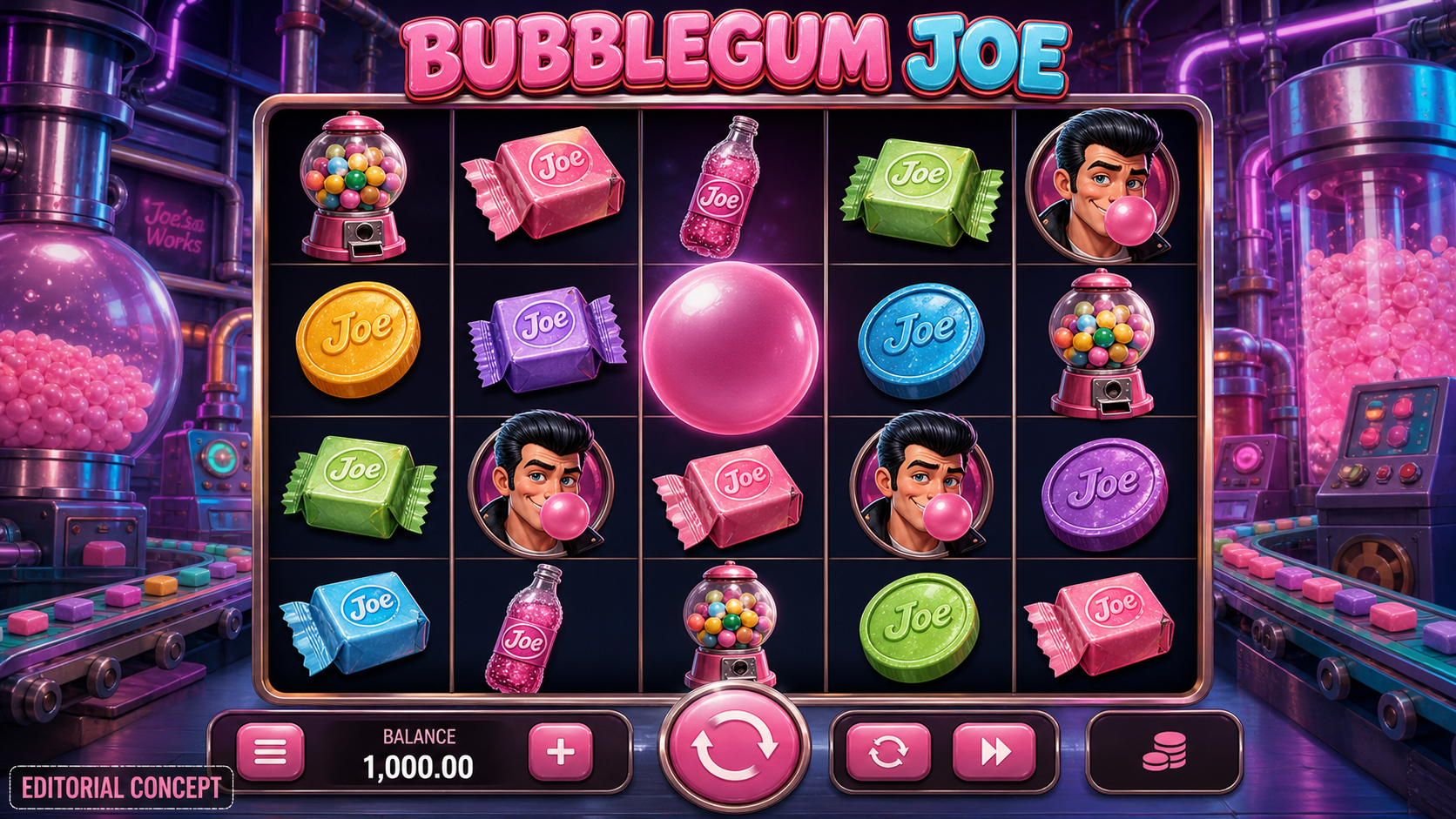
Why the 96% RTP Claim Is Not Enough
One early page lists 96% RTP. On the same page, maximum win is displayed as zero or unavailable, volatility is blank, and the editorial team states that analysis is still in progress. The demo is not active. This combination has the fingerprints of a database default rather than a number read from a live paytable.
Ninety-six percent is a common placeholder in slot databases because it resembles an industry baseline. Its familiarity makes it easy to repeat and difficult to challenge. Yet a familiar number is not automatically the correct number.
Yggdrasil games may be distributed in more than one mathematical configuration. Even after a confirmed release, the RTP seen at one casino may differ from another installation. A serious review needs the percentage printed in the game information panel and should state any alternate builds disclosed by the studio.
No such panel is publicly available for Bubblegum Joe. There is also no official page listing one or more percentages. The responsible classification is undisclosed, not 96%.
RTP should not be estimated from theme, studio history, or the behavior of another Yggdrasil game. Candy artwork does not imply gentle mathematics. A presumed free-spin round cannot reveal long-run return. Past Yggdrasil releases show how the studio structures other products, but they do not determine the model of an unreleased title.
The same rule applies if a casino lobby later prints 96%. That lobby figure would describe its installed build, not necessarily every Bubblegum Joe version. The number becomes useful only when attached to a real client and a date of inspection.
Volatility Cannot Be Read From Pink Artwork
A third-party metadata box calls Bubblegum Joe high volatility. The surrounding article admits that official details are still pending. No hit-frequency figure, maximum-win value, feature probability, or paytable supports the label.
High volatility is often assigned to upcoming games because it attracts search traffic and matches current slot trends. It is also sometimes inferred from Bonus Buy. Both shortcuts are unreliable. A game with purchased features may use medium volatility, and a sweet theme can hide any risk profile.
Volatility describes the distribution of modeled returns. It cannot be judged from the size of a bubble, the mood of the soundtrack, or the brightness of the symbols. Even a demo session would be insufficient for a precise classification unless the help file stated it. A short run of quiet spins could occur in a medium model, and several quick bonuses could occur in a high model.
For Bubblegum Joe, no official label is visible. The correct entry remains unknown. Writers should resist converting a guess into a specification merely because the word high already appears on one affiliate page.
This uncertainty has practical consequences for a review. Without volatility, the pacing cannot be described honestly. There is no basis for claiming frequent small results, long dry intervals, rare large prizes, or a balanced middle ground. Any paragraph making those claims would be fiction written in the language of analysis.
The Maximum Win Is Also Missing
Maximum win is one of the first figures readers expect from a modern slot review. Bubblegum Joe has no verified maximum in its public record. Major catalogs leave the field blank or mark it unavailable. One faulty FAQ converts the missing value into zero, which clearly does not mean that the game has no winning outcome.
A zero in an unfinished database is a null value handled badly. It should never become a headline such as Bubblegum Joe Pays Up to 0×. The correct response is to recognize a placeholder.
No reliable source currently prints 1,000×, 5,000×, 10,000×, or another ceiling beside a visible Yggdrasil rule sheet. Assigning a number from another candy title would be especially misleading. Sweet-themed games from different studios use completely different caps, math models, and bonus structures.
The maximum also cannot be inferred from the studio average. Yggdrasil's catalog ranges across restrained classic products and far more severe modern releases. The developer name narrows the technical ecosystem, not the payout ceiling.
Until an active client appears, the maximum-win field should read not publicly confirmed. If a later rule sheet lists a currency cap and a stake multiple, both should be recorded. Some games end a feature once the cap is reached, while others simply limit the amount credited. Bubblegum Joe has no public rule describing either behavior.

The Three Images Here Are Concepts, Not Screenshots
The image above is an editorial reconstruction created because no official reel screen could be located. It uses the title's likely bubblegum direction and presents a generic candy factory interface. The five-column grid, character design, symbols, and controls are not claimed as Yggdrasil's final layout.
The words Editorial Concept are printed inside the image for a reason. Removing that label would turn a speculative illustration into something that might be reposted as evidence. A reader should never use it to identify the number of rows, paylines, Wild design, Scatter symbol, or bonus trigger.
The same boundary applies to the cover and feature illustration. They translate the name Bubblegum Joe into a coherent visual world: a gum inventor, pink bubbles, candy machines, chrome pipes, and neon lighting. This makes the article readable without borrowing screenshots from an unrelated game.
The images deliberately avoid mathematical claims. They do not print RTP, max win, multipliers, jackpot values, or a free-spin count. The generic grid does not label Wild or Scatter because neither symbol has been publicly verified.
This approach is less convenient than pasting any candy-slot screenshot found in search results, but it protects the identity of the game. Bubblegum and Robo, Bubblegum Burst, Candyfinity, and several gumball titles have their own artwork and rules. Using one of those screens under the Bubblegum Joe name would create a false product record.
No Reel Layout Has Been Confirmed
Some directories leave the layout blank. Another upcoming-game list says only that the title has five reels, without rows or paylines. That single field is not enough to reconstruct the board.
A five-reel game might use three, four, five, or six rows. It could use fixed lines, all-ways evaluation, clusters, scatter pays, adjacent pays, Gigablox, or a proprietary Yggdrasil mechanic. The studio has released examples across many of those structures.
The title does not solve the puzzle. A bubble could expand across positions, but that is only a visual possibility. Gum could act as a sticky object, but the word bubblegum does not prove sticky Wilds. Joe could blow bubbles onto the reels, yet no public description says that he does.
This is where many early reviews go wrong. They take a thematic verb and turn it into a rule. Sticky gum becomes Sticky Wilds; blowing a bubble becomes expanding symbols; popping a bubble becomes cascades. Each idea sounds plausible, and none is verified.
A real layout description needs at least one official screenshot or a help page. The grid dimensions should be counted from an idle screen, while the pay system should come from the written rules. Animated promotional art can hide rows or show a temporary feature state, so it should not be the only source.
For now, Bubblegum Joe's reel geometry remains unknown. The concept grid used in this article is an illustration rather than a prediction.
Wild, Scatter, and Bubble Mechanics Are Still Guesswork
No official symbol sheet has surfaced. There is no confirmed Wild, Scatter, bonus icon, expanding bubble, sticky position, multiplier gum, or collection meter.
The absence is important because the name invites very specific speculation. Bubblegum is sticky, elastic, and capable of growing until it pops. Those physical traits could map neatly onto a slot mechanic. A gum Wild might remain on the board, stretch across a reel, capture nearby symbols, or burst into replacements.
These are design possibilities, not review findings. A deep article must distinguish mechanical analysis from creative brainstorming. Saying that a sticky rule would suit the theme is acceptable when labeled as an idea. Saying that sticky gum remains on the reels is false without a rule sheet.
The same restraint applies to the character. Joe may participate in a meter, appear only in the logo, or not exist as a visible person at all. Early teaser art does not show him. The original character used in the concept images is not based on an official Yggdrasil model.
If a real game screen later appears, the first checks should be simple. Count the grid. Record symbol names. Determine which positions accept special symbols. Note if Wilds substitute for every regular symbol or carry restrictions. Read the Scatter requirement and the exact number of awarded spins. None of those blanks should be filled from a competing candy game.
Free Spins Appear in Metadata but Not in Rules
One unfinished listing marks free spins as present. No paragraph explains how they trigger, how many are awarded, if they retrigger, or what changes during the round. Another major directory leaves every feature field empty.
The presence of a free-spin flag is plausible, but it is not strong enough for a detailed rules section. Database tags are often created before game documentation arrives. A default yes value may survive even when a roadmap changes.
There is no basis for stating that three Scatters award ten spins, that bubbles become sticky, that multipliers rise, or that Joe upgrades a meter. Those patterns occur in other products and are easy to copy unconsciously. They do not belong in a Bubblegum Joe review until the game's own help screen confirms them.
If free spins do exist, several details will determine their actual value. The starting quantity matters, but so do symbol frequency, retrigger rules, modified reel strips, retained states, and the maximum cap. A bonus that uses the same reels may play very differently from one that expands the grid or introduces a collection system.
The current review can say only that free spins are claimed in one unverified metadata block. It cannot treat them as established gameplay.
Bonus Buy Information Contradicts Itself
The Bonus Buy field is a clear example of why copying a single page is dangerous. One source says no. Another says yes. Both lack a live demo and a detailed price list.
A true Bonus Buy description should name the cost as a multiple of stake, the feature entered, any alternative purchase modes, and the RTP attached to each option. It should also state if the control is removed in markets that prohibit direct feature purchases.
Bubblegum Joe has none of this public documentation. The contradictory yes and no entries are therefore noise rather than evidence.
The correct article should not display a Buy Bonus button in a mock game screen. The concept art here avoids it. A generic spin control appears because the subject is a slot concept, but no special purchase control is shown.
If the game eventually launches with Bonus Buy, the review can be updated from the actual menu. If it launches without one, the current restraint will have prevented a false promise. Waiting for the rule is better than publishing a confident price that belongs to another Yggdrasil title.
The Bubblegum Theme Has Potential, but That Is Not a Rule
Bubblegum gives a designer a strong material to work with. It stretches, sticks, inflates, changes shape, and bursts. It also carries an immediate sound language: wrappers opening, gum snapping, a bubble swelling, and a sudden pop.
Joe gives the title a human anchor. A character can operate a gum factory, run a shop, test unstable recipes, or react when a bubble becomes too large. This is richer than an anonymous board filled only with sweets.
The concept image explores that potential through a laboratory control room and floating transparent bubbles. It does not indicate an actual Yggdrasil feature. The enclosed candy objects have no confirmed prize values, and the reel grid is intentionally generic.
From an art-direction perspective, the most promising contrast is between sticky organic material and hard industrial machinery. Chrome pipes, valves, tanks, and conveyor belts can frame elastic pink gum. The material difference would give the title a stronger identity than another open landscape made entirely from candy.
The teaser itself does not commit to this direction. Its red background may simply be Yggdrasil's standard pre-release design. A final game could use a retro diner, city street, comic-book workshop, schoolyard, or completely abstract bubble world.
Theme potential can support an editorial preview, but it cannot support judgments about animation quality or interface clarity. Those assessments require real frames from the running client.
Do Not Mix Bubblegum Joe With Bubblegum and Robo
Bubblegum and Robo is a different game from Peter and Sons. It uses a manga-influenced junkyard setting, expanding VS Wild reels, multiplier upgrades, sticky Wild behavior during free spins, feature purchases, and a large published maximum win.
Search results for Bubblegum Joe frequently place Bubblegum and Robo nearby because both names begin with Bubblegum. That proximity can contaminate an article. Details about ten free spins, VS Wild multipliers, sticky expanding reels, or a 20,000× ceiling belong to Bubblegum and Robo, not Bubblegum Joe.
Bubblegum Burst is another separate title, associated with Playtech. Golden Gumballs, Triple Pop Bubblegum, Big Prize Bubblegum, and several gum-machine games also appear in related searches. None can act as a substitute demo.
The safest identity markers for the present title are the exact name Bubblegum Joe and the Yggdrasil association. If an image carries a robot, junkyard, VS symbol, or Peter and Sons mark, it is the wrong product.
This separation matters for search quality as well as factual accuracy. Once an incorrect feature description is published, other databases may copy it. Repeated text then appears to confirm itself even though every page traces back to the same initial mistake.
What Yggdrasil's Missing Game Page Normally Would Tell Us
Yggdrasil's public pages for active games usually include a feature summary and a structured details block. The block commonly identifies RTP, volatility, category, release date, number of lines or pay method, maximum win, mobile status, supported platforms, resolution, and languages.
Bubblegum Joe does not have an accessible public page with that information. That missing page explains nearly every gap in third-party coverage.
Once a page appears, it should become the first reference point. The title may have multiple RTP options, and the public page may list only the default. A live operator build should still be checked afterward. The studio page establishes the product; the live help screen establishes the selected configuration.
Marketing copy also needs interpretation. A sentence may describe a bubble feature in broad terms without giving probabilities or thresholds. The rule sheet must supply the exact trigger, transformation order, payout handling, and cap conditions.
Images from the official page would also settle the art question. A logo asset could replace the conceptual title treatment. Base-game and feature screenshots could replace the marked editorial reconstructions. Until then, the concepts should remain clearly labeled.
Mobile Status Is Likely but Not Yet a Reviewed Experience
One external listing marks mobile availability as yes, and modern Yggdrasil releases generally use HTML5 across phone, tablet, and desktop. It is reasonable to expect mobile compatibility if Bubblegum Joe reaches commercial launch.
Expectation is not the same as testing. No public client was available to check portrait scaling, landscape framing, touch-target size, symbol clarity, loading time, or audio behavior.
A candy theme can work well on a small screen because bubble and gum shapes have strong silhouettes. It can also become visually crowded if every symbol uses similar pink highlights. Actual readability will depend on contrast, spacing, typography, and the amount of motion during feature events.
The character position matters too. Joe could occupy side space on desktop but move above the reels in portrait mode. A large character animation might cover symbols temporarily. No screenshot shows how Yggdrasil solved these layout questions.
The current review should therefore avoid statements such as perfect on mobile or smooth on every device. Those are test conclusions, not safe assumptions.
Sound, Animation, and Pace Cannot Be Scored Yet
Bubblegum suggests obvious sound cues, but no official gameplay video confirms them. A pop may mark a symbol removal, a stretch may accompany expansion, and factory machinery may form the background rhythm. The actual game could choose a different direction.
There is no basis for praising the soundtrack, criticizing repetition, or describing animation speed. Even the title logo is not publicly visible beyond plain teaser text.
Pace depends heavily on the pay system. A standard line game may settle each spin quickly. Cascades, sticky objects, expanding bubbles, or collection animations could make one round much longer. Since none of those mechanisms is confirmed, the tempo remains unknown.
Autoplay is listed on one external page, but local regulation frequently changes its presence. Turbo mode is not documented. Both controls should be checked on the live interface rather than inferred from Yggdrasil's other products.
A future revision of this review should record the duration of ordinary losses, simple wins, feature triggers, and any extended chain. That timing would reveal if the theme supports the action or slows it down.
What a Real Demo Audit Must Verify
The first task is identity. The loaded client should display Bubblegum Joe and Yggdrasil in its information or loading material. This prevents an aggregator from serving a similarly named title.
Next comes the board. Reels, rows, paylines or ways, symbol sizes, special positions, and win direction should be documented from the rule sheet. A screenshot of the idle base game should match those figures.
The mathematical audit follows. RTP, alternate RTP builds, volatility, minimum and maximum stake, maximum win, jackpot status, and cap behavior need to be recorded. If a feature purchase exists, its separate RTP and cost must be included.
Every special symbol then requires a plain-language rule. The audit should explain what the symbol replaces, where it lands, how it transforms, how long it stays, and how multiple copies interact. Bubble behavior must be observed across both winning and losing rounds.
Any free-game mode needs a verified trigger count, starting spins, retrigger rule, changed reel strips, retained features, multipliers, and termination condition. A single promotional animation is not enough.
Finally, the mobile client should be checked in portrait and landscape orientations. Controls, symbol legibility, help-menu access, sound options, and interruption recovery all matter. Only after those steps can Bubblegum Joe receive a conventional gameplay verdict.
What Can Be Said Without Guessing
The title is Bubblegum Joe. Multiple release trackers attribute it to Yggdrasil Gaming. Early calendars placed it on April 16, 2026, while another source later used June 22, 2026. Neither date is backed by a current public Yggdrasil game page.
The available teaser is a generic red Yggdrasil card with the game name. It contains no reel artwork. Slot directories still show inactive demos or unfinished analysis.
Bubblegum and candy are the only defensible theme classifications. The exact character, setting, symbols, grid, pay method, and mechanics remain unconfirmed.
A 96% RTP entry appears on one incomplete page, but other catalogs leave RTP blank. Volatility and maximum win are not reliably published. Free spins and Bonus Buy appear in conflicting metadata without supporting rules.
Those facts are enough for a status review but not enough for a pretend hands-on review. Stating the limit openly is more useful than filling every heading with recycled candy-slot language.
Final Verdict: An Interesting Name Waiting for a Real Game Page
Bubblegum Joe has a strong title. Gum is a material with obvious visual behavior, and Joe gives the theme room for a memorable character. Yggdrasil has the technical range to turn that premise into a line slot, cluster game, sticky-symbol system, expansion mechanic, or something less predictable.
None of those possibilities can be scored today. As of July 28, 2026, the public record still looks like a delayed or unresolved pre-release listing. The dates conflict, demos are inactive, the official public catalog lacks a usable entry, and core specifications are missing.
The three images in this article are marked editorial concepts. They are high-resolution interpretations of the name, not leaked art and not reconstructions of a verified demo. Their purpose is to keep the page visually coherent without stealing a screen from another game.
The correct verdict is therefore pending. Bubblegum Joe cannot yet be called a strong slot, a weak slot, a high-volatility slot, a 96% game, or a title with a particular maximum. It can only be described as a Yggdrasil-associated candy project whose public launch information remains incomplete.
That may be less dramatic than an invented bonus story, but it gives the reader something more valuable: a clean boundary between confirmed evidence and marketing-database noise. When Yggdrasil publishes the game page or an authentic demo becomes available, the review should be rebuilt from the help screen, not patched with more guesses.
By Fairy Editorial - 29 Jul 2026
Unlimited 1024
Unlimited 1024 JDB Gaming Review: When a Slot Starts Thinking Like a Puzzle
Unlimited 1024 looks less like a reel machine and more like a numerical puzzle dropped into a casino cabinet. Its 5×5 board contains powers of two rather than fruit, card ranks, animals, or treasure chests. Matching values merge, the new tile climbs to the next number, empty spaces are filled, and the board is checked again. A spin can therefore become a sequence of small mathematical reactions instead of a single stop-and-pay event.
The title gives away the target. Two becomes four, four becomes eight, and the chain works upward through 16, 32, 64, 128, 256, 512, and eventually 1024. Yet this is not a game of player-controlled tile movement. The resemblance to number-merging puzzles is visual and mechanical, not strategic. The random game engine creates the board and resolves each legal combination automatically. No swipe, tile selection, or planning decision changes the result.
That difference is central to reading the product correctly. Unlimited 1024 borrows the satisfaction of watching numbers grow while retaining the fixed-odds structure of a slot. The player starts the round and observes the resolution. The accumulation star above the grid adds a second numerical system, while a rainbow S symbol opens five free games. During those free games, the accumulator begins at four rather than two, allowing the elimination cycle to start from a stronger position.
JDB Gaming released the title in July 2023. Public records agree on the 5×5 layout, a stake interval commonly listed from 0.10 to 80, cascading or avalanche-style refills, five-spin free games, and four jackpot levels. They do not publish a confirmed RTP or volatility figure. That missing mathematics deserves more attention than the bright cosmic screen, so this review separates verified mechanics from claims that circulate without a visible JDB rule sheet.
The First Spin Feels Like Opening a Number Puzzle
The board is a square rather than a row of tall reels. Twenty-five cells sit inside a luminous frame against an indigo space background. Falling stars, planets, green nebula light, and purple clouds surround the grid, but the eye stays on the numbered tiles. Each value has its own hue and enough contrast to remain readable when several merges occur quickly.
The title sits above the board in metallic science-fiction lettering. Jackpot displays occupy the upper area, usually labeled Grand, Major, Minor, and Mini. Beneath them, the star-shaped accumulator shows its current value. The lower control bar holds the stake selector, balance, automatic-play control, turbo button, and spin key.
This is an unusually data-heavy screen, yet the information follows a sensible vertical order. Jackpot amounts appear first. The accumulator sits directly over the cells it affects. The board handles the current reaction. Controls remain below. The player can look from top to bottom and understand the state without opening a second panel.
The cosmic setting is a natural match for exponential growth. Numbers rising from two to 1024 resemble energy levels, and a large merge can be framed as a burst of light. The theme is thin in narrative terms, but it does useful work. Space supplies darkness for the neon board and scale for the idea of numbers growing beyond ordinary limits.
The soundtrack is commonly described as an electronic loop with an eighties arcade character. That choice fits the puzzle-machine appearance, though a repeated synth phrase may become noticeable during a long session. Direct audio and turbo controls make it easy to change the pace without entering a nested settings menu.
Why the Name Does Not Mean 1024 Paylines
Unlimited 1024 is sometimes listed as a 1024-ways slot. That description is misleading. A conventional 1024-ways game normally evaluates matching symbols across adjacent reels, beginning from the left, with each row position multiplying the number of available routes. Unlimited 1024 instead uses a square field and combines matching numerical objects.
The 1024 in the title refers to the number-growth ladder and the prominent 1024 tile. The grid does not need a printed payline map because traditional left-to-right line patterns are not the main language of the game. Its result comes from tile combinations, accumulated points, eliminations, and refills.
This distinction changes the way a spin should be watched. On a ways game, the useful question is how many matching symbols occupy consecutive reels. Here, the useful question is which equal values become combinable and what new value their merger creates. The board is closer to a reaction system than a set of independent reel strips.
Some catalog pages still apply generic slot fields such as paylines or ways because their databases expect every title to fit the same template. A blank payline entry is more accurate than forcing Unlimited 1024 into a standard reel category. The physical display has five columns and five rows, but those dimensions do not automatically create 3,125 or 1,024 winning routes.
The title also should not be confused with unrelated products that place 1024 Ways beneath a conventional reel logo. Those games may use animals, jewels, or cards across five reels. JDB's release is the cosmic number-board game with powers-of-two tiles and an accumulator star.
How One Board Resolves
A paid round begins when the spin control is pressed. The 5×5 board fills with numerical tiles and any special symbol assigned to that result. The system then identifies eligible matching objects, combines them, and raises their value. When objects disappear or merge, new pieces fall into the available cells. The check repeats until the board has no further ordinary combinations.
The visual sequence matters because one initial board may create several stages. Two matching low tiles can become a four. That four may sit beside another four and create an eight. If the refill supplies a compatible value, the chain may advance again. Each step alters the geometry of the grid, so the final state can look very different from the first stop.
The player does not choose which matching pair moves first. Published descriptions treat the process as automatic. That removes the decision-making found in a true puzzle and prevents the result from depending on reaction speed or spatial planning. The casino engine has already determined the valid resolution path.
Points from combined symbols form the basis of the ordinary award. A widely reproduced rule expresses the conversion as combined-symbol points multiplied by the bet amount divided by 100. The active client's information page should still be treated as final, since account currency and operator builds can affect how values are displayed.
This scoring model explains why a tile number is not necessarily a direct cash multiplier. A 128 tile on screen should not automatically be read as 128 times the total stake. Tile points feed the game formula, and the final win meter displays the currency result. Confusing board value with payout multiple would greatly distort expectations.
Matching Is Only the First Half of the Mechanism
The accumulation system begins at two in the paid game. A star above the board displays the current accumulator value, while successful combinations add energy or progress. Once its bar fills, the value rises. This creates a parallel ladder: the board builds numbers locally, and the star develops above it.
When ordinary combinations have finished, objects matching the accumulator value are removed. Their elimination may open cells and cause another refill, which can produce fresh matches. The mechanism therefore gives a board a possible second life after its initial merge sequence appears complete.
Imagine the accumulator showing four when the first cascade ends. Remaining four tiles become relevant even if they are not positioned for an ordinary merge. Removing them changes the spaces around higher values and draws in new objects. The new arrangement may start another automatic chain.
The accumulator resets at the end of the round, so progress is not a permanent collection meter carried across separate paid spins. Its purpose is to shape the current resolution. That reset prevents a player from slowly building a guaranteed state over many wagers and keeps each new board mathematically independent under the game's random model.
The meter is easy to misunderstand because it looks like progression. Watching it fill may feel as though the account is storing value for the future, but the relevant future is inside the same round. Once the current reaction finishes and the result is settled, the next paid round starts from the base accumulator state again.
What the Base Screen Tells You at a Glance
The most important object on the base screen is not the largest tile. It is the star displaying two. That number defines the starting point of the elimination layer and separates the paid game from the free-game version.
The tile colors make the board readable during movement. Lower values tend to use cool blues, cyan, or green, while stronger merged values shift into orange, red, magenta, and gold. Exact shades can vary by build or animation state, but the hierarchy remains clear: warmer tiles signal that several lower objects have already been combined.
The rainbow S tile breaks the numerical pattern. It cannot be mistaken for a normal value because it carries a large letter over a multicolored surface. One S is enough to start the free-game round, a notably lighter trigger condition than the three-scatter standard used by many slots.
No conventional Wild is listed for Unlimited 1024. That absence makes sense. A Wild replacing a number could create ambiguity about which value it should assume and how it should behave in a merge chain. The special-symbol system stays compact by giving the rainbow tile a separate free-game job.
The jackpot panels remain visible above the grid even though they are not part of normal tile arithmetic. Published descriptions state that a Grand, Major, Minor, or Mini award may be selected randomly after the board stops. The values shown on the live screen matter more than numbers captured in promotional art, since jackpot displays may depend on stake, currency, configuration, or linked-pool rules.
Why Small Numbers Are Not Automatically Weak
In a traditional paytable, a low symbol is simply less valuable than a premium symbol. Unlimited 1024 complicates that hierarchy. A two has a small face value, but several twos can start a chain that produces four, eight, and beyond. The low tile may be the first step in a much larger reaction.
Position matters visually even though the player cannot control it. Two identical objects located where the engine recognizes a combination are more useful than isolated high values that cannot interact. A screen with many modest numbers can therefore carry more immediate merge potential than a screen containing one impressive 512 tile surrounded by incompatible neighbors.
That does not turn visual inspection into a betting advantage. The full outcome remains random, and the player has no control over the incoming refill. It only changes how results are understood. The board should be read as a network of possible reactions rather than a list of standalone prizes.
This also explains why watching the complete resolution is important. A small early merge may look trivial before it creates the exact value needed for the next stage. The most satisfying sequences are not necessarily those that begin with the largest visible number; they are those in which several levels connect without interruption.
Turbo mode shortens the presentation but does not alter the underlying result. It is useful for someone who already understands the visual grammar, though running every animation at high speed can make the accumulator's intervention harder to notice. Standard speed better displays where the first merge ends and the elimination stage begins.
Five Free Games From One Rainbow S
The free-game trigger is unusually concise. One rainbow S symbol starts five free games. There is no need to place three scatters across specified reels, and the S is visually distinct from every numbered tile.
The round may be extended. Meeting the free-game condition again adds another five games. Public descriptions do not place a clearly verified universal ceiling on those retriggers, so the word Unlimited in the title should not be interpreted as a promise of endless free spins. It is safer to read the exact maximum, if any, in the active help file.
The important rule change appears in the accumulator. Paid play starts the star at two; free games start it at four. Skipping the lowest stage means the elimination system begins one step higher on the number ladder.
That change sounds minor until the board is considered. A four can be created from two twos, so the free-game accumulator is aligned with a value that ordinary merging can reach quickly. When four-valued objects are removed at the end of a combination phase, the resulting gaps may create a stronger refill cycle than the base two setting.
Free games do not replace the puzzle mechanism with a separate wheel or pick screen. They modify the same board the player already understands. This is an efficient bonus design: the rules become stronger without forcing a second visual language onto the session.
The Free Round Starts One Rung Higher
Starting the accumulation value at four changes the relationship between the star and the board. In the paid game, two is the most basic numerical object. In free games, the meter begins after that first doubling. The round is therefore primed to work with tiles that have already passed through one merge stage.
The free-spin counter is as important as the current board. Five starting games make the feature compact, so each reaction uses a noticeable portion of the round. A retrigger has clear value because another rainbow S adds five, effectively creating another full starting block rather than one isolated spin.
The number board resets according to the game rules between free-game actions, while the stronger accumulator condition applies to the feature. A single strong cascade does not turn later spins into a skill challenge. Each outcome still belongs to the random model, and visible numbers do not create a decision point.
The feature's best visual moment comes when a chain climbs through several powers of two. Two equal values merge, the new object finds a partner, and the sequence progresses toward the red or gold 1024 tile. Light trails and impact flashes make the arithmetic visible without requiring a written explanation.
The risk is repetition. Five free games using the same grid can feel brief when merges end early. The retrigger rule is therefore more than extra quantity; it determines if the feature has enough time to build a memorable sequence. A round with no added S may end before the accumulator change creates a major difference.
Reaching 1024 Is a Visual Milestone, Not a Guaranteed Jackpot
The 1024 tile is the thematic destination. It is large, warm-colored, and usually accompanied by a stronger burst than ordinary mergers. Yet its name recognition can encourage an incorrect assumption that reaching it automatically pays the largest jackpot.
Tile scoring and jackpots are separate systems. The numerical object contributes through the combination and points model. Grand, Major, Minor, and Mini belong to the jackpot layer. Public descriptions characterize a jackpot as a random post-board award rather than a fixed payment attached to the 1024 tile.
This separation allows the title number to appear more than once without exhausting the jackpot pool. A high tile can mark a strong merge chain while the jackpot check remains independent. The exact relationship, if any, should be confirmed in the current rules because third-party summaries rarely publish the probability or eligibility conditions.
The same caution applies to screenshots showing very large meter amounts. Jackpot counters in promotional art may use demonstration currency or sample figures. They are not promises that every operator carries the same pool. The values printed in the loaded client are the only relevant amounts for that session.
A player should also distinguish total win from tile value. The interface normally converts accumulated points into a currency figure beneath the board. The 1024 printed on a tile is part of the scoring language, not an account balance.
Four Jackpots Sit Outside the Puzzle
Grand, Major, Minor, and Mini give the game a second source of peak results. Their presence broadens the reward map beyond what the tile chain displays. A modest board may still be followed by a random jackpot event, while a dramatic merge sequence may finish without one.
This separation creates suspense after the apparent end of a round. Once no further combinations exist and the accumulator has completed its elimination check, the player still watches for the jackpot decision. The board may be settled, but the full spin is not necessarily over.
Public records do not state the hit rates for the four levels. They also do not clearly identify a universal seed amount or if every installation uses local, fixed, or linked values. It would be inaccurate to rank their practical frequency from appearance alone. Mini is presumably lower than Grand in amount, but its chance must come from the local rules rather than guesswork.
Stake eligibility is another point for the live help panel. Some jackpot systems scale amounts with the bet, some require a minimum stake, and others remain available at every accepted level. Unlimited 1024's public summaries do not settle that question with enough authority.
The best reading is conservative: the four panels identify possible extra awards, while their exact amounts and conditions belong to the loaded build. The number grid remains the core game even when no jackpot is selected.
RTP and Volatility Remain Undisclosed
No confirmed RTP percentage appears in the main public catalogs for Unlimited 1024. Volatility and hit frequency are also left blank. That is not a minor omission. RTP describes the modeled long-run return across all game components, while volatility describes how unevenly that return is distributed.
Some pages fill the gap with generic numbers or call the game high variance based on its appearance. Neither approach is reliable. A busy cascade system can be built on low, medium, or high volatility mathematics. Four jackpot meters do not prove a severe risk profile, and frequent tile movement does not prove frequent meaningful payouts.
The same problem affects the reported maximum. One review lists a 6,000× ceiling, while major catalogs mark maximum win as unavailable. Without a visible JDB paytable confirming that figure, 6,000× should be treated as an unverified secondary claim rather than a settled specification.
An operator may display the missing values inside the game's information panel. If so, that local disclosure takes priority over general review pages. It may also reveal that more than one mathematical configuration exists. Many studios distribute several RTP builds under identical artwork, though no such range is publicly confirmed here.
The absence of published data does not mean the game lacks programmed mathematics. It means an external reviewer cannot responsibly attach exact labels without seeing the selected client. Unlimited 1024 is mechanically clear but statistically opaque.
The Listed Stake Range Needs a Currency Check
Several independent catalogs list a minimum of 0.10 and a maximum of 80. Those figures are useful for identifying the broad control range, but they are usually displayed without a single universal currency. An operator may map them differently for pesos, euros, credits, or another account denomination.
The stake is adjusted from the lower control bar before a paid round begins. The grid does not ask the player to purchase lines because there are no selectable traditional paylines. Changing the bet scales the scoring conversion and may also alter jackpot displays according to the local configuration.
Public records list autoplay and a lightning-marked turbo function. Autoplay starts consecutive rounds under the client's permitted settings. Turbo shortens visual transitions. Neither control changes the random probabilities or turns a low tile into a stronger object.
No gamble feature is listed, and no bonus-purchase control appears in the main game records. Free games are reached through the rainbow S rather than a separate purchase panel. Local regulatory builds can remove autoplay or change control behavior, so the active interface remains final.
The wide listed interval does not make every amount appropriate for every account. It only describes the available technical settings. The important review fact is that the board's rule does not change with stake; the monetary scale changes around the same automatic merging process.
Mobile Play Suits the Square Board
Unlimited 1024 uses HTML5 and is listed for desktop, phone, and tablet play. The square grid adapts well because each cell keeps the same basic proportion. In portrait mode, the board can sit between jackpot meters and controls without squeezing five narrow reels. In landscape, the surrounding galaxy gains more room and the four jackpot boxes can remain in one line.
Numbers survive reduction better than detailed character symbols. A white 32 on a red tile remains readable on a small screen, while an ornate warrior or animal might lose facial detail. The powers-of-two sequence also gives the user a built-in recognition system. Shape and color support the printed number rather than replacing it.
Fast cascades can still challenge a small display. If several cells flash, merge, and refill together, the player may miss the exact route that created the final tile. The win meter and accumulator show the necessary summary after the motion ends.
Touch controls are large and positioned away from the active board. This reduces accidental spins while reading a result. The turbo button uses a lightning icon, autoplay is labeled, and the main spin key carries the strongest visual weight.
Performance depends partly on the casino wrapper and connection. A lagging lobby, compressed stream, or intrusive overlay may damage the experience even when JDB's own game file is efficient. Those external faults should be separated from the underlying board design.
What Unlimited 1024 Gets Right
The title has a clear mechanical identity. Number merging is not cosmetic decoration placed over ordinary reels; it controls the entire result display. The board, scoring language, accumulator, and free-game adjustment all grow from the same powers-of-two idea.
The second strength is legibility. Twenty-five cells create many possible interactions, yet printed numbers make each state easy to decode. A 64 tile communicates its rank immediately. The game does not need a long pay-symbol legend to explain why 64 sits above 32.
The accumulator gives the end of a cascade purpose. Many avalanche slots stop as soon as no new win forms. Here, the star may remove matching objects and reopen the grid. That extra check creates a distinct end-stage rhythm without adding another screen.
The free-game rule is economical. One S grants five games, a new S adds five more, and the accumulator starts at four. Three short facts change the pace without discarding the main system.
Finally, the four jackpot panels create a reason to watch the resolution after tile movement ends. The random award layer is separate from the puzzle board, which means both an ordinary-looking grid and a high-value chain retain a final moment of uncertainty.
Where the Formula Loses Transparency
The largest weakness is the missing statistical disclosure. Without confirmed RTP, volatility, hit frequency, and maximum win, the player can understand what the board does but not fully compare its mathematical profile with another slot.
The points conversion also creates distance between screen value and cash value. A large tile looks like a direct multiplier, yet the actual award uses accumulated points and stake conversion. The final number is clear after settlement, but the path may not be intuitive during the first few rounds.
The board has no player agency despite resembling a puzzle. Someone arriving from a 2048-style game may expect to choose movement direction or preserve a useful corner. Unlimited 1024 resolves automatically, so the puzzle theme can initially imply control that does not exist.
Five starting free games may feel short. A retrigger adds a meaningful block, but a round without another S can end before the stronger accumulator creates an extended chain.
The electronic soundtrack and repeated merge effects may also become familiar quickly. The underlying system changes numerically, while the visual action repeats the same flash, removal, and refill language. Turbo and mute controls help, but they do not add variation.
Catalog Errors Make Source Checking Necessary
Some recent pages label Unlimited 1024 as a BBIN game even though established catalogs identify JDB or JDB168 as the studio. The shared Asian casino distribution market likely explains the confusion: a lobby, platform, or aggregation network may be mistaken for the developer.
The correct product for this review is the JDB title released on July 3, 2023, with a 5×5 numerical grid, space background, accumulator star, and rainbow S. A page describing conventional 1024 ways, a different symbol set, or a 96% RTP without showing the JDB help file may be blending separate records.
Game-name searches also return unrelated 1024-themed slots. The visual identifiers are therefore more reliable than the title alone. The powers-of-two tiles and star meter are the decisive markers.
This source problem is why the review does not repeat every number found on an affiliate page. The 0.10 to 80 interval appears consistently enough to report with a currency warning. The five-spin trigger and accumulator change are described in detailed gameplay records. RTP and volatility remain blank across major catalogs, so attaching confident values would create false precision.
Final Assessment: More Puzzle Machine Than Reel Slot
Unlimited 1024 succeeds because it commits to one strong idea. A 5×5 board fills with powers of two, matching values combine, new tiles drop, and the process repeats until no normal reaction remains. The accumulator then checks the board again, removing objects that match its current value and potentially reopening the chain.
The base accumulator starts at two. A single rainbow S starts five free games, and another qualifying S adds five more. During the free round, the star begins at four. That one-step increase is the central bonus modifier because it changes which tiles the elimination system targets.
The four jackpot levels add a separate post-board possibility, while turbo and autoplay support the game's fast mobile rhythm. The square grid reads cleanly on a phone, and the number hierarchy remains clear even when effects fill the screen.
The unresolved mathematics prevents an unconditional recommendation. JDB's public-facing records do not confirm RTP, volatility, hit frequency, or a universal maximum win. The frequently repeated 6,000× figure lacks enough primary support to be treated as certain. Those values should be checked in the exact operator build before any real-money session.
As a design, Unlimited 1024 is far more interesting than its generic space background suggests. It does not merely attach a cascade to standard symbols. It rebuilds the result around numerical growth and gives the end of each chain a second test through the accumulator. The player has no puzzle decisions to make, but the automatic arithmetic makes every spin easier to follow than a dense web of hidden paylines.
The best audience is not defined by experience level. It is defined by taste. Someone who enjoys visible transformation, compact bonus rules, and number-based interfaces may appreciate the board. Someone seeking character animation, traditional reel combinations, or fully published statistics may find it distant. Unlimited 1024 is a slot wearing the skin of a puzzle, and that tension is both its clearest strength and its main limitation.
By Fairy Editorial - 29 Jul 2026